



 15 / 172

Telkom Integrated Report 2017
15
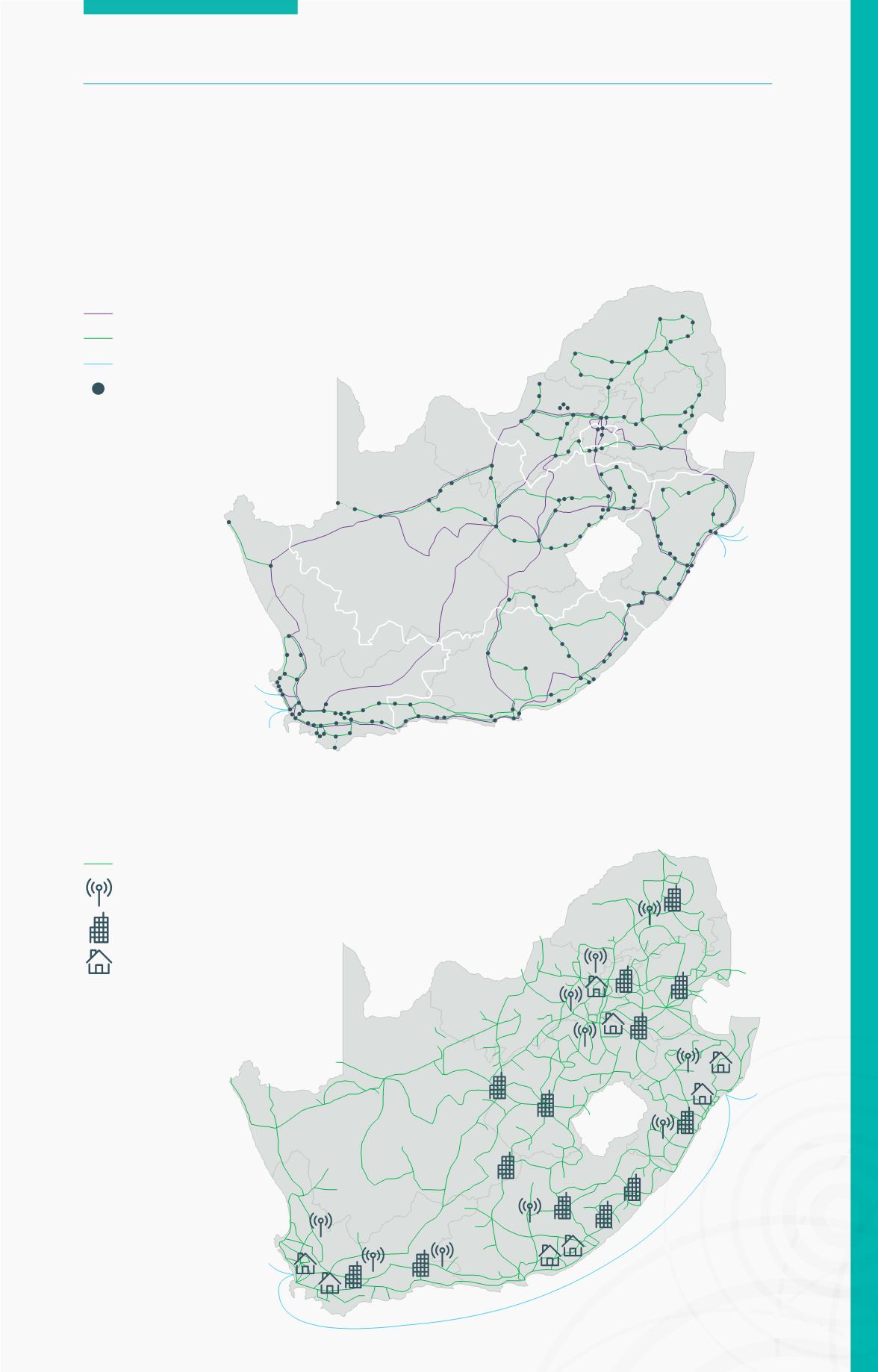
The national transmission network
is a transport network used to enable national and
international narrow and broadband connectivity between major regional centres.
Our fibre network
spans across national and local transport (core), and aggregation and access
footprints, enabling us to provide high speed connectivity across South Africa.
National and regional
National dense wavelength division multiplexing (DWDM) route
Wavelength access
Regional DWDM route
Submarine cable
SAFE
Cape Town
Piketberg
Springbok
Alexander Bay
Mosselbaai
Port Elizabeth
East London
Port Shepstone
South Africa
Far East Cable
(SAFE)
Seacom
Eassy
Pongola
Ladysmith
Newcastle
Secunda Ermelo
Nelspruit
Tzaneen
Thohoyandou
Louis Trichardt
Pietersburg
Onverwacht
Kopfontein
Pretoria
Johannesburg
Meyerton
Mmabatho
Klerksdorp
Middelburg
Harrismith
Bloemfontein
Kokstad
Kimberley
Upington
Beaufort West
Swellendam George
Oudtshoorn
Durban
Melkbosstrand
WASC
SAT-2, SAT-3
and WASC
North eastern region
Gauteng central
Eastern region
Western region
Southern region
Central region
Zeerust
Automatic switched
transport network
deployed at all
national layer sites
Core fibre-optic network
Fibre-optic cable
Enterprises
Base stations
Homes
Fibre to the
home (FTTH)
219 825
passed with
a connectivity rate
of 18%
Fibre to the business
(FTTB)
52 755
end
points terminating
Fibre to
the cabinet (FTTC)
2 million
homes
passed
Fibre to the base
stations
5 928
base stations
Openserve has passed over 2.2 million
premises as at 31 March 2017, providing
high-speed broadband connectivity
using fibre.
Western region
Gauteng central
Central region
Eastern region
Southern region
North eastern region