Product responsibility
The business sustainability of Telkom depends on our
management of the aspects of our services and products
that directly affect our customers including health and
safety, information and labelling, marketing, and privacy.
Customer satisfaction is a key concern for Telkom, and
we aim to tailor our products and services to meet the
customer needs while considering sustainable health and
safety related matters.
Product and service labelling
Consumer Protection Act
In terms of the Consumer Protection Act, 68 of 2008 (“the
Act”), consumers have the right to fair value, good quality
and safety. Section 61 of the Act states that a producer,
importer, distributor or retailer of any goods is liable for any
harm caused by the supply of goods or product failure which
result in the death or injury or illness or loss/physical damage
to property and any economic loss arising from such injury,
death or losses or physical damage to property. As a retailer
of goods and products, it is imperative that Telkom ensures
that it does not supply unsafe or defective goods and that
there are adequate warnings to the consumer pertaining
to any hazard arising from or associated with the use of
the goods.
During the reporting year Telkom was not involved in
any litigation or pending litigation relating to any harm
envisaged under Section 61 which arose as a consequence
of any product/goods supplied to a consumer. Telkom has
not been found guilty of breaching any of the provisions
relating to non-compliance with the provisions of
Section 61, during the reporting period.
End-User and Subscriber Service Charter
Regulations
In November 2011, Telkom received notice from ICASA regarding Telkom’s non-compliance with regard to the
End-User and Subscriber Service Charter Regulations as
published in Government Gazette No. 32431 on 24 July
2009 (‘the Regulation’) and advised that the Authority is
referring this matter to the Complaints and Compliance
Committee for a formal hearing to be held in respect of the
following:
| • |
Regulation 4.9(a): “…maintain an average of 90% fault
clearance rate for all faults reported within three (3)
days”; and |
| • |
Regulation 4.9(b): must clear “the remaining ten
percent (10%) of faults reported… within six (6) days
of the reporting of the fault”. |
In respect of the aforementioned Regulation, for the
2009/2010 reporting period, Telkom did not meet the
mandatory percentages as prescribed in respect of the fault
clearance rate. A licensee who is held to be non-compliant
by the Complaints and Compliance Committee (CCC) may
be liable to a fine.
CCC outcome and recommendation
Key aspects of the CCC judgment are as follows:
| • |
ICASA’s failure to determine a format for the reporting is a fatal flaw to its case against Telkom; |
| • |
ICASA had failed to prove non-compliance on the part
of Telkom on the balance of probabilities; |
| • |
Non-compliance is not capable of being discerned
clearly from the report submitted by Telkom. It is not
possible, therefore, to consider levying a penalty that is
consistent with the degree of non-compliance; and |
| • |
The Regulations as they stand are problematic and are
not capable of implementation. |
The CCC further made the following recommendations
to ICASA:
| • |
ICASA determines and make available a standard
format to all its licensees. Licensees should be afforded
the opportunity to study the format so that they can
raise any issues that they may have; |
| • |
Since the Charter regulations as they stand are
problematic and are not capable of implementation,
ICASA should review them; |
| • |
ICASA should approach Telkom to stop its Court action
with an undertaking that ICASA will review the Charter
regulations; and |
| • |
If ICASA is considering bringing other licensees in
front of the CCC on similar charges, it should consider
suspending them until the Charter regulations
are reviewed |
Thus, Telkom was not penalised for this contravention
and ICASA is drafting the revised regulations for public
comments.
Customer privacy
South African legislation governing consumer protection
and customer privacy has evolved rapidly in the past few
years and Telkom is focused on aligning its business practices
with the requirements. Telkom’s primary obligation to
respect customer privacy emanates from the provisions of
the Electronic Communications Act, 36 of 2005, and Code
of Conduct, End-User and Subscriber Service Charter.
Requests for any confidential information relating to
a customer’s personal details are handled by each of
Telkom’s regional nodal points. These nodal points deal
with any requests or subpoenas for customer information.
There have been no breaches of customer privacy or losses
of customer data during the reporting period.
Competition law compliance
Settlement discussions with the Competition Commission
were initiated and successfully concluded in April 2013. This
ruling related to the case between Telkom and the South
African Value Added Networks Services Association (SAVA)
and various other complainants pertaining to alleged anti-competitive
behaviour between 1999 and 2002. Telkom
and the Commission agreed to withdraw their respective
appeals against the Tribunal’s initial ruling in August 2012,
resulting in the said ruling remaining unaltered. Accordingly,
Telkom will pay the fine that was awarded by the Tribunal in
the sum of R 449 million.
We have also subsequently negotiated to settle a second
claim relating to a Multiple Complaints Referral by several
complainants including Internet Solutions (Pty) Limited, the
internet division of Multi-choice Subscriber Management
Services (Pty) Limited, Verizon (Pty) Limited and the
Internet Service Providers Association.
As part of this settlement, Telkom is required to pay a
penalty of R200 million which has been fully provided for.
The settlement also requires an undertaking by Telkom
regarding the functional separation between the Group’s
retail and wholesale divisions.
We are committed to understanding the unique
responsibility that we have as the national incumbent. We
acknowledge that past actions of the Group have had a
negative impact on our business and we take accountability
for this. We have been and will continue to uphold
responsible conduct and compliance in all our businesses.
Read more in of the consolidated annual financial
statements.
CUSTOMER SATISFACTION
Telkom conducts regular customer satisfaction surveys
by means of targeted and random telephone interviews.
These reach approximately 120,000 people per annum.
By their very nature, random surveys may reach some
customers whose numbers are not listed for such purposes,
potentially giving rise to concerns about breaches in the
security of customer data privacy.
Since 1997, all surveys have been conducted by research
providers accredited by the SA Marketing Research
Association (SAMRA) whose code of conduct commits all
practitioners never to allow personal data collected in the
process of market research “to be used for the purpose
other than the market research”. All market research survey
work and the statistical results generated are audited on a
random basis by third parties for purposes of data quality
and data security. The information generated by market
research surveys is used to inform Telkom’s advertising
tracking programmes, sponsorship and branding initiatives
in addition to customer loyalty measurements.
Telkom has a national customer care management centre
to deal with customer complaints that may have been
received through Telkom’s call centres. These complaints
are then handled by escalation advisors. Any request
for information from an outside party is governed by the
Promotion of Access to Information Act, which gives effect to the public’s right of access to information from public
and private bodies; taking into consideration appropriate
provisions within the Act. Telkom keeps a record of the
requests received each year and it reports annually to the
Human Rights Commission with regards to these requests.
The primary aim of the customer loyalty management
(CLM) research conducted by Telkom is to determine
our customers’ satisfaction with their designated main
customer contact (for example, the account manager in
the enterprise environment), as well as with products and
services offered by Telkom.
Specific objectives are to:
| • |
Measure the impact that overall quality of service and
value for money have on loyalty and commitment
towards Telkom; |
| • |
Determine the perceptions of service while interacting
with Telkom at the different touchpoints: pricing, main
customer contact (account manager, service delivery
manager, account representative, business consultant,
call centre agent, Telkom Direct Stores agent),
technical support/technician, customised solutions,
communication, ordering process, products and
services, invoicing and billing/Telkom account, dispute
resolution and Cybernest; |
| • |
Obtain an overall comparison of Telkom with other
service providers |
| • |
Establish the likelihood of switching from Telkom to
another service provider; |
| • |
Determine the overall experience with installations
and repairs. |
Fieldwork takes place on an annual basis and was
conducted between August and December 2012 by means
of telephonic interviews. Approximately 10,000 customers
who had contact with Telkom, were interviewed.
Results are reported as either “Top 2 Box” scores or “Top 3
Box” scores. This means the percentage of customers that
rated Telkom as “very good” and “excellent” or as “good”,
“very good” and “excellent” (respectively) out of a 5-point
excellence scale (excellent; very good; good; poor; very
poor).
Telkom clients included in the survey:
| • |
Enterprise markets, government sales and
wholesale services: All customers are given the
opportunity to take part in the survey. Customer
contact lists are provided by key role players within
the different environments. |
| • |
Medium and large business: All Medium and Large
Business customers who had contact with a Telkom
sales representative within the month prior to fieldwork,
form part of the universe with whom telephonic
interviews are conducted |
| • |
Small business and residential: A representative
sample of Small Business and Residential customers
who logged faults, had a billing enquiry or required
a service activation is extracted on a weekly basis
and telephonic interviews are conducted with
these customers. |
Model explanation
The loyalty model shows how loyal customers are towards
Telkom and how to improve on loyalty levels. A set
of questions was asked of customers, each indicative of
a different aspect within the loyalty model. Behaviours
indicative of loyalty include customers saying that they
would recommend, continue using or increase the volume
of business they do with Telkom, as well as the likelihood
of actively searching for an alternative communication
provider. A lower score is desirable when asking customers
whether they would actively search for an alternative
provider. Based on answers to these four questions,
customers are grouped into different loyalty segments:
Definition of loyalty segments:
| • |
Passionate customers are extremely positive in their
responses and show no negative perceptions. They are
most likely to express the desired loyalty behaviours. |
| • |
Favourable customers are mostly positive and show
only modest negative perceptions towards Telkom. They
are likely to display loyal behaviour in their interactions
with Telkom, although not to the degree of those
classified as Passionate. |
| • |
Fence-sitter customers currently have a neutral stance
towards Telkom. Their perceptions of loyalty in the
future will determine whether they move into the more
favourable or vulnerable loyalty categories. |
| • |
Vulnerable customers do not hold a strong allegiance
to Telkom and are likely to hold negative perceptions
towards the Company |
| • |
Defector customers have negative perceptions
of Telkom and are less likely to remain loyal. |
| • |
Unclassified customers are those who cannot be
classified into any of the above loyalty segments. |
Top line findings including customer satisfaction statistics
The graph below reflects the combined
results of all divisions, excluding Wholesale Services, Telkom
Internet and 8•ta, and are based on 10,253 interviews.
Most of the results show significant improvements, with
pricing and the service delivery manager ratings remaining
stable.
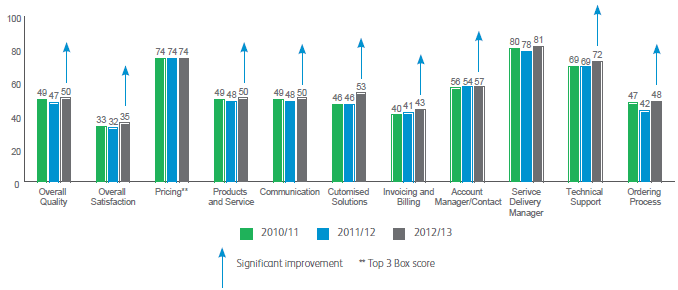 |
| Graph: top line findings, customer satisfaction statistics |

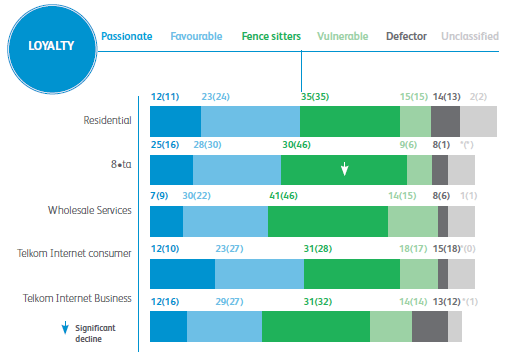
There was a slight increase in loyalty levels across most business segments. Across the board, more than a third of customers
were classified as Fence Sitters. This implies that there are many neutral customers who can be swayed either way.
|


