OCCUPATIONAL HEALTH AND SAFETY
Telkom has implemented occupational safety as a crossdisciplinary
responsibility protecting the safety of employees
at work, as well as the safety of co-workers, family members,
customers, service providers, nearby communities and other
members of public who are also affected. Over the past few
years Telkom has introduced many campaigns, policies,
procedures and programmes to prevent Occupational Health
and Safety (OHS) related incidents.
During this reporting period, our health programmes
focused on a reduction in healthcare costs and absenteeism.
This resulted in improved productivity and contributed
towards the creation of a more supportive and sustainable
working environment. OHS also seeks to assist employees
making choices that facilitate work-life balance and a more
sustainable workforce.
Meeting GRI LA7 and LA81
The disclosure below meets the requirement of the GRI’s LA 7 Indicator:
| |
Disclosure |
|
|
2012 data |
|
2013 data |
|
| |
Work-related fatalities |
|
|
2 |
|
2 |
|
| |
Absenteeism |
|
Telkom |
136,749 days |
|
137,702 days |
|
| |
|
|
Trudon |
2,265 days |
|
2,725 days |
|
| |
|
|
Swiftnet |
437 days |
|
633 days |
|
| |
Lost days |
|
|
7,204 days |
|
6,767 days |
|
| |
Occupational diseases |
|
|
0 |
|
2 (not accepted by
the COID to date) |
|
| |
Rates of injury |
|
|
770 |
|
694 |
|
| 1 |
Reasonable assurance has been obtained on GRI indicators LA7 and LA8. |
Telkom has education, training, counselling, prevention,
and risk-control programmes in place to assist employees,
their direct dependents and contract workers with serious
diseases. Telkom believes that employees who are physically
and emotionally well, and have a positive and committed
attitude, are more motivated to achieve business success.
This, in turn, can greatly influence productivity, which is a
key aspect in ensuring the sustainability of our business.
It is therefore the objective of Telkom’s Thuso HIV/AIDS and Wellness Workplace programme to keep employees
healthy. This is accomplished by highlighting the
importance of good health through education and regular
screening. The programme also assists employees that are
already at risk of developing chronic lifestyle conditions to
adapt their lifestyles.
The Thuso HIV/AIDS programme is in place across Telkom’s
South A frican operations to educate, train, counsel, prevent,
and manage the risk of employees contracting serious
diseases.
The programme includes:
| • |
A series of wellness days that aim to:
| – |
Educate and provide information concerning
healthy living and prevention of serious diseases
including HIV/AIDS , tuberculosis, PSA (prostate
antigen screening test), high blood pressure,
obesity, type II diabetes, high cholesterol and
cardiac conditions. |
|
| • |
On-site health risk assessments covering HIV ,
tuberculosis, diabetes, cholesterol, blood pressure and
body mass index (BMI):
| – |
In the reporting period, 5,903 employees (3,621 in
2012) were tested for HIV and 6,455 employees
(3,952 in 2012) participated in the on-site wellness
screenings. |
| – |
The number of employees and dependants tested
for HIV since the programme’s inception in 2004 is
37,930 and the actual HIV tested prevalence rate
for all those tested is 3.21%. |
|
| • |
The Thuso 24-hour medical call centre provides
counselling, care and support to Telkom employees and
their immediate dependants in relation to any health
matter, including HIV/AIDS and tuberculosis treatment.
The call centre is staffed by qualified medical professionals
that can assist individuals in any health matter. |
As part of our education and awareness strategy, the Thuso
Workplace Programme is included in Telkom’s induction
programme for all newly appointed or recently promoted
employees to educate them about its objectives, roles and
benefits.
Telkom’s HIV/AIDS prevention strategy includes a
nationwide free condom dispensing programme.
In addition, the Telkom Foundation provides funding to
a number of programmes that have education, training,
counselling, prevention, and risk-control programmes in
place to assist communities with serious diseases, primarily
HIV/AIDS . These programmes are described on the
following two pages. The total Telkom Foundation spend
on programmes that address serious diseases amounts to
R1,435,100 (total Telkom Foundation spend is R 42 million for
the financial year).
| Organisation |
Location |
Education/Training |
Counselling |
Prevention/ Risk Control |
Treatment |
|
| The Etafeni
Day Care
Centre Trust |
Western Cape |
The programme
has a variety of sub-programmes
in place
to educate and equip
HIV/AIDS infected
and affected
children and yout |
Through Social Work,
Community Development,
Women’s Wellness and
Economic Development
Programmes, Etafeni
provide individual and
group counselling to HIV/AIDS affected/infected
children, youth, women
and men, through their lay-counsellor
and community
careworker.
They also offer pre and
post-test adherence
counselling, reaching
thousands of people every
month. |
Etafeni equips the Nyanga
community as a whole with
information on HIV/AIDS ,
including prevention and risk
control. |
All beneficiaries, through
their programmes are given
access to treatment for HIV/AIDS as well
as TB . |
|
| Gaasca |
Northern Cape |
Gaasca gives
educational talks to
the community and
its members about
HIV/AIDS in general,
and how it affects
older persons. This
is achieved through
talks and a Sunday
afternoon radio
programme. |
|
Prevention is addressed
through education and
awareness campaigns.
For example, during “Health
Week”
(9 to 11 May 2013) health
professionals came to test
members and provide
information on prevention. |
Gaasca has a mobile clinic
that visits the centre on a
monthly basis to ensure
that older people take their
medication. They also give
individual health counselling
talks on an ad hoc basis. |
|
| Kgatelopele
community
home |
Limpopo |
Kgatelopele visits
churches, schools,
health facilities,
imbizos and
communities to
educate and train
them about
HIV/AIDS . |
Kgatelopele staff provide
counselling to individuals
and households affected by
HIV/AIDS .
They engage with local
clinics and social workers
to help those with HIV/AIDS and TB. Households
are visited by Kgatelopele
nurses, social workers and
volunteers. |
Condoms are distributed
to high transmission areas
such as taverns.
Risk Control Kits including
gloves are provided to
volunteers and families in
order to protect against
transmission of
HIV/AIDS . |
Local households are visited
on a daily basis to ensure
that patients are taking
treatment on time as per
their prescriptions. |
|
| Obrigado
home-based
care |
Mpumalanga |
Obrigado provides:
Health Talks at
the clinic every
morning, Health
Education to nearby
schools on weekly
basis, Awareness
Programmes to the
community (nearby
villages), Candle
lights, Peer Education
and Health Education
provided at home;
which is conducted
during door-to-door
household visits that
is done every day.
In addition,
awareness sessions
are held at local
community areas and
schools to educate
learners about
prevention of HIV/Aids. |
The organisation has
Caregivers who are trained
as lay-counsellors who
provide counselling which
is conducted during their
daily activity programmes.
They work closely with the
local clinic where they refer
patients found at home to
the clinic for counselling
and testing during their
door-to-door household
visits. |
The organisation distributes
condoms to nearby Shops,
Taverns and all community
centres. In addition, PMTCT (Prevention of Mother
to Child Transmission) is
administered at the clinic,
and also to the community
via door-to-door household visits. |
The organisation has
Caregivers who are trained
for DOTS (Direct Observant
Treatment Support) who
provide DOTS to TB + HIV patients at their homes
every day. They also
educate patients (including
their family members) |
|
| Zululand
Hospice
Association |
KwaZulu-Natal |
Our staff, including
nurses, are trained
in all aspects of
palliative and home-based
care (how to
care for a sick person
at home).
This knowledge is
passed on to families,
neighbours and
friends, and to the
wider community.
Education covers
infection control
and prevention of
disease spread, and
treatment support. |
The Hospice’s counselling
programme equips people
to deal with life-threatening
illness, bereavement, issues,
and provides a support
group for HIV -infected
people. |
Patients, families and their
communities are taught
how TB and HIV is spread,
signs and symptoms,
prevention measures
(safe sex, cough hygiene,
sunshine and fresh air),
waste disposal, and infection
control.
Our staff members are
provided with masks and
gloves as part of their
nursing kits. |
HIV/TB treatment involves
many tablets and strict
timekeeping.
Patients are taught the
importance of compliance
with their medications, and
the benefits and side effects.
Morvite is provided to
indigent patients so they
do not feel sick from taking
medications on an empty
stomach.
Treatment is monitored and
patients encouraged and
supported to be compliant. |
|
Workplace Safety
Telkom’s OHS management system is OHSAS 18001 certified
and aligned to the Telkom Health and Safety Policy (OHSP).
Telkom has a detailed OHS policy which takes a holistic
approach towards ensuring overall compliance with the legal
requirements of the Occupational Health and Safety Act (OHS Act), 85 of 1993. To maintain compliance with applicable
legislation and the Telkom OHSP, it is imperative that Telkom
initiates OHS performance targets which drive a more specific
approach in managing certain identified legal requirements
and emerging statistical trends. The OHS performance targets
are reviewed periodically to address any current OHS needs.
The respective service organisations within the Group ensure
the implementation and achievement of the Telkom OHS performance targets on a quarterly basis. The safety, health
and environment (SHE) management division monitors these
targets accordingly and provides support where intervention
is required.
During this reporting cycle, internal OHS legal compliance
audits were carried out on operational managers to determine
a baseline compliance rating for the Group. The methodology
used during the audit programme took a slightly different
approach whereby the audit team utilised each individual
audit session to identify compliance gaps and to coach, train
and support line managers immediately. The response from
line management indicated that the exercise was extremely
well received.
The ultimate goal of this exercise is to maintain an overall
compliance rating of at least 85% and to improve the
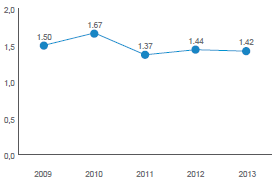
incident frequency rate of 2.66 per 100 employees and a
lost time incident frequency rate of 1.42 per 100 employees.
This will ultimately contribute to an improved lost time and
productivity performance for the Group.
Telkom OHS performance targets
| |
1 |
|
Visible leadership/commitment |
|
Defines the employer’s overall dedication and holistic comprehension of the
requirements of workplace OHS |
| |
2 |
|
Roles and responsibilities |
|
Ensures that both human and other resources are available in order to
expedite the requirements of the OHS Act |
| |
3 |
|
Hazard identification and risk
management |
|
Defined as a critical requirement to determine adequate controls to mitigate
consequential risk exposure of employees |
| |
4 |
|
Legal requirements |
|
Ensuring the compliance of applicable prescribed legislation in the ongoing
management of health and safety law |
| |
5 |
|
Training, awareness and
competence |
|
The employer has a legal obligation to ensure employees are trained and are
deemed competent or at least conversant with the risks associated with the
activities for which they are employed |
| |
6 |
|
Communication, consultation and
involvement |
|
Critical requirement when striving for a preferred culture of behaviour based
OHS rather than an enforced legal compliance requirement |
| |
7 |
|
Crisis and emergency management |
|
A proactive approach towards unplanned incidents is crucial to a successful
OHS management system. Contingency protocols are of paramount
importance |
| |
8 |
|
Incident management |
|
Workplace related incidents and how they are managed may reflect a
company’s attitude and commitment towards OHS . Both legal and internal
processes exist to which Telkom must comply. Telkom strives for zero
incidents. Incidents contribute significantly to absenteeism and associated
employee lost days cost |
| |
9 |
|
Monitoring, audits and reviews |
|
Ongoing auditing, monitoring and reviewing of the effectiveness of OHS management remain paramount in ensuring overall compliance of the OHS Act. Both periodic and scheduled audits are contracted within the Telkom
OHS performance targets |
| |
10 |
|
Occupational health and hygiene |
|
It is a legal requirement to ensure that employees who may be exposed
to any form of hazard be medically screened to determine the associated
affects. Medical surveillance programmes are periodically implemented to
mitigate this risk as far as is reasonably practicable. A healthy employee is a
productive employee |
As stipulated in the OHSA ct and associated ISO 18001
Standard, periodic reviews of a company’s performance
against the requirements of the OHSA ct are imperative in
determining overall compliance and effectiveness of the OHS management system. The audits incorporated an assessment
of OHS compliance and achievement towards the Telkom OHS performance targets as listed above.
During this reporting period a stratified sample of 492
operational managers was audited. The findings of the collective
audits yielded an 82% compliance rating, an improvement of
3% when compared with last year’s performance results.
Overall OHS compliance and Telkom SHE performance targeTS
An overall compliance rating of 82% indicates that
Telkom is committed to ensuring the health and safety
of its employees. The quality of Telkom’s OHS document
management system website also demonstrates its support
towards assisting both the employer and employees by
providing online access to methods, procedures, guidelines,
policies and the necessary forms to successfully implement
a sustainable OHS management system.
Section 16(2) assignees trained
During the 2013 financial year, 53 selected executive
management employees were appointed as Section 16(2)’s
by the GCEO to assist with the requirements of the OHS Act. The Section 16(2) appointees have undergone formal
training provided by an external training institution.
The newly appointed Telkom GCEO will undertake to
appoint designated Section 16(2)’s executives to assist
with the implementation of his OHS Act mandate in the
next period. Further training opportunities will be provided
to ensure compliance.
Injuries on duty (IOD)
It is with deep regret that we report that two Telkom
employees lost their lives as a result of a vehicle accident.
The Telkom board and executive management extend their
condolences to the employees’ families and colleagues.
Through Telkom’s Retirement Fund the necessary financial
support to the families of the deceased, as per rules of
the fund, was made available and bereavement support
was also offered through the Company’s Employment
Assistance programme. Their names and details are
recorded below:
| |
Name |
Region |
|
Cause of fatality |
|
| |
CP Phenya |
North Eastern region |
|
Vehicle accident |
|
| |
MP Swarts |
North Eastern region |
|
Vehicle accident |
|
No fatality on duty is acceptable and Telkom will continue
to work with all employees, unions and stakeholders to
reduce the number of fatalities to zero.
The following tables and graphs exclude Trudon and
Swiftnet:
In the period under review, the Incident Frequency Rate (IFR) improved by 13%, while the Lost Time Frequency Rate (LTIFR)
experienced only a marginal improvement. The Group aims to maintain an LTFR below 1.5 and to improve IFR to below 2.5.
Data excludes Trudon and Swiftnet.
| IOD description |
2009 |
|
2010 |
|
2011 |
|
2012 |
|
2013 |
|
| Bitten by dog |
44 |
|
49 |
|
43 |
|
35 |
|
39 |
|
| Fall/trip/slipped/from ladder |
295 |
|
292 |
|
255 |
|
273 |
|
248 |
|
| Insect stings |
60 |
|
43 |
|
28 |
|
46 |
|
31 |
|
| Struck by object/against |
210 |
|
120 |
|
126 |
|
129 |
|
135 |
|
| Lifting/pushing |
65 |
|
82 |
|
77 |
|
84 |
|
62 |
|
| Vehicle accident |
117 |
|
112 |
|
103 |
|
96 |
|
65 |
|
Table: injuries on duty (IOD) 2009 to 2013
 |
 |
| Graph: Incident frequency rate |
Graph: Lost time incident frequency rate |
 |
 |
| Graph: number of lost days as a result of IOD |
Graph: number of lost days per 100 employees |
 |
|
| Graph: IOD costs (Rm) |
|
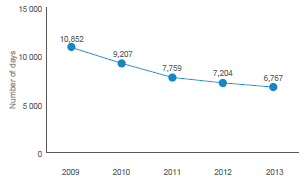
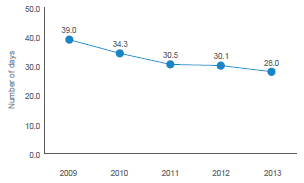
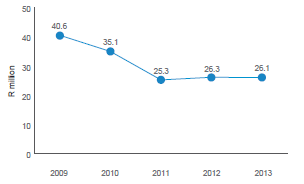
Over the past five years we have observed a significant
reduction in the number of days lost as a result of incidents
on duty (28%) and in days lost per 100 employees (39%).
This resulted in a 3.8% decrease in the total cost-to-company
of incidents on duty.
Fall injuries are the leading cause of IOD at Telkom. Our
challenge will be to drive behavioural change to reduce the
incident rate further.
Occupational Health Medical Surveillance
programme
The purpose of Telkom’s Medical Surveillance programme
is to identify medical conditions that could lead to an
occupational disease. Risk based medical surveillance fi-tfor-duty medicals are conducted at the following intervals:
| • |
Pre-placement; |
| • |
Periodic/transfer; |
| • |
Return to work after injury or prolonged illness; and |
| • |
Exiting employment at Telkom. |
The following information is taken into consideration when
determining the type of medical surveillance programme
required:
| • |
The type of work an employee is performing; |
| • |
Duration of the task; |
| • |
The materials being used; and |
| • |
The potential for exposure. |
The specific test results and other medical information
revealed through testing are confidential and stays between
the employee and the occupational medicine practitioner.
Clinical case management
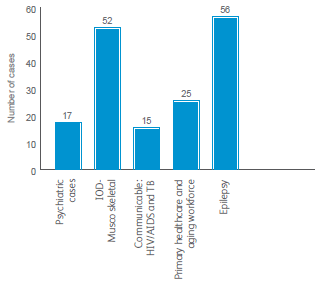
A total of 165 cases were seen by our occupational medical
practitioner between April 2012 and March 2013. The
graph below illustrates the most prevalent
diagnoses of clinical case referrals in the 2013 financial
year:
 |
 |
| Graph: Clinical Case Management: 165 cases |
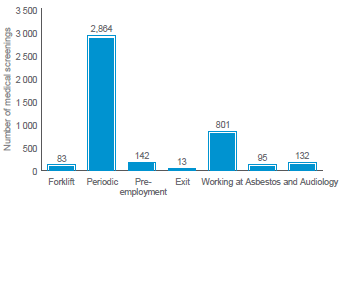
Graph: types of medical screening for the period April 2012 to March 2013 |
Medical surveillance, or screening, is a statutory requirement.
Medical screening takes place at timed intervals that are
determined by risk based criteria to ensure that employees
are medically fit to perform their inherent duties and
are not subjected to health hazards. This demonstrates
preventative action being taken to avert future incidents.
The frequency of the medical surveillance is based on the
applicable laws and regulations as well as determined by
Telkom’s occupational medical practitioner. Thus, not all
employees will be screened in terms of medical surveillance
during the course of any given year; this will also depend
largely on an employee’s risk profile.
The following different types of medical screening are
performed on site by occupational health practitioners:
| • |
Pre-employment; |
| • |
Working-at-height medicals (mast and towers); |
| • |
Periodic medicals, which include medical screening for
occupational diseases (depending on the risk exposure,
the frequency can vary from annually to every two
years); |
| • |
Exit medicals; |
| • |
Transfer (departmental) medicals; |
| • |
Forklift medical screening; |
| • |
Audio screening (call centre environments) as a result of
exposure to sound levels that exceed an eight-hour time
weighted average of 85 dBA – initial baseline exam); |
| • |
Biological monitoring – Lead exposure; and |
| • |
Asbestos – AR :9. |
A total of 4,130 medical examinations were performed in
the different risk categories during the year.
The table below indicates the medical screening trends at
Telkom:
| |
Trends |
Concerns |
|
| |
Obesity |
Weighing above 110kg –
no weight management
programme enforced |
|
| |
Hypertension |
Uncontrolled, defaulters and
lack of follow-up to ensure the
effective management of
the condition |
|
| |
Psychological problems |
Employees using anti-depressant
without follow-up
care from the treating doctors
and Telkom OMP |
|
| |
Diabetes |
Type II and insulin-dependent
– lack of follow-up
and monitoring of employees
suffering from diabetes.
Programme is important for all
climbers and drivers |
|
| |
Ageing workforce
with chronic medical
problems |
Above 50-year olds allowed to
climb masts and towers |
|
| |
No enforcement
of medical
recommendations
by OHP |
Line managers seem to not
be taking responsibility for
ensuring that employees with
medical condition adhere to
recommendations |
|
Exposure to hazardous substance and
electro-magnetic frequency (EMF) radiation
Telkom has an extensive EMF radiation exposure prevention
programme in place to protect employees and communities
at risk of exposure. All radiation zones on Telkom premises
are demarcated to warn employees.
A further mitigating action put in place is to switch off
power before employees enter these danger zones.
Telkom also has a well-defined audit programme in place
which audits radiation patterns to ensure third parties are
not be affected by Telkom’s EMF operations. Readings
are taken annually and stored on a database for future
reference. Where third parties have raised concerns,
new tests are taken and the results reported back to the
concerned party via Telkom’s Legal Services. There were
no reported cases of EMF radiation levels exceeding the
prescribed limits as per the International Commission on
Non-Ionising Radiation Protection (ICNIRP) specification.
Occupational hygiene
survey process
Occupational hygiene surveys were conducted as part
of T elkom’s responsibility to provide a healthy and safe
working environment.
Three types of surveys are conducted as part of our
programme:
| 1. |
Ad hoc – These surveys are requested by Telkom
employees or health and safety representatives.
Telkom’s service provider call centre is contacted
directly to conduct surveys including: temperature, dust,
illumination, water and diesel fumes surveys. |
| 2. |
Scheduled surveys – Buildings are identified and a list is
sent to Telkom’s service provider. The service provider
contracts the appointed vendors to conduct these
scheduled surveys, which include: Indoor Air Quality
(IAQ), water, and temperature surveys. |
| 3. |
Pre and Post-surveys – These surveys are conducted as
part of the service providers’ statutory contract with
Telkom. These are performed prior to the relocation of
employees or construction of a building, and then again
after the employees have been relocated. |
The following types of surveys are conducted by Approved
Inspection Authorities:
| Type of survey |
|
Description |
IAQ
| • |
Carbon dioxide |
| • |
Carbon monoxide |
| • |
Relative humidity |
| • |
Air temperature |
| • |
Volatile organic compounds |
|
|
The main purpose of the survey is to:
| • |
Quantify employee exposures to specific occupational health hazards; and |
| • |
Comprehensively assess the risks associated with all significant occupational
health hazards to which employees are exposed as a result of their work. |
|
Water
| • |
Water quality: pH, turbidity and total dissolved solids |
| • |
Macro determinants: chloride |
| • |
Micro determinants: iron |
| • |
Bacteriological limits: ecoli |
|
|
The main purpose of the survey is to:
| • |
Determine the quality of the drinking water supplied to Telkom employees; |
| • |
Evaluate and check whether the distribution system performs correctly; and |
| • |
Propose the necessary recommendations to ensure compliance to
statutory requirements. |
Water samples are analysed by a SANAS accredited Micro Laboratory and according to SANS 241 –1 and 2:2011 (Edition 1). |
Illumination
|
|
The main purpose of this survey is to:
| • |
Assess the lighting levels in accordance with the schedule as stipulated in the
Environmental Regulations for Workplaces under the OHS Act, 85 of 1993. |
|
| Ergonomics |
|
The goal of ergonomics is to:
| • |
Create an environment that is well-suited to a user’s physical needs; and |
| • |
Ensure compliance to the OHS Act, 85 of 1993. |
|
| Noise |
|
The main purpose of this survey is to:
| • |
Assess whether noise levels emitted at a source exceeds exposure limits in
accordance with the OHS Act, 85 of 1993, as well as recommended SANS Standards; and |
| • |
Prevent hearing impairment by proactively identifying excessive exposure. |
|
Most of the parameters tested for by these surveys were
within acceptable levels, apart from the turbidity levels for
some of the water quality surveys that were conducted.
However, elevated turbidity levels do not make water
unsafe for human consumption.
Corrective action is being taken to resolve the material noncompliance
issues identified through these surveys.
Thuso HIV/AIDS and Wellness Workplace
Programme
Telkom’s Thuso HIV/AIDS and Wellness Workplace
programme is a comprehensive and holistic programme
which provides assistance at no cost to permanent
employees and immediate families as well as contractors.
 |
| Graph: employee HIV tested prevalence rate |
| The above graph excludes Trudon and Swiftnet |
The programme initiated in 2004 is regarded as one of
the flagship initiatives in the Employee Wellness and SHE domain as well as the Telkom employee value proposition.
It encapsulates Telkom’s wellness philosophy to care for
and support its employees.
The Thuso value offering has been designed to measure
lifestyle factors across inter-related health risk areas
(diabetes, cholesterol, blood pressure and BMI as well as
HIV, TB and PSA). These on-site health risk assessments are
offered during on-site Wellness Days to all employees, their
families and contract workers.
Through these interventions certain high cost, high risk
conditions are identified and managed by providing
employees access to care, counselling and treatment
through the Thuso Employee Wellness and HIV/AIDS Workplace programme. In addition to these services, health
data is collected from voluntary participants in the annual
Telkom Lifestyle Survey and evaluation of the programme is
done through regular monthly reporting on the outcomes
of the programmes, as well as an Annual Absenteeism
Analysis and a KAP Survey amongst the recipients of the
services of the Thuso programme.
During the year under review 6,455 employees participated
in the on-site wellness events (an increase of 2,503
employees from the previous year).
HIV/AIDS and Tuberculosis Workplace
Programme
Since its inception in 2004, the Telkom Thuso Programme
has touched the lives of 37,173 individuals who submitted
to voluntary HIV testing. During the year under review
5,862 employees (5,311 permanent employees and 551 contractors) were tested with 162 employees
(139 permanent employees and 23 contractors) testing HIV positive. This equates to a HIV Tested Prevalence of 2.76%
for permanent and contractor employees combined and
2.61% for permanent employees and 4.17% for contractors.
The combined HIV Tested Prevalence rate is illustrated in the
graph and although there has been a slight rise from 2.4%
to 2.7% since last year the general trend is decreasing,
with more employees being tested in this financial year
compared to the two previous years.
Tuberculosis screening
All employees that undergo Wellness Screening also undergo
tuberculosis (TB) risk screening. Individuals that are at risk of
having TB are referred for TB diagnosis and treatment.
6,347 employees (5,733 permanent and 614 contractors)
were screened of which 95.75% reported no symptoms of TB.
3.54% of individuals screened reported one or more symptoms
and 0.20% reported receiving TB treatment.
These percentages have remained stable since 2009 with
a minimum of 95% of Telkom employees reporting no TB symptoms.
Treatment programme
The Thuso programme’s comprehensive value offering also
includes pathological laboratory testing, individual clinical
case management via the Thuso 24/7 Call Centre, screening,
treatment of opportunistic infections such as TB and H1N1,
post-exposure prophylaxis, mother-to-child transmission,
psychological counselling, and the provision of nutritional
supplements and drugs to an address of choice, which is what
makes it so successful. This service offering is extended to
spouses, partners, and dependent children who are regarded
as immediate family. These services are available, at no cost,
to Telkom permanent and contract and temporary employees.
Highly Active Antiretroviral Therapy (HAART) treatment
is offered to those individuals registered on the Thuso
Programme with a CD4 count of below 350 cells/ml, which
is in line with the governmental and non-governmental
organisation (NGO) norms.
| |
Treatment profile of individuals |
Number |
|
| |
Total number of individuals on Thuso programme |
765 |
|
| |
Number of individuals receiving treatment through Thuso |
425 |
|
| |
Number of individuals on Pre-HAART * |
165 |
|
| |
Number of individuals on HAART |
258 |
|
| |
Number of individuals on PMTCT |
2 |
|
| |
Number of individuals on PEP |
0 |
|
| |
Number of individuals that have stopped
their anti-retrovirals |
0 |
|
| |
Number of individuals receiving
treatment through other programmes |
236 |
|
| |
Number of individuals not yet on
treatment |
104 |
|
| * |
HAART refers to highly active anti-retroviral treatment |
The successful Thuso Post-Exposure Prophylaxis (PEP)
programme provides 24-hour assistance via the call centre
for people with any HIV risk exposure, such as rape or condom
bursts. Individuals that become exposed have immediate
access to the clinical call centre for advice and support and
referrals for HIV testing, and starter packs for prophylaxis. We
are proud to report that through this intervention we have
had zero HIV transmissions since its inception.
We are also able to report that our extensive counselling
provided to pregnant HIV -positive women on prevention
of mother-to-child transmission has ensured that, since the
programme’s inception, no HIV positive babies have been
born.
Education
Condom distribution is an important component of any
HIV/AIDS prevention strategy and, as such, forms part of
our workplace prevention programme. For the year under
review we distributed 2,157,502 condoms nationally, which
is an increase of 1,903,215 from the previous cycle.
Employee Wellness Programme
Telkom hosts a series of Wellness Days across its operations
on a regular basis. During the year under review, we also
targeted specific functional units and regional sites with
the objective of providing business-specific health profiles.
The regional sites included remote or rural sites (less than
10 employees) that could not previously be reached due
to distance and cost. These employees were afforded
the opportunity to participate in the Thuso programme
through the service of locally based medical practitioners.
Employees are also able participate in Telkom’s annual Lifestyle
Survey, which focuses on issues such as alcohol consumption,
smoking, physical activity, stress and chronic diseases.
Employee Assistance Programme (EAP)
 |
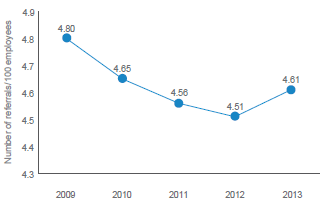 |
| Graph: EAP referrals |
Graph: EAP/100 employees |
| The above graph excludes Trudon and Swiftnet |
The above graph excludes Trudon and Swiftnet |
Telkom provides psychological care and support to its
employees and their families to help them deal with personal,
family and work related psycho-social problems, and to
optimise psychological wellbeing. Research indicates a positive
correlation between psycho-social wellness and productivity,
and therefore demonstrates the strategic importance of the
EAP as a management tool.
Numerous factors can influence the psycho-social well-being
of an individual. In the past year, high levels of personal stress,
marital and family difficulties, depression and finances were
among the problems that were referred to the EAP for care
and support. Employees experiencing trauma caused by hijacking,
robberies, accidents and other crises were also referred
to the EAP for counselling and therapy. These are the main
causes for the rise in EAP referrals for this reporting cycle.
During the 2013 financial year, 983 individual and
131 group counselling requests were received. On average, 93
referrals were recorded each month. A total of 3,896 individual
sessions were conducted at a cost of R 2,115,440 for the period.
As in the previous financial year, the majority of the referred
cases were crises and trauma related (27%), while 21.5%
were attributed to marital and family related challenges.
Due to the sensitivity of many cases (medical conditions,
personal finances, unwillingness to indicate the kind of
problems experienced) 30.6% of the referrals did not specify
the reason for the request for counselling.
Psychological problems such as stress, anxiety and depression
made up a further 12.7% of the referrals received by the
EAP office. Poor performance, absenteeism and incapacity
accounted for a further 5.6% of the referrals and the
remaining 2.6% were for substance abuse and other psychosocial
related issues.
Network Field Operations (36.8%), Customer Services (9.1%),
Network I nfrastructure Provisioning (7.5%), Network Core
Operations (6.4%), Consumer Markets (4%) and Telkom
Direct Shops (3.8%) were the predominant users of Telkom’s
EAP services.
The EAP is not only responsible for the psychological care
and support of its employees, but also strives to equip them
with the necessary competencies to counteract the stresses
and strains of daily living. Financial and stress management
workshops, as well as psychological resilience and work-life
balance interventions, were conducted as preventative and
enabling interventions during the past year.
|


