The focus on stakeholder management has sharpened
as the difficult prevailing economic conditions have
highlighted the importance of stakeholder inclusivity and
responsiveness in achieving strategic objectives.
As stated in the 2012 Integrated Report, we have embarked
on a process to bolster our stakeholder engagements and
processes. Feedback received on last year’s stakeholder
engagement section revealed a need for greater clarity
around the value-add of stakeholder engagements and
how it facilitates the achievement of strategic objectives.
Further areas of improvement as per the 2012 audit
findings suggested that responses to stakeholder issues
and concerns should be tracked, measured and reviewed
at least every quarter and that the mitigating actions are
continually assessed. A further recommendation to ensure
greater robustness was to review the process followed by
stakeholder owners to identify their stakeholders’ issues.
A fully functional stakeholder management working group
was introduced in 2013 and will be responsible for driving
and monitoring our responsiveness to stakeholder issues
and ensuring continuous assessment of the effectiveness
of our responses to stakeholder issues.
Telkom is in the process of implementing an automated
centralised stakeholder issues database that will enable a
common view of material issues across the organisation,
ease of monitoring and evaluation as well as reporting on
stakeholder issues to various structures.
The 2013 financial year saw an exodus of Telkom board
members when government exercised its rights as majority
shareholder to elect a board that it believed could steer
Telkom in the desired strategic direction. Immediate
stability was brought about with the election of the new
board members and chairman. Following the resignation
of the GCEO, a new GCEO and chief operating officer were
appointed on 1 April 2013. These appointments will further
enable the achievement of top management’s strategic
objectives.
Owing to the changes that occurred at board level during
the reporting year, there were no material issues from the
recently appointed Board, however, the board effectiveness
report highlights the concerns for 2013.
Telkom has placed greater impetus on its approach to
enterprise stakeholder management. The organisation
has over the past few years focused on the alignment of
its stakeholder relationships with its strategic objectives.
Telkom has a dedicated unit that focuses strictly on
stakeholder management and reports into the Social and
Ethics Committee.
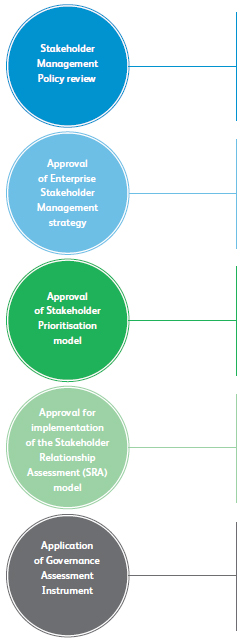
Telkom’s Stakeholder Management Policy, approved by the
Board in 2009, was reviewed in the 2013 financial year.
The outcome was an increase in the number of stakeholder
groups from 11 to 13. ‘Government’ and ‘Regulators’ are now
listed as separate stakeholder groups, previously grouped as
‘Authorities.’ ‘Partners’ were removed from under ‘Suppliers’
to become a stand-alone stakeholder.
Telkom’s Enterprise Stakeholder Management strategy, which
we began implementing in 2011, was formally approved by
the Board. The strategy provides the foundation on which
the implementation of the Stakeholder Policy should be
based and ensures better connection of business strategy
to stakeholder issues.
During 2012, Exco approved the prioritisation of stakeholder
groups which will assist us execute our strategy and business
plan so that at all times we have a clear sense of those
stakeholders driving the sustainability of the business without
neglecting other key stakeholders.
Following Telkom’s participation the SRA pilot project, which
yielded useful results on our strengths and weaknesses among
our stakeholders, Exco approved the first phase of the SRA
model for government stakeholders, with the other groups to
follow. This will enable us to better respond to the concerns
of these stakeholders.
The organisation has adopted an IoDSA-approved
governance assessment instrument. This instrument allows
Telkom to perform self-assessment with regard to King III
compliance. We obtained AAA scores in each of the categories
indicating that we fully apply or explain non-compliance to
the King III principles in all the categories provided for in
the assessment instrument.
| |
Stakeholder |
2013 Material issues |
|
Telkom response |
|
Method of engagement |
|
Progress |
|
| |
Enterprise
business
customers |
|
|
Telkom has a network
transformation programme
which will provide the
Group with the latitude
for product and service
innovation. |
|
| • |
Forums |
| • |
One-on-one |
| • |
Website |
|
|
| • |
Perceptions about
overall products and
services improved
from 50% to
57%, according
to our Customer
Loyalty survey: |
| – |
Customers believe
that Telkom
products and
services lack
innovation. |
| – |
Telkom products
and services are
reliable and add
value. |
|
|
| b. |
Lack of or
insufficient
communication |
|
|
We are committed to
improving our existing
communication channels.
Telkom is always seeking
better methods to interact
with customers, e.g. social
media. |
|
| • |
Electronic newsletters
including products and
services information to
targeted customers |
| • |
Presence on
social media |
| • |
Face-to-face
interaction |
| • |
Breakfasts |
|
|
| • |
2013 Customer
Loyalty survey shows
critical improvement
in customer
satisfaction with our
communication. |
|
|
| c. |
Inflexible products
and services |
|
|
Products and services are
bundled to meet customer
needs. |
|
| • |
One-on-one |
| • |
Ongoing engagement
with account
representatives |
| • |
Improved products
and services
information |
|
|
| • |
The network upgrade
will be accelerated
over the next three
years and will
improve service
delivery through: |
| |
| – |
faster internet |
| – |
easy connection |
| – |
wireless services |
| – |
cellular services |
|
|
|
|
|
Telkom has dedicated
representatives for certain
customer accounts.
An escalation process
is also in place to assist
with speedy resolution of
customer queries. |
|
| • |
Ongoing engagement
with account
representatives |
|
|
| • |
Overall satisfaction
with account
representatives
improved from 64%
in FY 2012 to 71% in
FY 2013. |
|
|
| |
Retail and
consumer
customers |
| a. |
Customer
experience,
broadband, billing
and communication |
|
|
Telkom has a team in place
to develop an operational
plan to improve service
delivery.
Best practice peer review. |
|
| • |
Pinnacle magazine |
| • |
One-on-one |
| • |
MI survey |
| • |
Customer perception
study |
|
|
| • |
The operational plan
is being developed
and will be finalised
in 2014. |
|
|
| |
Wholesale
customers |
|
|
Improvement of our
products and services
through technology
and bundling. Telkom is
transforming its technology
to replace existing legacy
technology with a view to
improve its product and
service offering. |
|
| • |
Products and
services information |
| • |
Ongoing engagement
with account managers |
|
|
| • |
Telkom has
successfully
undertaken the
20 Mbps and
40 Mbps broadband
trial plans, which
include locations and
trial objectives. The
project has focused
on FTTx and highspeed
DSL services. |
|
|
|
|
Legacy technologies
inhibit our ability to
reduce prices. The network
transformation programme
will assist us to provide
greater value for money on
products and services. |
|
| • |
Products and
services information |
| • |
Email |
| • |
One-on-one
engagement |
| • |
Ongoing engagement
with account managers |
|
|
| • |
Customer satisfaction
improvements of
between 3% and
13% across all
customer segments
was achieved. |
|
|
| |
Investors |
| a. |
Lack of clarity/
alignment with
government |
|
|
Telkom is working with
government to build a
more positive, constructive
relationship. More
regular engagement with
government will help
achieve clarity around
the role of Telkom in
the broadband rollout
and our ability to service
developmental versus
commercial objectives. |
|
| • |
The chairman, GCEO
and other Telkom
executives and
representatives interact
with government on a
regular basis |
|
|
| • |
Initial engagements
with government
have been positive. |
| • |
Positive relationships
with the GCEO
and chairman. |
| • |
Submission of
national broadband
proposal to
government. |
|
|
| b. |
Operational
concerns including
historic track record
of poor investment,
high execution risk
and a high cost base |
|
|
A review of the group
strategy is currently
underway. Telkom is
committed to reporting
on delivery of operational
performance against
financial metrics, e.g. cost
reduction. |
|
| • |
One-on-one meetings |
| • |
Conference calls |
| • |
Attendance of
conferences |
|
|
| • |
Feedback from
investors has been
positive regarding
recent decision to
impair legacy assets. |
| • |
Details on the group
strategy will be
provided within the
next 6 to 9 months. |
|
|
| c. |
Risks associated with
the mobile business: |
| |
| – |
Telkom’s ability
to fund and
absorb the losses
associated with a
start-up business |
| – |
Building a fourth
mobile entrant
in a mature,
competitive
market |
|
|
|
Currently reviewing the
mobile business to de-risk
the business case. Mobile is
central to Telkom’s future
and critical to the provision
of converged solutions.
Our focus on profitable
segments of the market
follows a niched approach. |
|
| • |
One-on-one meetings |
| • |
Conference calls |
| • |
Attendance
of conferences |
| • |
Investor presentations |
|
|
| • |
An update on the
Mobile business will
be provided to the
market once the
Group strategy is
finalised. This will be
done in the next six to
nine months. |
|
|
| d. |
Regulatory risks:
competition fines,
lack of sub-1,000
Ghz spectrum, LLU
obligations, etc. |
|
|
Telkom has taken the
view to settle competition
and other legal issues
expediently where this
is in the best interests
of the Group. We aim to
engage proactively with
the Regulator on issues
impacting the industry. |
|
|
|
| • |
Competition
Commission
fines settled. |
| • |
ICASA has postponed
LLU for re-assessment. |
|
|
| |
Government |
| a. |
Achieving the rollout
of broadband to all
households by 2020 |
|
|
Telkom will seek alignment
with government to ensure
that it fulfils its objectives
as national incumbent.
Telkom seeks to form
a partnership with
government on the
commercial rollout of
broadband. |
|
| • |
Participation in
policy forums |
| |
| – |
Treasury’s market
sounding |
| – |
ICT and job
competitiveness |
|
| • |
Vision 2020 |
| • |
Inputs and
presentations on NDP |
| • |
SIP15 |
| • |
ICT Panel Review
Committee and
its processes |
| • |
Meetings |
|
|
| • |
National broadband
policy document
submitted to
government;
awaiting feedback. |
| • |
Ongoing engagement
with relevant
government bodies
and stakeholders. |
|
|
| b. |
Strategy not aligned
to government goals |
|
|
Ongoing interaction
with government in
order to ensure better
communication and
alignment of objectives. |
|
|
|
| |
Regulators |
| a. |
Rollout to
underserviced areas,
particularly rural
communities, at
affordable prices |
|
|
Promoting Telkom’s
partnership with
government. |
|
| • |
Correspondence |
| • |
Meetings |
|
|
| • |
Recent government
documents show an
understanding of the
critical role Telkom
can play in delivering
telecoms solutions
to under-serviced
areas with support of
government. |
|
|
|
|
Legal challenge to
regulations. |
|
| • |
Correspondence |
| • |
Meetings |
|
|
| c. |
Increased spectrum
licence fees |
|
|
Co-operation with ICASA to
reduce financial impact. |
|
| • |
Correspondence |
| • |
Meetings |
|
|
| d. |
Local Loop sub-leasing
(unused
Loops) |
|
|
This is a work in progress.
Achieved postponement
beyond November 2011. |
|
| • |
Correspondence |
| • |
Meetings |
|
|
| • |
Work in progress
to find alternative
solutions to LLU. |
|
|
|
|
No action by ICASA. |
|
| • |
Correspondence |
| • |
Meetings |
|
|
|
|
| f. |
Increased revenue
from operating
licence fees |
|
|
Meeting with regulator on
this issue. |
|
| • |
Formal submissions |
| • |
Correspondence |
| • |
Meetings |
|
|
| |
Employees |
|
|
Started VSP, VERP and
retrenchments. Telkom has
performed a qualifications
and skills audit. Currently
implementing a strategic
workforce plan. |
|
| • |
Intranet |
| • |
Performance
management/one-on-one
discussions |
| • |
Staff meetings |
| • |
CEO road shows |
| • |
Electronic Newsletter,
T-News |
| • |
Online/Telkom Touch
Magazine |
| • |
DMS/Skytrain |
| • |
Business Planning/
team building sessions |
| • |
Culture
Values Assessment |
| • |
Employee Engagement
Survey |
|
|
| • |
The VSP and VERP
will focus mainly
on employees
who have reached
retirement age. |
| • |
The qualifications
and skills audit will
assist the Group
align skills to
organisational needs
and identify gaps. |
| • |
These interventions
are critical to
the successful
implementation of
Telkom’s strategic
workforce plan. |
|
|
|
|
Employee skills
development through
certified SAQA-accredited
training. |
|
| • |
Skills
training programmes |
| • |
Conferences |
| • |
Workshops |
|
|
| • |
Telkom provides
internal and external
skills development
interventions that
enable employees
to grow into other
areas of business
where there are
skills shortages. |
| • |
In 2012 financial year
Telkom trained
4,414 employees
on NGN related
courses, while 6,329
employees were
trained in the 2013
financial year. |
|
|
|
|
Shrinking revenues make
it difficult for Telkom to
make a contribution to the
government’s job creation
agenda. Escalating labour
costs erode profitability
of the Group. Broadband
rollout may assist in this
regard. |
|
| • |
One-on-one
with government |
| • |
Job forum |
| • |
Transformation forum |
|
|
| • |
The current financial
performance makes
it difficult to create
direct employment. |
| • |
Empowerment
initiatives like
bursary schemes,
learnerships and
supplier development
programmes. |
|
|
| d. |
Career development
and planning;
succession planning |
|
|
New succession planning
map approved. Rollout
happening at Executive
and senior management
level. |
|
| • |
Succession planning
framework |
|
|
| • |
Telkom has career
development and
succession plans
to enable the
nurturing of talent,
retention of critical
skills and leadership
development. |
|
|
| |
Organised
Labour |
| a. |
Telkom’s role in
transformation of
society through
universal service and
access |
|
|
Recognition of the need to
balance financial and social
aspects. |
|
|
|
| • |
Work in progress,
with positive gains
made in addressing
inequalities and
discrepancies in
remuneration as
well as ensuring
a transformed
environment. |
|
|
| b. |
Lack of trust by
organised labour |
|
|
Telkom engages with
organised labour on an
ongoing basis. |
|
|
|
| c. |
Matters relating
to transformation,
diversity,
employment
equity and skills
development |
|
|
National Equity
and Development
Transformation Forum
address transformation
and diversity. Gender and
Disability Programmes
target specific groupings.
Telkom has appointed
a company to assist in
recruitment of persons with
disability.
Programme on declaration
of disability. |
|
| • |
National Equity
and Development
Transformation Forum |
|
|
| |
Media |
| a. |
Lack of high-level
executive on/off-the
record engagement
with media and
Telkom GCEO/Exco
team |
|
|
Telkom has embarked
on a high-level media
engagement process
for Telkom executives to
improve accessibility and
combat negative press.
We began a structured
programme to introduce
new GCEO to key media
audiences. |
|
| • |
One-on-one meetings |
| • |
Media briefings |
| • |
Press releases |
|
|
| • |
Renewed focus
on engagements
with the media will
ensure that we report
positively in new
financial year. |
| • |
Fair coverage of
results and the legacy
asset impairment
among business and
ICT media. |
| • |
GCEO introductory
media road show
successfully executed. |
|
|
| b. |
Negative
perceptions of
Telkom in the media |
|
|
| |
Suppliers |
|
|
Cost of doing business is
monitored to ensure that
the total cost of procuring
or sourcing goods is not
exceeded. |
|
|
|
| • |
Telkom scored 2.80,
while the benchmark
supplier average
is 3.30. |
| • |
Telkom will identify
drivers of cost-to-serve
like multiple contracts,
guaranteed rush
delivery, and fines. |
| • |
Voice of Supplier
report. |
|
|
|
|
Telkom has commodity
managers responsible for
managing relationships
with suppliers. |
|
|
|
| • |
Telkom scored 3.08,
while the benchmark
supplier average
is 3.87. |
| • |
Telkom will build
awareness around
the concept of
‘customer of choice’
through various
initiatives including
assessment of
customer profitability
and improving
forecast accuracy. |
| • |
Voice of Supplier
report. |
|
|
|
|
Telkom seeks to improve
the procurement cycle time.
This will assist to contain
the total cost procuring or
sourcing goods. |
|
|
|
| • |
Telkom scored 3.05,
while the benchmark
supplier average
is 3.59. |
| • |
Accurate forecasting
has been identified
as an area
for improvement. |
| • |
Voice of Supplier
report. |
|
|
|
Business
partners |
| a. |
Lack of clarity
whether Telkom
is pursuing a
commercial or social
mandate |
|
|
We are engaging
government with a view to
aligning its commercial and
social agenda. |
|
|
|
| • |
The review of the
Telkom strategy by
the new Board and
GCEO will provide
a new perspectiveand clarity on mobile
strategy. |
|
|
| b. |
The logic behind Telkom Mobile and
8•ta as two mobile
brands |
|
|
The brands are aimed at
different mobile segments. |
|
| c. |
The viability of
Telkom Mobile |
|
|
Telkom continuously
reviews the mobile business
case to ensure viability. |
|
| |
Opinion
makers |
| a. |
Lack of continuity
with regards to
the GCEO of the
company |
|
|
Telkom has appointed the
new GCEO and the COO.
This will assist in ensuring
continuity. |
|
| • |
AGM |
| • |
GCEO road shows |
| • |
Analyst presentations |
|
|
| • |
Engagements with
government on
Telkom’s role in ICT
aspiration will address
issues of influence. |
|
|
| b. |
The influence of
government on
Telkom |
|
|
Telkom is engaging with
government with a view to
aligning expectations. |
|
|
|
| |
Civil
society |
| a. |
Lack of access to
funding |
|
|
Telkom Foundation has
a policy which clearly
articulates areas of focus. |
|
| • |
Email |
| • |
Evaluation of proposals |
|
|
| • |
Reviewed
engagements with
civil society to
determine inroads
made and the work
by Telkom Foundation
continues to yield
positive results. |
|
|
| |
Competitors |
Local loop unbundling |
|
Telkom is engaging relevant
authorities in the sector on
this matter |
|
|
|
| • |
Engagements with
Authority are ongoing |
|
|
| Telkom is seen as
monopolistic |
|
Telkom is not a significant
market leader |
|
|
|