
Our operating environment
 ‘Twenty years ago telecom infrastructure was used to
provide mostly basic voice and data communication
services; today it is playing an essential part in the
greatest innovation story of the current age while
forming the backbone of the future economy.’
 Dalibor Vavruksa
Head of CEEMEA
Citibank Telecom Research
Global Perspective & Solutions
November 2014
Our global environment
Current global industry trends
- Migration from voice to data resulting in falling profitability
- Fixed-mobile substitution is ongoing
- Industry consolidation to enable scale and scope
- Move to the cloud
- Rapid growth in machine-to-machine (M2M) revenues
- Convergence of telecoms, multimedia and ICT (TMT) to enable new ways of achieving profitability
- New sources of competition, as the natural entry barriers, which historically protected telecoms
companies against competition from other industries such as over the tops (OTTs), e.g. Google and
WhatsApp, continue to weaken traditional margins
- Evolving regulatory environment not favourable to fixed-line investment and innovation
- The role of government is critical to broadband take-up in developing countries
Risks and opportunities
- The major structural imbalances and potentially disruptive undercurrents affecting the global economy
are impacting the telecoms industry in terms of a fall-off in business spend
- Even in a slow growing economy consumers are prioritising smartphones and Internet connectivity
- In order to be sustainable telecoms companies need to be in a position to take advantage of
opportunities created by the global megatrends, of digital disruption and waves of creative destruction.
This will require substantial investment
- Opportunities include those arising from the convergence of telecoms and IT into ICT
This has resulted in the purchase of IT companies by telecoms companies
Rapid change
- The major structural imbalances and potentially disruptive undercurrents affecting the global economy are impacting the telecoms industry in terms of a fall-off in business spend
- Even in a slow growing economy consumers are prioritising smartphones and Internet connectivity
- In order to be sustainable telecoms companies need to be in a position to take advantage of opportunities created by the global megatrends, of digital disruption and waves of creative destruction. This will require substantial investment
- Opportunities include those arising from the convergence of telecoms and IT into ICT
This has resulted in the purchase of IT companies by telecoms companies
Rapid change
Globally, telecoms companies are grappling with the impact of new technologies and the speed of the change they bring with them. A major challenge for telecoms companies is making the shift from highly profitable legacy voice services, which are in decline, to less profitable data services.
Change is being driven by:
- Consumers addicted to connectivity, speed and wireless connections
- More affordable mobile voice services due to intense price competition in the mobile sector
- Ongoing expansion of the mobile ecosystem, together with demand for high bandwidth applications and services, which is putting pressure on the industry to increase the availability and quality of broadband connectivity (offloading some mobile bandwidth demand to Wi-Fi is proving an effective complement to mobile networks)
The role of the regulatory environment
Wireless and Internet connectivity is likely to play an even more prominent role in the global economy in the future, however, the nature of the new opportunities this connectivity presents may mean that policies that worked in the past may not work in the future.
Regulatory uncertainty, in particular concerning long-term competitive and net neutrality policies, and uncertainty about future telecom products and the role of telecom operators, makes it difficult for telecoms companies to plan long term and form sound long-term strategies. Another challenge for telecoms companies is that while innovation by global Internet leaders appears to have been substantially rewarded, the regulatory environment has suppressed the scope for telecoms to innovate.
Because both telecoms and the Internet are playing an increasingly important role in the global economy, it is crucial that the policy decisions made regarding these industries will facilitate equitable sustainable growth. It is also crucial that they are speedily resolved.
What the future holds
Indications from industry research are that meaningful net growth in traditional telecoms companies will resume once the decline in legacy voice services slows down significantly and companies take advantage of revenue opportunities in the emerging digital world.
These revenue opportunities include the material value telecoms networks can add to the economy through the provision of:
- Cloud services
- Machine-to-machine (M2M) services
- Artificial intelligence that can be applied across a number of industries including finance, health and education
The challenge is that the more advanced these services become the more customers will require and demand:
- Guaranteed and secure services
- Increased bandwidth capacity and improved quality
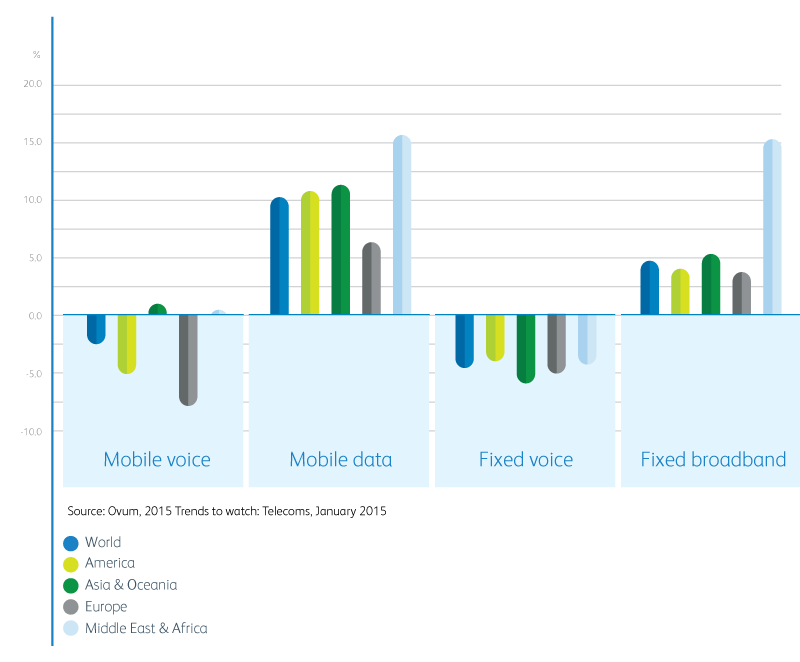
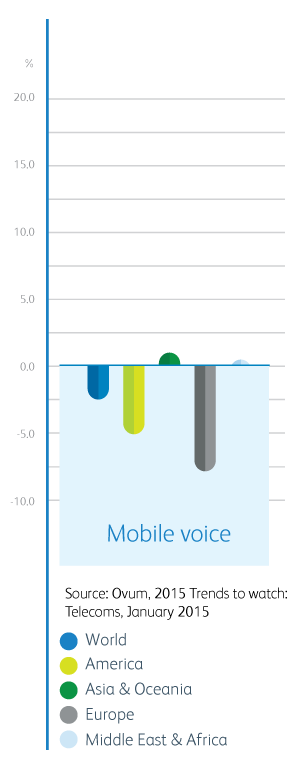
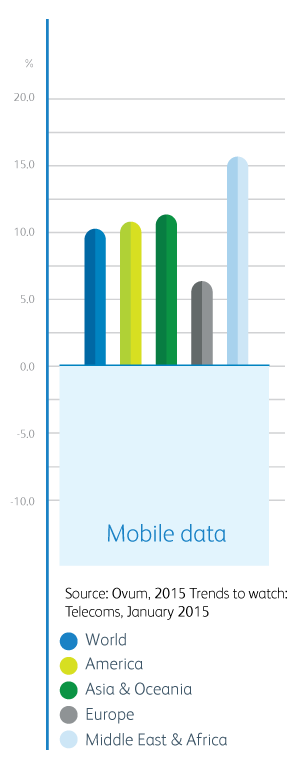
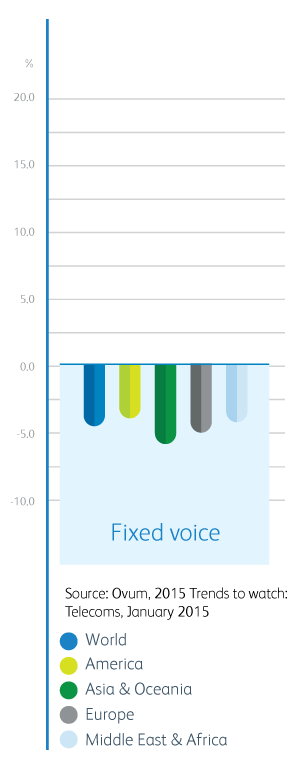
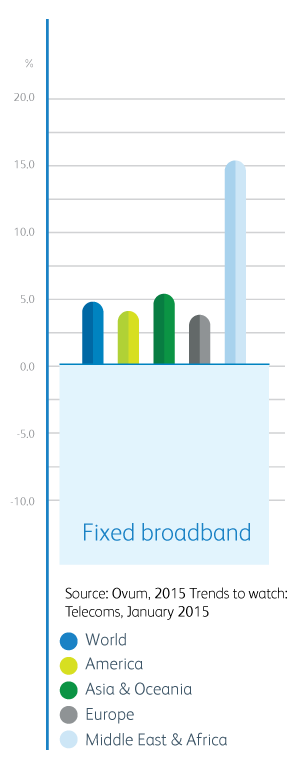
The graph (below) forecasts the use of various telecoms products worldwide and by region in 2015. Not only does it forecast a decline in fixed voice usage throughout the world, but it also shows a decline in mobile voice usage both globally and in the Americas and Europe, while growth in mobile voice in the Middle East and Africa and Asia and Oceania is expected to be very limited. The Middle East and Africa are clearly expected to be the biggest growth areas for mobile and fixed broadband data.
Forecast mobile voice, data, fixed voice and fixed broadband revenue growth by region in 2015
The South African environment
Overall, the South African telecoms environment presents challenges and opportunities similar to those present globally. In line with global trends a diversified value-adding telecoms industry, highly concentrated in both fixed and mobile services, has developed in South Africa over the past twenty years. We do, however, face some unique challenges and opportunities.
These include:
- Addressing the challenge of the low penetration of broadband in South Africa
- The need to democratise data and invest in connectivity to drive meaningful change in South Africa by enabling economic growth while a vast gap in incomes persists
- The ability to monetise increasing data traffic
- Increasing cost of importing technology and maintaining international connectivity as a result of the US$:R exchange rate
- South Africa is lagging in terms of ICT policy reform. Inadequate policies resulted in South Africa struggling to agree on call termination rates
- Meeting South Africa’s vision of connecting all South Africans by providing products that cater for all South Africans
- Increasing labour costs
- Lack of capacity in power generator, Eskom
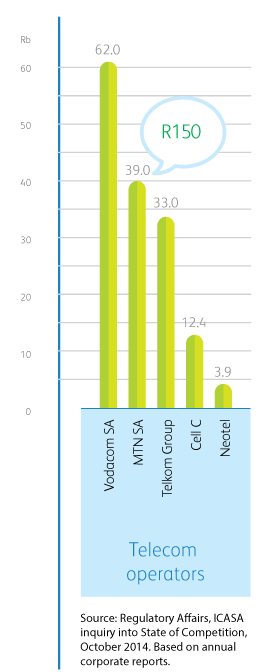
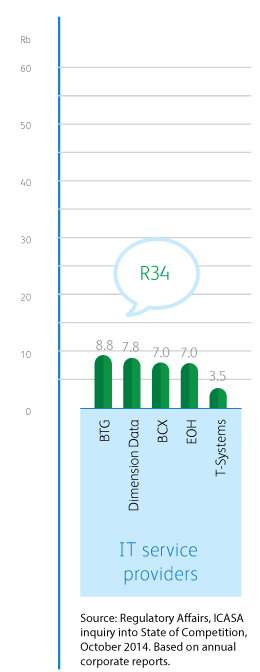
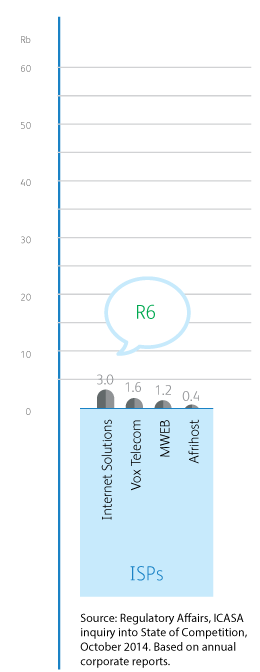
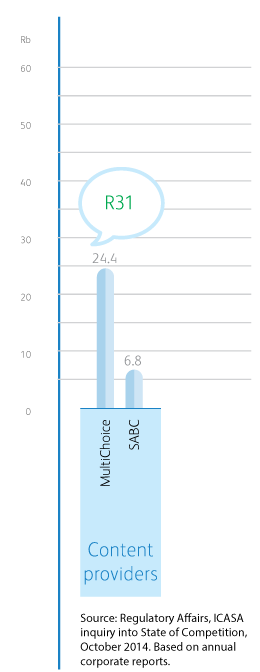
The South African ICT sector generates revenues of approximately R240 billion a year, with telecoms by far the largest contributor at 61 percent.
Estimated South African revenue for major ICT companies in 2014 (R billion)


Product category and market player South African Telecommunications
| Mobile voice | Mobile broadband | Fixed voice | Fixed broadband | ICT services | |||||
 |
|
|
|
|
|||||
| Converged player | |||||||||
| Vodacom | Vodacom | Vodacom | Vodacom | ||||||
| Neosmart | Neotel | Neotel | Neotel | ||||||
| Wireless player | |||||||||
| MTN | MTN | Converged offers for SME* | MTN | ||||||
| Cell C | Cell C | ||||||||
| Fixed player | |||||||||
| VolP | MWEB | MWEB | |||||||
| VolP | Vox Telecom | Vox Telecom | |||||||
| VolP | iBurst (WBS) | iBurst (WBS) | |||||||
| Mobile voice: Narrowband 2G/2.5G |
Mobile broadband: 3G, 3.5G, LTE |
Fixed voice: incl voice over copper, internet dial-up, VoIP |
Fixed broadband: non-dial-up broadband via copper (xDSL), WiMAX, CDMA or fibre access |
ICT services: cloud, hosting, managed services, data centre management |
|||||
Source: Telegeography 2014, Operator Websites 2014, BMI 2014
*Reliant on Telkom infrastructure
The South African regulatory environment
The key public stakeholders of the South African telecommunications industry are the Independent Communications Authority of South Africa (ICASA), the Department: Telecommunications and Postal Services (DTPS) and the Department: Communications (DC). Other public stakeholders that may involve themselves in the industry are the Competition Commission and the Competition Tribunal.
ICASA, which falls under the DC, is the regulator for the South African communications, broadcasting and postal services sector. Its mandate in terms of the ICT sector is spelled out in the Electronic Communications Act for the licensing and regulation of electronic communications and broadcasting services. ICASA is empowered to monitor compliance with licence terms and conditions, develop regulations, plan and manage the radio frequency spectrum and protect the consumers of these services.
The DTPS is tasked with creating a vibrant ICT sector that ensures that all South Africans have access to robust, reliable affordable and secure ICT services in order to advance socio-economic development goals and contribute to building a better world. It is responsible for developing ICT policies and legislation and contributing to e-skilling our nation to achieve equitable prosperity and global competitiveness.
While Telkom dominates the fixed-line voice market, competition from Neotel and value added network services (VANS) is growing and changing the market dynamic. In line with the trend in many emerging markets mobile substitution for fixed-line voice services has affected growth in this market.
While we still receive our largest revenue contribution from fixed-line voice Telkom has seen a significant decrease in this market since 2010. In addition, the rapid expansion of wireless broadband has impacted on the demand for our traditional copper-based fixed Internet lines.
 For more information on our products, services and
infrastructure see the Productive and Intellectual capital
sections of this report on pages 62 to 77.
Telkom’s position
While Telkom dominates the fixed-line voice market, competition from Neotel and value added network services (VANS) is growing and changing the market dynamic.
In line with the trend in many emerging markets mobile substitution for fixed-line voice services has affected growth in this market. While we still receive our largest revenue contribution from fixed-line voice Telkom has seen a significant decline in this market since 2010. In addition, the rapid expansion of wireless broadband has impacted on the demand for our traditional copper-based fixed Internet lines. To compensate for the loss of fixed-line voice revenue and become the leading provider of converged ICT solutions we are using the convergence of telecoms, multimedia and ICT (TMT) to find new ways of maintaining profitability.
We are:
- Deploying the next generation broadband services to more and more South Africans, from entry level 4 Mbps per second ADSL through to premium 20 Mbps and 40 Mbps VDSL services, 100 Mbps per second fibre to the home, an LTE service primarily as a fixed line, accelerating the extension of our next generation network, having already invested in the largest terrestrial fibre network in the country
- Becoming data centric so that our revenue is driven by the provision of data services and we achieve high economies of scale, which will allow for high speed data intensive services at affordable prices
- Revamping our access network using multi service access nodes (MSAN) which give us the ability to enable different types of services from the same access node MSANs and address current and future demand as they are scalable and flexible
- Delivering simple and compelling bundles and converged products to consumers that place our offerings at the centre of the digital home
- Through our Customer First approach winning customers, which will allow us to achieve economies of scale
- Reducing costs to our wholesale customers with the aim of increasing access to broadband (Telkom announced a unit price reduction of up to 63 percent across its wholesale product range in April 2015)
- Offering access to our new generation broadband access technologies and MSANs to other Internet services providers (ISPs) on an open-access basis with the aim of delivering even higher speeds to the industry
and we plan to:
- Exponentially increase our ability to offer IT services that are responsive to current and future connected strategies and include compelling cloud-based and data centre services. Our proposed acquisition of BCX, which the South African Competition Commission has recommended for approval by the Competition Tribunal (subject to certain conditions), would allow us to rapidly achieve this goal
- Retain and recruit the talent we need to deliver against our strategy and provide an environment that supports innovation and continuous improvement
Telkom and the regulatory environment
Our main regulatory challenges are related to regulations in place, and those proposed, which create a playing field that is unevenly balanced towards our competitors. There are also significant historical legacy regulatory matters that we are addressing one by one to create a level playing field. We have made significant progress in this connection, which has had a positive impact on our profitability.
We have strengthened our regulatory team, which is working to resolve key regulatory matters by positively engaging with the regulator on call termination rates, spectrum, universal service obligations, local loop unbundling and open access, quality of service charters and Competition Commission compliance.

What the future holds for Telkom
- We will continue to put our customers first by improving our customer experience through process improvements, delivering a sustainable winning mobile proposition to consumers and business, accelerating and extending the delivery of our next generation network
- We will find innovative ways to compensate for our loss of revenue from voice services
- We will meet the challenge of ensuring our product range and product prices cater for all South Africans
- As lead agency on the national broadband plan Telkom will have the opportunity to work with South African telecoms companies to democratise data by addressing the current low penetration of broadband in South Africa
- We need to find ways to meet the challenge of democratising connectivity while at the same time ensuring that our business remains profitable and sustainable
- Telkom is looking at ways to optimize its operating model, this includes creating three standalone businesses: a consumer business focusing on leading in home connectivity and services, enterprise focusing on connectivity solutions for business customers and an infrastructure wholesale business, which would run the network and associated IT, field services and operations to service other licensed operators
This separation into a more clearly defined business will lead to greater accountability and cost efficiencies. It will also encourage the right behaviours in the marketplace.
Building stability, unlocking potential

 Refer to Rep Trak results