Natural capital
 Natural capital includes the natural resources and processes needed by an organisation
to produce its products. This includes renewable (timber and water) and non-renewable
(fossil fuels, minerals and metals) resources and processes such as energy consumption,
waste creation, emissions etc. We maintain and enhance natural capital by:
- Reducing our dependence on fossil fuels
- Eliminating waste by reusing or recycling it whenever possible
- Protecting biodiversity and eco-systems
- Wherever possible using renewable resources from well-managed and restorative eco-systems
- Managing resources efficiently.
Telkom is categorised as a medium to low risk organisation in terms of the impact of its activities on the environment, however, advancing communications technology is likely to increase our energy demands. Our energy management forum and our energy manager are tasked with identifying opportunities to make our operations as energy efficient as possible and to reduce our carbon intensity (i.e. the amount of carbon we produce per employee). Not only are we committed to reducing Telkom’s impact on climate change by reducing our carbon intensity, but we also need to make every effort to reduce our energy costs and the impact of the proposed carbon tax on Telkom’s operating costs. Our annual electricity costs at around R700 million a year are already a significant contributor to our operating costs.
Our approach to environmental management is based on international best practice, legal compliance and maintaining our environmental and social licence to operate. Key aspects of our environmental management include: governance, compliance and control, strategy and management systems.
| Our approach | FY2015 activities | Our future | ||||
| Environmental management | ||||||
Telkom’s environmental management division, which is ISO 14001:2004 EMS certified, is responsible for ensuring our operations implement our revised sustainability strategy and our environmental policy and management system (EMS). A management review of the effectiveness of our EMS takes place annually
Our environmental policy drives our management of the key natural capital aspects Telkom has identified. These are discussed below |
Telkom’s environmental policy was reviewed this year to ensure it conforms with Telkom’s new sustainability strategy, which identifies the material environmental issues in terms of our internal processes, legislative obligations, supply chain management and stakeholder engagement
During FY2015 Telkom did not incur any environmental management contraventions, fines or penalties |
We will continue with our annual management review of our environmental management system during which compliance requirements and opportunities to support continual improvement are reviewed and action plans are established
We will also continue to manage our key natural capital aspects in accordance with our environmental policy |
||||
| Water management | ||||||
| Telkom is not a water intensive business. Our main use of water is for cooling and office catering and hygiene. We do, however, operate in a water scarce region and therefore need to do everything we can to reduce our water intensity (i.e. the amount of water we consume per employee) | Our water consumption calculations are cost-based. Therefore, the most accurate way to measure whether we have improved our water consumption is to compare the total water costs year-on-year. This shows a reduction of 5%.
We introduced an energy and water management working group during the year under review, which is looking at further opportunities to reduce our water consumption including rainwater harvesting, waterless urinals and borehole sites to reduce dependency on municipal water supply |
The energy management forum will identify additional opportunities to reduce water consumption and finalise the feasibility studies identified in FY2015 |
 Water consumption
5% improvement in water consumption due to a reduction in Telkom’s property portfolio and water saving initiatives
Greenhouse gas (GHG) emissions in FY2015
| Scope | FY2015 tC02e |
FY2014 tC02e |
% change |
||||||||
| Scope 1 direct emissions from sources owned or controlled by Telkom using fossil fuels (diesel 11 693ˆ tCO2e) and refrigerant gases 31 795ˆ tCO2e) | 43 488ˆ | 49 353+ | 11.8 | ||||||||
| Scope 2 emissions from the generation of electricity using fossil fuels | 684 306ˆ | 643 536+ | 6.3 | ||||||||
| Scope 3 emissions from sources not owned or controlled by Telkom | 44 213 | 47 087+ | (6.1) | ||||||||
| Total | 772 007 | 739 976+ | 4.32 |
| ˆThese numbers have been assured by Ernst & Young Inc. +Assured by CA Governance |
The increase in our GHGs is as a result of an increase in the use of both fossil fuel (Scope 1) and electricity (Scope 2). In order for an organisation like Telkom to grow it inevitably consumes more fossil fuel and electricity generated from the burning of fossil fuels, which will, of course, generate more GHGs. However, it needs to do so efficiently. In terms of the rand revenue generated by Telkom in 2015 our production of GHGs was not as efficient as it should be as it exceeded our revenue growth of 1.5 percent by 2.8 percent. However, a further interrogation of the increase in our Scope 1 (fossil fuel) consumption reveals of the two largest Scope contributors to this, ‒ diesel consumed by generators and refrigerant gases, we managed to reduce our GHG emissions from refrigerant gases by 23.1 percent year-on-year while our consumption of diesel consumed by our diesel generators increased by 26.35 percent, a large proportion of which can be attributed to load shedding by Eskom. If this increase in our diesel usage is extracted from the calculation our efforts to improve our efficient use of fossil fuels improves substantially.
| Our approach | FY2015 activities | Our future | ||||
| Emissions management and energy use | ||||||
Telkom’s approach to emission management and energy efficiency is to focus on improving our energy efficiency, which will help us manage rising costs and reduce our carbon intensity
We have appointed an energy manager to focus on our energy efficiency and have also established an energy management forum to oversee our initiatives in this regard
Deficiencies in our electricity data methodology are being addressed, which includes the installation of smart electricity meters to provide accurate real-time data at building and site level |
Electricity consumption accounts for 89% of Telkom’s carbon emissions (Scope 2 emissions) We had a 3.1% increase in electricity consumption year-on-year as a result of:
A number of energy efficiency initiatives were undertaken during the year. Our phased energy efficient lighting initiative targeted 550 buildings in FY2015, reducing their energy consumption and the associated cost
Telkom’s outsourced technical fleet, employee air travel, business travel by road and diesel fuel for standby generators are the primary contributors to our Scope 2 (fuel) carbon footprint
Ongoing load shedding by the national electricity provider results in an increase in our use of diesel fuel for our generators
Improved technical fleet despatching systems installed during FY2015 reduced the distance our vehicles travelled by 4.6 million kilometres, which is a 4.2% reduction in mileage year-on-year
Telkom’s subsistence and travel policy also encourages avoiding travel by using video or teleconferencing |
Lighting control strategies proposed for implementation in FY2016 include timer controlled scheduling of lighting, occupancy sensors and photo sensors that control lighting by sensing ambient light conditions. They also include the ongoing energy efficient lighting initiative, which is a multi-year project targeting 600 buildings in FY2016
Adjust set point temperature in selected equipment buildings of heating, ventilation and air conditioning (HVAC) to reduce energy use
Improve efficiency of the HVAC component of our data centres to conserve energy and reduce cooling costs
Continue with the feasibility study into establishing an energy centre at our Centurion campus to provide 7 MW off-grid electricity generation through gas tri-generation technology and photovoltaic systems
Our new technical fleet solution will include the latest fleet management technology |
||||

Our carbon footprint (GHG emissions) data has been validated according to the GHG Protocol calculations and independent auditors EY have assured our Scope 1, 2 and 3 emissions, using the ISAE 3000 and ISAE 3410 auditing standards. The emissions of our subsidiaries, Trudon and Swiftnet, are included in these calculations.
Telkom participated in the Carbon Disclosure Project (CDP) for the fourth year running in FY2015. This participation provides our stakeholders with information on how well Telkom is managing its energy and carbon footprint. We are also a member of the National Business Initiative (NBI) and the Energy Efficient Leadership Network (EELN) and are signatories to its pledge. To fulfil our pledge our energy management forum: develops energy efficiency strategies aimed at reducing our carbon footprint; identifies opportunities to be less dependent on the national grid; creates employee awareness regarding the need to reduce energy consumption; and develops and implements attainable energy reduction targets that are aligned with Telkom’s business strategy.
- 11.8 percent decline in Telkom’s Scope 1 greenhouse gas (GHG) emissions year-on-year (direct GHG emissions from sources owned or controlled by Telkom using fossil fuels) despite need to use diesel generators during load shedding. The decrease in the kilometres covered by our technical fleet contributed to this significant decline in GHG emissions
- 6.3 percent increase in Telkom’s Scope 2 GHG emissions year-on-year (indirect GHG emissions from the generation of electricity using fossil fuels) from using 677 547 MWh (657 047 MWh in FY2014) of electricity in FY2015. As explained on page 92 the increase in our use of electricity is as a result of duplication occurring during real estate and systems changeovers
 6.1 percent decrease in Telkom’s Scope 3 GHG emissions year-on-year (GHG emissions from sources
not owned or controlled by Telkom, such as aircraft, using fossil fuels)
- 4.3 percent overall increase in Telkom’s GHG emissions year-on-year
By introducing improved fleet despatching systems we reduced the kilometres our technical fleet covered by 4.6 million kilometres year-on-year which is a 4.2 percent reduction in mileage year-on-year. We expect to achieve further reductions in FY2016.
| Our approach | FY2015 activities | Our future | ||||
| Waste management, resource consumption and recycling management | ||||||
The Total Facilities Management Company is responsible for the management of Telkom’s general waste streams. It is also responsible for any hazardous waste Telkom produces. Certified contractors are used to ensure the safe disposal of hazardous waste and their certificates of compliance are regularly audited to ensure they comply with hazardous waste management regulations
We generate revenue from certain types of waste that result when telecommunications equipment and infrastructure is made redundant and legacy systems are replaced. This waste, which includes copper, optic fibre, batteries and e-waste, is sold to certified waste management companies who manage the different waste streams in accordance with the relevant regulations |
To comply with the recently revised Waste Management Act Telkom is certifying its regional reverse logistics sites as registered waste management sites
As we enhance our telecommunications infrastructure with new technology we are producing a considerable amount of waste that needs to be responsibly recycled |
The ongoing implementation of new systems and our next generation network will continue to generate waste, some of which is recyclable. We will ensure that our waste disposal complies with the Revised Waste Management Act and at the same time ensure we recover the revenue due to us from the recycling of copper, etc
During FY2016 Telkom will implement enhanced recycling initiatives, which will include plastics, glass and tin |
||||
| Biodiversity impact management | ||||||
Telkom is sensitive to the impact of our network on biodiversity. Our environmental management specialist is responsible for ensuring any potential impact on the biodiversity of an area is mitigated and that we comply with all the relevant regulations and legislation
If it is necessary to encroach on an area of biodiversity Telkom consults with local government environmental conservancies, NGOs and specialist conservation groups working in the area |
Environmental impact assessments (EIA) have been conducted by independent environmental assessment practitioners for all our new highsite infrastructure rollouts. This ensures we do not cause undue disruption or environmental damage to an area
Telkom often takes part in the legally required public participation meetings held by other businesses as part of their EIA process to ensure they do not impact our infrastructure |
We will continue to monitor and keep to an absolute minimum our impact on the biodiversity of any area where we are rolling out our network. |
||||
| Environmental incident management | ||||||
| Every year Telkom conducts safety, health and environment (SHE) compliance audits on a predetermined stratified sample. The results from these audits are used to determine each area’s performance in terms of the environmental targets set |
This year 49 SHE audits were conducted. They achieved a 91% compliance rating. Telkom did not contravene any environmental laws or regulations, nor did it incur any environmental management fines or penalties during FY2015 |
Annual SHE compliance audits on a predetermined stratified sample will continue |
||||
| Awareness and training | ||||||
| Our annual environmental targets include undertaking environmental training and awareness |
Environmental training and awareness continued during the year, as is required by our annual environmental targets. 1 902 knowledge reviews and awareness topics were completed during FY2015
|
The electronic learning module aligned with the ISO 14001:2004 standard, which was not completed during FY2015 due to more critical training requirements, will be completed in FY2016, as will ongoing environmental training and awareness programmes |
||||
Waste generation and recycling
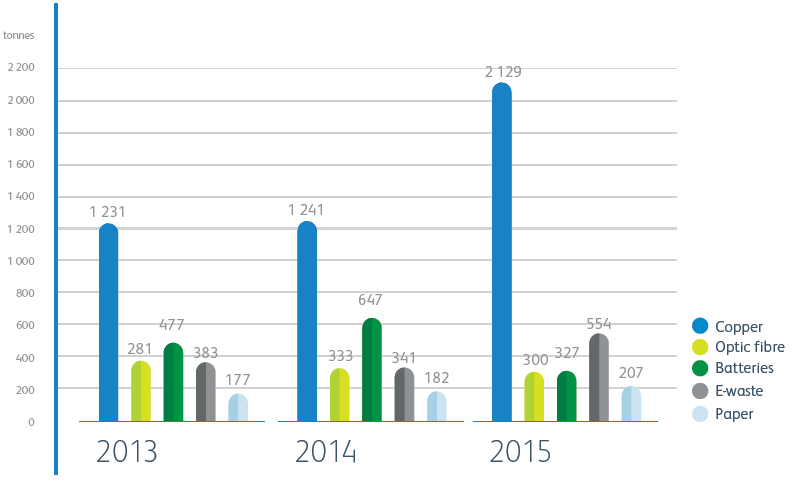
The process of replacing legacy technology with new technology generates a considerable quantity of waste which we need to ensure is recycled responsibly. We also need to ensure we are fairly reimbursed for the revenue generating waste that is extracted through the recycling process. In FY2015 our total waste increased 28 percent to 3 517 tonnes, 61 percent of which was copper recovered from legacy networks.
- We sold 2 129 tonnes of copper this year (1 241 tonnes in FY2014), a 71.6 percent increase year-on-year, as a result of a backlog of copper recoveries
- 300 tonnes of damaged fibre optic cable and offcuts was recovered (333 tonnes in FY2014) (9.9 percent less than the previous year) and recycled responsibly through our social upliftment project with Sindawonye granulators and processors
- 327 tonnes of batteries (49.5 percent less than last year), which we use as back-up power, was disposed of in accordance with the specified hazardous waste regulations
- 554 tonnes of e-waste was disposed of in accordance with legislated protocols (1 341 tonnes in FY2014). This is an increase of 62.5 percent
- 207 tonnes of paper was recycled by Telkom in FY2015, an increase of 13.7 percent
- Our move to our new campus includes a move to the paperless office, which hopefully will reduce this quantity of paper recycling
Waste stream