Human capital
 Our human capital includes the competencies, capabilities, experience and motivation
to innovate of our people. The alignment of our people with and their support for our
approach to governance, risk management and ethical values is all part of our human
capital, as is their ability to understand, develop and implement our strategy and to
lead, manage and collaborate; as well as their loyalty and motivation to improve our
processes, products and services.
Our approach to human resources management is based on international best practice, upholding the United Nation’s (UN) Universal Declaration of Human Rights and the International Labour Organisation’s Declaration on Fundamental Principles and Rights at Work, which form part of our commitments as a signatory to the UN Global Compact (UNGC). The development of our human resources strategy and its alignment with our group strategy and our employment policies and procedures are the responsibility of the chief of human resources who reports to our group chief executive officer.
Committed to:
engaging with and listening to our workforce and providing our team with a safe, comfortable and inclusive workplace
building a friendly, reliable and competent team focused on providing our customers with the best possible service
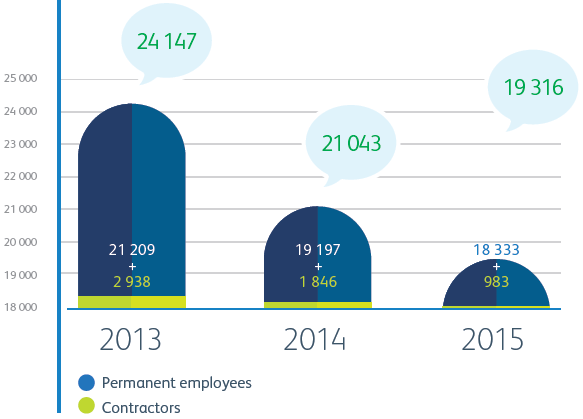
Company employee numbers as at 31 March
Headcount movement
| 2015 | 2014 | 2013 | |||||||||
| Opening balance | 19 197 | 21 209 | 20 939 | ||||||||
| Employee gains | 93 | 255 | 915 | ||||||||
| Severance | (189) | (732) | (49) | ||||||||
| Early retirement | (191) | (1 103) | (6) | ||||||||
| Natural attrition | (577) | (432) | (590) | ||||||||
| Total | 18 333 | 19 197 | 21 209 |
Overall employee turnover of 5.1% in FY2015 (11.2% in FY2014)
| Our approach | FY2015 principal activities | Our future | ||||||||
| Human resources management | ||||||||||
| Reduce our significant employee costs and optimize the efficiency of our workforce | Telkom further reduced its employee numbers (permanent employees and contractors reduced by 8.2% year-on-year following a 12.9% reduction in the previous year) | We will complete our current employee reduction project and focus on optimizing the efficiency levels of our workforce | ||||||||
| Fit for purpose organisational design | We continued with the redesign of our organisation to achieve more effective
use of our human resources |
Having achieved the organisational redesign we set out to achieve three years ago Telkom will be in a position to unlock the potential of its employees | ||||||||
| Build a strong internal brand, and improve employee satisfaction and performance levels, following the negative impact of our restructuring on both satisfaction and performance | We engaged with our employees on the objectives of Telkom’s restructuring plans. There was some improvement in employee satisfaction levels, however, our ability to rebuild our internal brand has been hampered by not being able to complete our employee cost reduction project. Telkom launched Project Re:Connect, which is designed to integrate our workforce and provide our employees with a workplace that encourages collaboration | We will be working hard on engaging with our employees and seeking their commitment to the vision and values we have developed for the new Telkom. Our focus on putting our internal and external customers first will be the key driver. Project Re:Connect, which will be rolled out during the year, will see Telkom come together as one team on one campus into which the latest thinking on productive working environment has been incorporated | ||||||||
| Labour relations (three recognised unions: Communication Workers Union (CWU) (majority union), South African Communication Union (SACU) and Solidarity) | Engage union leadership Address employee concerns through improved engagement |
1 011 workdays were lost to industrial action in connection with protests against restructuring and job losses during FY2015 Management engaged with union leadership in a two-day workshop to share our vision, strategy and project plans See pages 81 for details of employees belonging to bargaining units |
We need to complete the employee reduction exercise, which we were unable to complete in FY2015. This will be achieved through ongoing consultation with the union leadership and employees regarding the reduction in employee numbers | |||||||
| Employee benefits for full-time employees | Providing attractive employee benefits that form part of our retention strategy | In addition to providing medical, leave and retirement benefits in excess of legal requirements, from FY2014 our employees participate in short- and long-term (share) incentive schemes | Ensure we provide employee benefits that attract and retain the skills we require | |||||||
| Talent management, attraction, retention and development | Retain talent, attract new talent, especially scarce and business critical skills, develop talent pipeline and foster talent through Telkom Centre of Excellence | A stable new top leadership team is in place. Our efforts to address employee satisfaction resulted in an overall low attrition rate of 3.1%, however, retaining critical skills remains a challenge We provided 77 bursaries for full-time undergraduate studies in scarce skills and 680 employees were awarded part-time undergraduate and postgraduate bursaries in fields relevant to Telkom’s operations Telkom promoted research in communication technology to encourage young scientists to pursue their interests in South Africa |
Ensure our remuneration model is designed to reward and retain top talent We will address our succession plan, particularly in terms of highly specialised roles that are key to our business Continue to improve our marketing of Telkom as a top employer of choice among professionals Continue to invest in our talent pipeline Continue to invest in the Telkom Centre of Excellence |
|||||||
| Attraction, retention and development of talent | ||||||||||
| Skills development | Ensure we have the necessary skills to:
|
Invested R300 million in building an appropriate pipeline of technical and leadership skills, as well as customer facing skills | The development and retention of the technical, leadership and customer facing skills we need to be competitive and achieve our strategic objective of placing the customer at the heart of all we do will remain a key focus in the new year | |||||||
| Cultural diversity and transformation | Cultural transformation to support business strategy Compliance with B-BBEE codes and achieving employment equity |
Our new organisational design is flattening our structures, reducing bureaucracy and bringing us closer to our customers. To support this redesign we need to transform the culture of our business; and to support the culture change we are creating a new working environment that will foster collaboration and the sharing of ideas and capabilities Telkom maintained its Level 3 B-BBEE contributor status and its efforts in this regard are also in line with the B-BBEE ICT codes. We established a business unit assurance council which is responsible for overseeing B-BBEE performance and other assurance issues; |
Project Re:Connect will play an important part in our efforts to transform our culture into one that is sufficiently flexible, agile and innovative to compete successfully in the very competitive ICT environment. In addition to the new converged environment for our employees we will have a customer centre where we can share our business innovations and solutions with our customers We performed an impact analysis of the amended B-BBEE codes of good practice, which came into effect on 1 May 2015, to determine which areas may require significant investment. We have developed an implementation plan to address the requirements of the amended codes, which have introduced higher targets and stringent key measurement principles |
|||||||
| Safety, health and wellbeing | Meeting our obligation to provide a safe and healthy work environment | We updated our safety, health and wellbeing (SHW) policy and managers’ duties in relation to SHW Actions taken resulted in a decline in reported injuries. These included: safety training, root cause investigations, risk assessments aimed at eliminating or minimising hazards We recognise that a healthy workforce is a more productive workforce. We provide health and disease screening for our employees, their families and contractors; offer a medical assessment programme for all employees working in high risk environments; monitor our work environments; and the Thuso wellness programme provides wellness education, counselling, screening, support and care for those at risk of chronic disease An independent, confidential health helpline is available to our employees 24 hours a day |
We will continue with our efforts to keep our employees safe and healthy During the year we plan to make some improvements to our employee assistance programme by including a range of preventative interventions |
|||||||
See Productive capital section on pages 62 to 73 of this report for information on re-engineering of our property portfolio and
Intellectual capital for information on our efforts to ensure our IT systems are fit for purpose.
In FY 2015 76.9 percent of our employees belonged to bargaining units, a 1.8 percent increase year-on-year.
| Union | FY2015 % |
FY2014 % |
FY2013 % |
||||||||
| CWU | 40.3 | 39.7 | 38.6 | ||||||||
| SACU | 20.2 | 20.5 | 20.6 | ||||||||
| Solidarity | 16.4 | 15.3 | 15.5 | ||||||||
| Total | 76.9 | 75.5 | 74.8 |
In FY 2015 32.2 percent of our management belonged to bargaining units. This shows an increase of 10.7 percent year-on-year and an increase of 27.7 percent over the past three years during which the Telkom group’s strategy has included a drive to reduce employee costs.
| Union | FY2015 % |
FY2014 % |
FY2013 % |
||||||||
| CWU | 7.9 | 8.2 | 7.6 | ||||||||
| SACU | 10.4 | 10.1 | 10.4 | ||||||||
| Solidarity | 13.9 | 10.8 | 7.3 | ||||||||
| Total | 32.2 | 29.1 | 25.3 |
Our investment in learning and development

- On a permanent employee base of 18 333, a total of 76 641 facilitator-led training days were delivered during FY2015 (on a permanent employee base of 19 197 in FY2014 a total of 92 914 facilitator-led training days were delivered)
- An average of 4.2 training days per employee were provided during FY2015 (average of 4.8 in FY2014)
-
16%
decrease in our safety incidents year-on-year -
35%
of our safety incidents are slips,trips and falls -
35%
decrease in our motor vehicle accident rate year-on- year

Safety, health and wellbeing
Working at heights remains the greatest safety risk at Telkom. During FY2015 absolute rules were developed and implemented to address practices that can result in injuries on the job. We have a medical assessment programme, which continually monitors the health of employees working in high risk environments. Pre-employment medicals are conducted to determine a baseline for all employees and medical evaluations or medicals are conducted periodically in accordance with specific risk profiles. 3 955 medical examinations were conducted in Telkom during FY2015.
- There has been a 43 percent improvement in our lost time injury frequency rate year-on-year
- During FY2015 Telkom employees had 418 work-related injuriesˆ
- 3 945ˆ days were lost to injuries
- 129 468ˆ days were lost to absenteeism in FY2015
- Certified hygienists annually conduct hygiene surveys across the Telkom group
- The Thuso wellness programme, which includes a helpline, is available to all our employees
and their families. It is used to promote the wellbeing of our employees. During FY2015
4 509ˆ people were tested for HIV. Telkom’s HIV prevalence rate for FY 2015 is 2.43ˆ and
cumulative prevalence rate is 3.00ˆ
Safety
| Telkom has had no fatalities for the past two years. We regrettably had two fatalities in FY2013.
| Our lost time injury frequency rate (LTIFR) continues to improve
Our LTIFR performance
| 2011 | 2012 | 2013 | 2014 | 2014 | ||||||||||
| 1.37 | 1.44 | 1.42 | 2.10 | 1.18 |
Developing skills and creating job opportunities
- An average of 4.2 training days per employee were provided during FY2015
- 34 unemployed graduates were given the opportunity to participate in a skills programme
- 32 unemployed graduates were given internships in Telkom
- 38 Telkom employees participated in network operations learnerships
Talent development
- 77 bursaries awarded to external bursars for full-time undergraduate studies in scarce skills
- 41 students successfully completed their studies in 2014, of which 10 now have permanent positions in Telkom and 22 are on fixed term contract with Telkom
- 680 Telkom employees were awarded bursaries for part-time undergraduate and postgraduate studies in fields relevant to Telkom’s operations
- 240 full-time postgraduate students have the opportunity to pursue their research studies at the Telkom Centre of Excellence
Employment equity
- 66 percent of our employees are historically disadvantaged South Africans (HDSAs)
- 31 percent of our employees are female
- 22 percent of our employees are HDSA females
- 44 percent of our employees are HDSA males
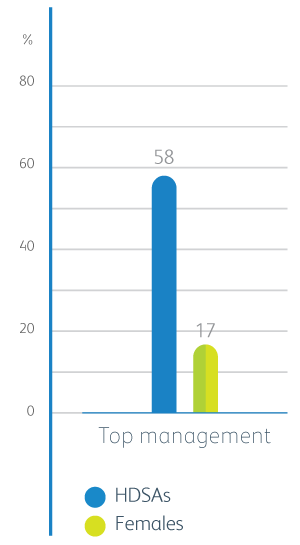
Diversity in Telkom’s management