Productive capital
 Our Productive capital includes our buildings, our infrastructure and the goods we own
or lease that make it possible for us to deliver products and services to our customers.
It also includes these products and services. It is key to our sustainability, and if we use
it efficiently it allows us to be flexible, innovative and increase the speed to market of
our products and services.
- Integrated our fixed and mobile businesses into one consumer business to drive cost synergies
and promote convergence
Operating costs reduced by 1.2% - Continuous growth in voice and data
Broadband subscribers increased 7.9% to 1 005 286 - Managed data network sites increased 1.0 percent to 47 599
Mobile subscribers increased 21.2% to 2 186 774 - Mobile sites integrated increased 3.4 percent to 2 510
1 317 mobile LTE sites integrated - Coherence in pricing of products in retail portfolio
- Ongoing decrease in fixed-line voice (11.9 percent) and leased line revenue (22 percent)
| Services | Our approach | FY2015 principal activities | The future | ||||||
| Fixed-line voice | |||||||||
Challenges: Fixed-to-mobile substitution and pressure on fixed-line voice revenues Reduction in data prices Highly competitive and aggressive pricing environment Improving customer experience |
Focus on: Providing a good customer experience Understanding where our value chain is broken and designing interventions to fix it Promoting convergence to address declining fixed-line usage |
Integrated fixed and mobile businesses to drive cost synergies and promoted convergence through the design of our product offerings We have made extensive changes in our ISP to improve customer service from architecture changes to technology. We have also made big changes to how we manage faults |
We will continue to work on improving our levels of customer service, which includes outsourcing the management of our call centres to call centre specialists Provide small and micro enterprises (SMEs) with cost effective products, simple bundled solutions and better targeted channels to market Use multi service access nodes (MSAN) to revamp our access network, enable different service types from the same access node and a future-proof access network |
||||||
| Fixed-line data services | |||||||||
Challenge: Rollout of fibre to the home (FTTH) and fibre to the business (FTTB) threatens ADSL product offering |
Our approach is to ensure we can deliver what our customers want |
Ensured cheaper services to our customers at faster speeds Recognised for the fourth year running as the best fixed broadband service provider in South Africa at the annual My Broadband Conference |
We will future-proof our capabilities using fibre technologies and mobile technologies Provide high speed data intensive services at affordable prices |
||||||
| Mobile communication services, mobile voice and mobile data | |||||||||
Challenges: Fourth entrant into a highly competitive market Outcome of Competition Commission’s decision on extension of our bilateral roaming agreement with MTN and managed network service arrangement for MTN to take over the operational and financial responsibility for Telkom’s radio access network |
Ensure sustainable, winning position for our mobile communication services Wherever possible reduce the cost of services to our customers Use mobility to exploit convergence opportunities Leapfrog technology by deploying LTE and creating ubiquitous access through Wi-Fi Extend our roaming agreement with MTN to include bilateral roaming and outsourcing of the operation of our radio access network |
Negotiated with regulator to achieve steep decline in the cost of interconnection services Provided our customers with a next generation 3G network which includes fixed-line voice services, data services and nomadic voice services Recognised as best mobile broadband operator for the third consecutive year at the annual My Broadband Conference Pursued Competition Commission approval |
IT services that deliver compelling solutions to our customers We will continue to focus on providing award-winning mobile communication services that ensure we put our customer first |
||||||
| IT services | |||||||||
Challenges: Managing the ability to deliver on potentially rapid growth from a small base Increasing energy costs Load shedding |
Transform the way IT is delivered through the cloud Realising organic growth in IT and cloud services Expanding through inorganic acquisitions |
Our focus has been on converging and bundling our products to provide seamless end-to-end solutions that meet the needs of our entire range of business customers Our proposed purchase of Business Connexion, which has received Competition Commission approval and awaits Competition Tribunal approval, is intended to deliver on this approach |
We will continue to develop converged business offerings to meet the needs of SMMEs, corporates, international business and government through the provision of virtual private networks, voice, IT and cloud services, data networks and mobile technologies |
||||||
| Carrier-to-carrier | |||||||||
Challenges: Self-provisioning by other licensed operators A high cost base largely as a result of headcount and maintenance costs of legacy network Copper theft Load shedding negatively affecting operations and customer services |
Investing R12 billion over a five-year period in connectivity through our next generation high speed broadband network to support South Africa’s entire broadband ecosystem Creating an invincible network Providing high-speed fixed-line broadband Delivering superior customer service Managing our high cost base |
Investment in our next generation network rollout and access network revamp made it possible for us to halve the cost of Telkom’s IP Connect products over the past 18 months 3G coverage reaches approximately 55% of population 6 100 Wi-Fi hotspots |
Enabling our resellers, through our network and resell products, to operate and compete successfully in their customer markets Meet next generation customer expectations by making strategic investments in technology and building innovative products and services Grow and defend our fixed infrastructure business |
||||||
| Distribution channels | |||||||||
Direct sales Sales force Shops Contact centre Third party channels Online |
Improve online channels Transform contact centres Rationalise shops Make good progress with the convergence of our products through the design of our product offerings Revamp our online channels |
Invested in improving our online channels to make them more user friendly New leadership in contact centre; outsourced contact centres, installed new state-of-the-art technology platform Multi-skilled operators to support customers on all our products Closing 20 unprofitable shops and rolling out enhanced store branding. Remaining shops have improved performance Improved online purchase and service platform to make it easier for customers and potential customers to access our online services |
Continue improving online service and sales channels Continue to monitor effectiveness of contact centres to deliver Customer First service Continue to enhance shop experience and roll out enhanced store branding, changing layout and workflows |
||||||
| The Telkom brand | |||||||||
| Our brand tagline ‘Tomorrow Starts Today’ is about rebirth and new beginnings. It’s a statement of our renewed focus and a declaration of our revitalised drive to bring seamless and embedded communications solutions to South African homes and businesses | In 2014 the Orange Index Satisfaction ratings for Telkom fixed-line increased 26%, for Telkom Internet it increased 28% and for Telkom mobile it increased 33% We still have a long way to go but our commitment to Customer First is clearly achieving results |
The Telkom brand is our promise to deliver in the present while leading the way to the future. This will only be done by understanding and anticipating the needs and desires of our customers We will achieve this by talking and listening to our customers so that we understand their needs |
|||||||
| Property portfolio | |||||||||
Complete top down strategic review of property portfolio and segment portfolio into different types of asset classes Reduce our costs by ensuring our property portfolio is fit for purpose Use property design to bring the organisation closer together and reduce costs Efficiency – sold off non-core properties |
Property portfolio strategy in place and rationalisation and consolidation has begun to unlock financial value Migrating head office functions to new campus in Centurion |
This will be a year of execution during which we will continue to transform our property portfolio and unlock financial value Head office functions now located in open plan environment on the Centurion campus |
|||||||
Telkom Business
 Supports South Africa’s corporates and businesses by offering them converged communication
solutions that combine fixed-line, mobile and data centre services
- 39.8 percent growth in Metro-ethernet revenues
- 82.4 percent increase in business IT services revenue
- 650 percent increase in business converged solutions revenue off a low base
Cybernest
Our seven data centres provide three main services: basic hosting with cooling, power and backup-power
services; managed and fully managed hosting; and disaster recovery services.
- Total data centre space 9 700m2
Telkom Consumer
Our aim is to become the centre of the digital home and lifestyle by offering a range of converged solutions that combine fixed-line and mobile solutions for the home
- 22.6 percent increase in data revenue
- 5.1 percent decrease in total voice and interconnection
- 7.4 percent increase in residential ADSL subscribers
- 9 percent increase in Telkom Internet subscribers
- 47.8 percent increase in mobile data revenue
- 21.2 percent growth in mobile subscriber base to over two million
Telkom Wholesale and Networks
- Has the largest footprint in South Africa with more than 147 000 cable km of fibre
- 16 588 distribution points enabling more than 100 000 services
- 19.4 percent increase in ADSL subscribers
- Telkom Mobile 3G coverage reaches approximately 55 percent of the population
- 1 317 LTE sites integrated
- 6 100 Wi-Fi hotspots
- Two diverse submarine cables off the west coast of Africa connecting to Europe and two diverse submarine cables off the east coast, one connecting to Europe and the other to Asia
- Terrestrial fibre connects SADC countries
- International IPNet (POPs London, Amsterdam, New York, Hong Kong, Frankfurt)
- Our global VPN spans 111 countries and over 700 cities
- Satellite services include three major earth stations covering Africa
Map of national fibre network

Telkom core global submarine cable network
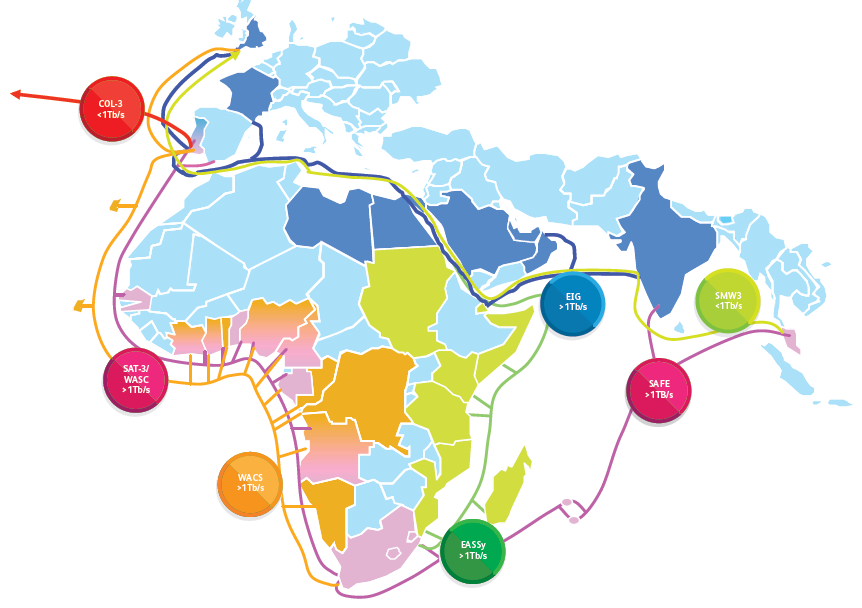
West
cable landings
SAT-3/WASC - SA - MLK, Angola, Gabon, Cameroon, Nigeria, Benin, Ghana, Ivory Coast, Senegal, Canary Islands, Portugal
COL3 - Portugal, USA
WACS - SA - YZF, Namibia, Angola, DRC, Congo, Cameroon, Nigeria, Togo, Ghana, Ivory Coast, Cape Verde, Canary Islands, Portugal, UK, London POP
East
cable landings
EASSy - SA - MZN, Mozambique, Madagascar, Dar es Salaam, Tanzania, Kenya, Somalia, Djibouti, Sudan
EIG - India, Oman, UAE, Djibouti, Saudi, Egypt, Libya, Monaco, France, Gibraltar, Portugal, UK, London POP
SAFE - SA - MLK, SA – MZN, Reunion, Mauritius, India, Malaysia
SMW3 - Malaysia, India, Middle East, Europe
Our consumer business
Our greatest challenge in both Telkom Consumer and Telkom Business remains the derisking of our business by countering the decline in our fixed-line voice revenues with growth in our revenues from mobile and data services in a highly competitive and aggressive pricing environment.
Our consumer business had three priorities for the year under review. These were to:
- Grow our revenue base
- Improve our customer experience
- Manage our cost base
Growing our revenue base
Ensuring a sustainable and winning position for our mobile services
We integrated our fixed and mobile businesses into one consumer business with the aim of taking out cost duplication and promoting convergence.
We needed to ensure a sustainable and winning position for Telkom Mobile. We delivered well against our mobile plan, exceeding our targets by achieving a 21.2 percent increase in mobile subscribers, increasing the minutes used by 79 percent and growing data usage by 70 percent.
During the year we also managed to influence a steep decline in the cost of interconnection services with the regulator.
Improving the performance of our fixed-line business
Our focus on growing our fixed-line revenue through enhanced value propositions achieved growth of
7.4 percent in residential DSL subscribers and a nine percent growth in our Internet subscribers. We also
achieved a net increase of 12 percent in revenue from our fixed business. The convergence of our product
offerings would appear to have assisted with the improvement in the performance of our fixed business
with customers using mobile and fixed services having increased 101 percent over the year.
Delivering the next generation of broadband services
During the year our delivery of the next generation of broadband services to an ever-increasing number
of South Africans resulted in a 7.4 percent increase in our ADSL subscribers. These services range from
entry level 2 Mgbs per second ADSL through to premium 20 Mgbs and 40 Mgbs very-high-bit-rate digital
subscriber lines (VDSL), LTE services (primarily as a fixed line with a Wi-Fi router) and most recently
100 Mgbs per second fibre to the home (FTTH). It was critical that we priced these products
competitively and ensured that there is coherence in our pricing portfolio between the various product
offerings.
The rollout of our next generation broadband services was well supported by a marketing effort that included local advertising, pop up shops and a focus on selling to gated communities.
Content and value-added services capability
Our marketing campaign aimed at getting customers and potential customers to associate Telkom with the provision of content, which was linked to a Multichoice Explora set-top box, did well, exceeding its target by 160 percent. It was particularly successful in creating brand and product awareness. Our research before the campaign showed that only 30 percent of the research sample saw Telkom as a provider of entertainment and content; after the campaign recognition of Telkom as a provider of entertainment and content had improved to 70 percent. Our progress with regard to establishing a content and value-added services capability for Telkom has been slower than we would have liked, but we are taking care to rather be right to market than first to market.
Convergence and bundling
Convergence of our product offerings is necessary if we are to provide a competitive service offering.
It has the advantage of offering our customers one seamless retail offering and it mitigates against the
deterioration in voice usage. Our research shows that over 21 percent of prepaid mobile customers prefer
integrated data products.
We made good progress with convergence and the design of our product offerings. Our summer 2014 campaign offered five different smartphone bundles, ranging from entry level to advanced through to premium and super premium. At the heart of these bundles was a fixed broadband service offering Internet connectivity, together with a voice service, a mobile data service and a range of applications and value-added services. Some offerings included customer premises equipment and the value-added services included educational content and Microsoft Office. We found that on average, customers who have moved from 3G to LTE use 36 percent more data.
Creating new ICT-focused businesses
 By working to identify and grow entrepreneurial opportunities across the ICT industry and within Telkom’s
supplier value chains, FutureMakers, which was launched post year end, will facilitate the growth of the
ICT sector, develop technology entrepreneurs, provide access to technology by increasing bandwidth
penetration and grow Telkom’s revenue. For more information on the FutureMakers programme see the
enterprise development section of Social and Relationship capital on page 87 of this report.
Managing our costs
We are phasing out a number of unprofitable products. A number of pay phones were also proving unprofitable, however, as the provision of pay phones is part of our licence obligation we had to negotiate reducing this service. We previously reduced pay phones from 90 000 to 45 000. This year we were able to remove additional unprofitable units and reduce the number of pay phones to 22 000. In terms of our licence agreement we are obliged to provide a pay phone service in hospitals and prisons.
We identified that we had 20 shops that were unprofitable, which we are closing down. In addition to closing down unprofitable shops we needed to improve the performance of our existing shops. During the year under review we have reduced our running costs and doubled the performance of our remaining shops.
Driving our Customer First programme
In order to build a team with Customer First competence we needed to understand how our customers experienced our service and identify the drivers of good or bad customer experiences. We undertook extensive research that helped us understand where our value chain is broken and what interventions we needed to put in place to fix it.
To improve our customer service we made extensive changes to our provision of Internet services. These included organisational, architectural and technology changes, as well as changes to our value proposition. We needed to make changes to how we manage faults. The results of a research survey carried out in the first quarter of 2015 indicate that the work we have done has exceeded our expectations as we have achieved an improvement in our customer service ratings in a year that we expected would take us two years.
We recognise, however, that we still have a long road to travel before we will be satisfied with the level of service we offer our customers, but we are making progress.
Our online channel was providing poor service to our customers. We have put considerable effort into rectifying this. Our offering is still not where we want it to be but it is a great deal better. In order to achieve the type of online experience we want to offer our customers we need to overcome certain system integration challenges.
Our contact centre plays a key role in the delivery of customer service. We were operating from nine different contact centre sites around the country, productivity was poor and so were our systems. We outsourced our contact centre to experts who specialise in the day-to-day management of contact centres and introduced new contact centre leadership. We shut down the old technology platform we were using in our fixed-line contact centre and transferred to a state-of-the-art system, which we were already using in our mobile contact centre. We also, as part of our integration of our fixed and mobile businesses, integrated our contact centres into one contact centre and have multiskilled our operators so they can support our customers on all our products. As was to be expected our service levels dropped during the changeover period, but they have picked up rapidly now that our new contact centre is bedding down.
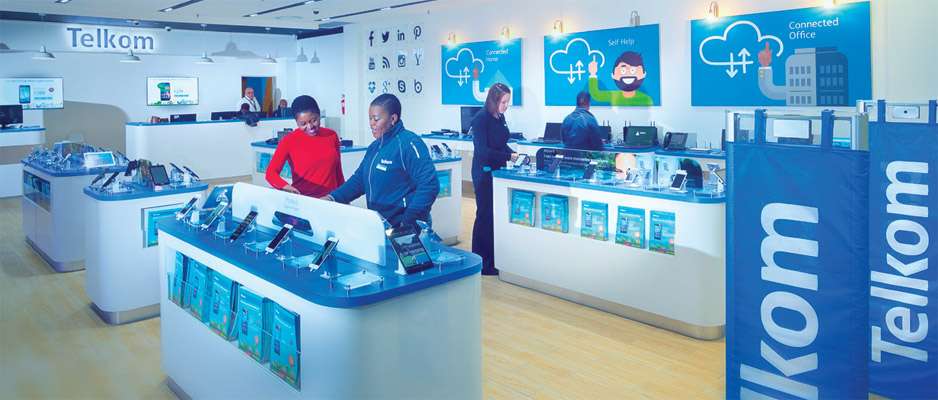
Our shops are also an important part of our interface with our customers. A great deal of work has been done to improve the customer experience in our shops and we are rebranding our stores, changing the layout and workflows to enhance the customer experience in our shops. The first of our shops to receive a rebranding was our shop in the Cresta shopping centre in Johannesburg.
Telkom Business
Telkom Business saw a slowdown in data connectivity revenue and a marked decline in voice usage during the year under review. The move away from legacy technology saw our revenue from Metro-ethernet increase 39.8 percent and revenue from business IT services increased 82.4 percent.
Our provision of managed data network services through Cybernest achieved a 13.8 percent increase in revenue. Cybernest’s data services include basic hosting with cooling, power and backup-power services, managed and fully managed hosting and disaster recovery services. The business has seven fully-fledged data centres, with those at Hartebeeshoek in Gauteng and Bellville 2 in Cape Town custom built to provide ultra-quick service to our enterprise customers. Bellville 2 is also among the most energy efficient facilities of its kind.
Through organic growth Cybernest has become a significant competitor in this market. During the year under review it gained a number of significant business clients and also had an exceptional year in the public sector.
Telkom Business introduced an industry-specific vertical approach to servicing our customers during the previous financial year. Our objective was to provide best practice tailor-made solutions for customers in specific industries, including the financial services sector, retail, the public sector, commerce and industry. We are a strong contender in all these sectors and in particular in the financial services sector where three of the four biggest banks use Telkom almost exclusively as the communications service provider. We have also made good progress in the provision of e-services to government with a strong focus on education and health care.
Our plans to expand our ICT capability through inorganic growth will strengthen the core of our business offering with the right ICT services and increase our competitiveness through an integrated cohesive approach to the market.
Business mobile
Our mobile business offering has done well, doubling revenue, beating its targets and gaining some major corporate customers. It has, however, had service challenges during the year, which we are addressing.
Convergence and bundling in business
Our efforts to converge and bundle our product offerings and provide seamless end-to-end solutions for business have also proved most successful with our revenues from these solutions increasing 650 percent, albeit from a low base. Our converged business offerings, which are designed to meet the needs of SMMEs, corporates, international businesses and government, range from basic to complex solutions and include virtual private networks (VPN), voice, IT and cloud services, data networks and mobile technologies.
Fibre migration
We did so well with our sale of fibre to customers that we had a huge backlog, which marred our service delivery. We did, however, succeed in connecting 1 000 business customer sites to fibre during the year under review.
Addressing fixed-line voice decline
The decline in business voice revenue
remains a challenge, with the pressures on
pricing presenting the biggest hurdle.
This is in line with our global peers.
Business customer service
Most of our business customers say we
are too slow and too conservative, but we
have also had very positive feedback in
terms of our willingness to help, our focus
on customer care and delivering what we
promise, and being competitive. We have
also had large financial service companies
telling us that Telkom is ahead of the game,
agile and dynamic, which is what we are
working hard to achieve. We recognise
that we still have a considerable amount of
work to do to ensure that our sales force is
equipped to sell converged services.
Telkom Wholesale and Networks
Telkom Networks has been operating in a very challenging environment over the past 12 months competing with smaller providers that have much lower fixed costs than we have and are much more agile than we are. The competition is particularly fierce in the provision of fibre services. Competition is also coming from some of the over the top players (OTTS) such as Google, WhatsApp etc. We have had to ensure that our response to these challenges aligns with our strategy and where we want to position ourselves competitively.
Telkom Wholesale and Networks’ leased line revenues continued to decline as a result of self-provisioning by their customers.

A key feature of our competitive strategy has been our wholesale unit price reductions of up to 63 percent across our product range including wholesale fibre broadband access, IP Connect, Resell DSL, Metro-ethernet and SAIX dedicated access offerings.
Our R12 billion investment in our next generation high speed broadband network and OSS/BSS applications is aimed at driving the penetration of broadband, which will make it possible for our customers to grow the market. It is also an investment in the kind of connectivity that will drive meaningful change in South Africa.
Access to our new generation broadband access technologies, including fibre to the home and business and multi service access nodes (MSAN), is offered on an open-access basis to other Internet service providers. These are all aimed at delivering even higher speeds to the industry and driving demand among consumers for rich media content.
To address the need for access to the next generation network, by 31 March 2015 we had already laid passed 1 030 519 homes with next generation access (fibre to the curb); provided our wholesale customers with access to 20 Mbps, 40 Mbps and 100 Mbps in selected areas; increased the number of ports activated via MSAN by 103 percent to 964 196 active ports; and contributed to the upgrade of the Sat-3/WASC/SAFE submarine cable system. We were first with our LTE-A rollout and by 31 March 2015 had integrated 1 317 LTE sites.
Property portfolio
Having completed a top down strategic review of our property portfolio, which segmented our property portfolio into six diverse asset classes:
- Head office
- Exchange buildings
- Mast and towers
- Warehousing and logistics
- Retail outlets
- Vacant land
We identified opportunities to unlock financial value through the rationalisation and consolidation of our portfolio. We then developed a strategic plan designed to make more efficient use of space and reduce costs, while ensuring that our property portfolio is fit for purpose.
We started implementing our plan during FY2015 which included:
- Implementing workplace of the future office standards
- Consolidating our head office
- Selling excess land and building assets
- Reviewing our mast and tower portfolio
- Aggressively reducing our energy intensity
- Optimising our facilities management value chain
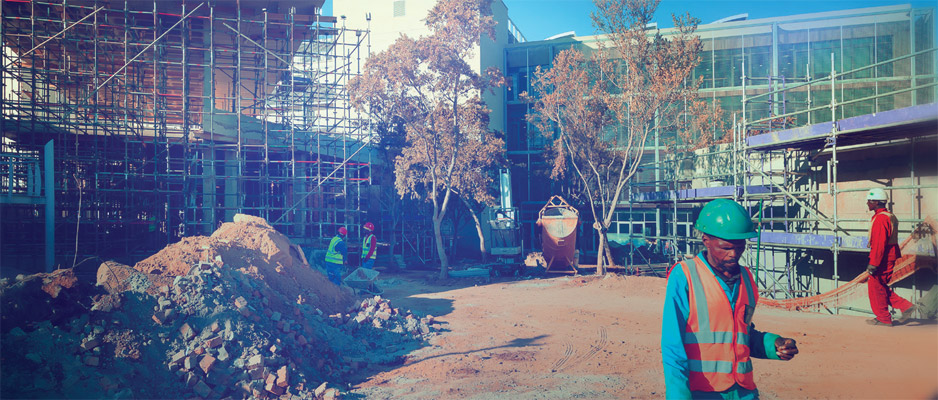
The move to our Centurion campus has allowed us not only to apply the international benchmark of providing nine square metres per head in an open plan configuration, but also to use this as an opportunity to bring the organisation closer together and reconnect the different parts of our business to achieve the collaboration and integration essential for the achievement of our strategic objectives. Creating a new campus has given us the opportunity to use the latest energy efficient technology and biometric systems. By getting rid of waste paper baskets beneath our desks, encouraging a minimum paper environment and providing recycling banks we aim to reduce, re-use and, most importantly, recycle our waste. We have also included a flagship mobile store on our new campus.