
Corporate governance
Our approach to governance
Telkom understands that a sound and robust approach to group corporate governance standards throughout our organisation requires a focus on performance as well as conformance. We also recognise that strategy, performance, sustainability and risk are inseparable. Through our strategic objectives we pursue the long-term sustainability of Telkom’s business. We establish clear lines of accountability for these objectives from board level down.
Our primary objective is the creation of value for all our stakeholders through the provision of innovative customer and market-focused solutions. At the same time we are committed to the highest standards of governance and we strive to embed a culture that values and rewards exemplary ethical standards, personal and corporate integrity, as well as respect for others.
 To ensure we consistently practise effective
corporate governance throughout the
group, our board applies the principles of
King lll. In terms of the King lll principles
the board must consider the concerns
and priorities of its wider stakeholder
environment in its strategic guidance and
decision-making processes. A table setting
out our application of the principles of
King lll is available on our website at
www.telkom.co.za
Telkom’s commitment to good corporate citizenship and sustainable development was recognised when it was included in the JSE Socially Responsible Investment (SRI) Index in 2014. The review conducted by the JSE of companies in the FTSE/JSE All Share index is carried out against a holistic set of environmental, social, governance (ESG) and related sustainability concerns and a fourth area of climate change.
Our governance framework


Leadership and effectiveness
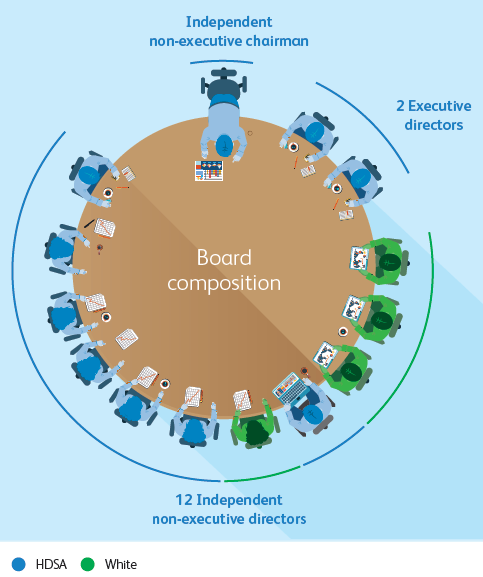
 The Telkom group has a
unitary board structure.
The majority of its members
are independent non-executive
directors.
There are 14 directors
in total, 12 of whom are
considered independent and
two executive directors.
Brief biographies of the
directors are set out on
pages 37 and 39 of this
report. The size of the board
is appropriate given the
complexity of the Telkom
business and the time
demands placed on non-executive
directors.
 By appointing strong,
independent directors to
our board and separating
and clearly defining the roles
and responsibilities of the
chairman and the group chief
executive officer, Telkom
believes it has equipped
its board to make the right
decisions in the right way.
Our board performs its duties within a framework of policies and controls, which provide for effective risk assessment and management of our economic, environmental and social performance. The Telkom board charter, which is closely aligned with the recommendations of King lll, details the responsibilities of the board. Our memorandum of incorporation (MOI) also addresses certain of the directors’ responsibilities and powers.
The board governs through clearly mandated board committees, accompanied by appropriate monitoring and reporting systems. All the board committees operate under board-approved terms of reference, which are reviewed annually to keep them aligned with current best practice. Our board committees are all chaired by independent nonexecutive directors who attend our annual general meeting to respond to any shareholder queries. The mandates, charter and terms of reference governing the board and its committees are available from our company secretariat.
Brief written reports of the meetings of all committees, prepared by the respective chairmen, are included in the papers submitted to board members in advance of the next board meeting and all committee chairmen report orally on the deliberations and activities of their respective committees at the next meeting of the board.
The audit and social and ethics committees are statutory committees in terms of the Companies Act and operate as recommended by King lll. Shareholders are required to elect the members of the audit committee at the company’s annual general meeting. While the social and ethics committee is a statutory committee its members are appointed every year by the board at its first meeting following the annual general meeting.
The board’s size and the required mix of skills and experience needed to provide strategic direction and leadership are regularly reviewed by the nominations committee. The board’s composition is also reviewed annually to ensure it is representative of the demographics of South Africa.
An independent review of the board’s performance was conducted by a consulting firm, specialising in the assessment of senior leadership, during FY2015. The review was conducted by means of a questionnaire sent to all directors, which was followed up by face-to-face interviews. In addition, the lead external audit partner who interacts frequently with the board and its audit committee provided input. The consultants found that it was remarkable, given the relatively short period the board had been working together, that the board had achieved a level of effectiveness that one would typically only expect from a board that had been working together over many more years. They attributed this to the leadership of the chairman, who is viewed as a strong and inclusive leader who guides debate with a fair hand. He is also seen as being accessible, engaged and committed. They found that the board’s effectiveness can also be attributed to the complementary skillsets of the board members, their collegiality, commitment to the business and a shared sense of purpose and urgency. The consultants reported that the group chief executive officer’s firm leadership of a skilled executive, together with his open and proactive demeanour, has also had a significant positive impact on the board.
Delegation of authority in Telkom

 See page 114 of our Approach to risk management.
Delegated authorities
The board has a formal schedule of matters reserved for its consideration and decision, which include, among others, approving:
- Strategy
- Business plans and budgets
- Financial statements
- Significant acqusition and disposal of assets
- Executive directors’ appointment and remuneration
- Dividend policy
- The integrated report
- Capital expenditure for investment
- Granting of varying authority levels
The board also reviews and approves significant group-wide policies and frameworks including social, ethics and sustainability policies.
 Its delegation of certain matters to its committees is described
in the terms of reference of these committees. The roles and
responsibilities of the board’s committees, which include the audit,
risk, remuneration, nominations, investment and transactions, and
social and ethics committees are set out on our website
(www.telkom.co.za). The board has also appointed a chief risk officer
to whom it has delegated responsibility for risk management,
sustainability and stakeholder management, which has been
integrated into our existing ERM framework. In addition, the board
has delegated some of its responsibilities in terms of stakeholder
engagement to the executive: investor relations and the managing
executive: corporate affairs.
The group chief executive officer is responsible for formulating and recommending to the board long-term strategies and policies and, through the approved framework of delegated authority, ensuring their implementation. In discharging his duties he is assisted by the executive committee.
The board sets the strategic direction for the group, determines policies, agrees performance criteria and delegates to management the detailed planning and implementation of the group’s strategic objectives and policies, in accordance with appropriate risk parameters. It also plays an important role in setting ethical standards of conduct. The board also monitors compliance with policies and achievement against objectives by holding management accountable for its activities through quarterly performance reporting and budget updates. In addition, the board receives regular updates from the business and functional units, enabling it to explore specific issues and developments in greater detail.
All board members are equally accountable for the proper stewardship of the affairs of the group. The non-executive directors have a particular responsibility for ensuring that the business strategies proposed are fully discussed and critically reviewed and that the interests of stakeholders, and in particular shareholders and employees, are considered. This stewardship includes the fostering of business relationships based on trust with customers, suppliers and others and considering the impact of our operations on the environment and on the communities in which we operate.
Our non-executive directors meet regularly without the executive directors being present. These meetings give them an opportunity to discuss management performance and other business or concerns that they might have, without the presence of the executive directors.
During the financial year under review the board received reports from the:
- Group chief executive officer on strategic progress, matters considered by the executive committee and stakeholder engagement
- Chief financial officer on the group’s financial position
- Chief risk officer on enterprise risk management
- Chief of human resources on union engagements, employee remuneration and employee wellness
- Business units or functional areas on progress against strategy
The board also received and debated reports on issues relating to governance and peer group comparisons, and considered certain transactions proposed to it by the group chief executive officer.
The board held additional special board meetings during the year under review to consider the rationale regarding several new strategic initiatives and projects and to agree our turnaround strategy. Decisions were made following rigorous debate during which the long-term interests of our shareholders and other stakeholders were taken into account and the seeking of external advice on certain issues where this was deemed appropriate.
Appointment of new directors
When we appoint new directors they receive formal and informal induction related to the group and their duties as directors of Telkom. We also provide our directors with ongoing support and resources that allow them to develop and refresh their skills and knowledge regarding their roles as directors of Telkom, which include any changes to legislation or regulations and briefings on market developments. The directors have unrestricted access to executive and general management in order to acquire any knowledge or information relevant to the discharge of their duties.
Directors’ conflict of interest
In terms of the Companies Act, JSE Listings Requirements, King lll and the board charter, a director of a company must avoid a situation in which he/she has, or can have, a direct or indirect interest that conflicts, or possibly may conflict with the interests of the company. The board has established procedures to enable the directors and prescribed officers of Telkom to notify the group of any actual or potential conflict situations and to declare any significant interest in the group or its contractors.
Rotation of directors
In terms of the group’s memorandum of incorporation, one third of our directors are required to retire from office at every annual general meeting. We select the retiring directors based on their tenure since they were previously elected or re-elected to the board.
Company secretary
The Telkom group company secretary is responsible for administering the proceedings and affairs of the directorate, the group and, where appropriate, owners of securities in the group in accordance with the relevant laws. The group company secretary, who is the secretary for all the board’s committees, is available to assist all our directors with advice on their responsibilities, their professional development and any other relevant assistance they may require.
Xoliswa Mpongoshe, the duly appointed group company secretary until her resignation in June 2015, was not a director of Telkom and on that basis the board is comfortable that she maintained an arm’s length relationship with the executive team, the board and the individual directors in terms of Section 3.84(i) of the JSE Listings Requirements. There was no interference by the board with regard to her performance pertaining to corporate governance. The board, having assessed her abilities based on her qualifications, experience and the level of competence she demonstrated as Telkom’s group company secretary, as required in terms of Section 3.84(I) of the JSE Listings Requirements, agreed that she was sufficiently qualified, competent and experienced to act at Telkom’s group company secretary.
Nwabisa Piki is the duly appointed acting group company secretary. She is not a director of Telkom and on that basis the board is comfortable that she maintains an arm’s length relationship with the executive team, the board and the individual directors in terms of Section 3.84(i) of the JSE Listings Requirements. There is no interference by the board with regard to her performance pertaining to corporate governance. Nwabisa has taken on the role of acting company secretary as an interim measure following the resignation of the group company secretary with effect from 30 June 2015 until the appointment of a new group company secretary. The board is comfortable that Nwabisa Piki is sufficiently qualified, competent and experienced to act as Telkom’s group company secretary during this interim period, which includes the annual general meeting of the group in August 2015.
The board and its committees
| Committee attendance | ||||||||||||
| Name of director and status | Date appointed |
Board attendance |
Audit | Remu- neration |
Nomin- ations |
Investment and transactions |
Social and ethics |
Risk | ||||
| Independent non-executive directors | ||||||||||||
| JA Mabuza (Board and nominations committee chairman) |
Nov 2012 | 8/8 | 4/4 | 3/3 | 2/9 | |||||||
| I Kgaboesele (Chairman audit committee) | July 2011 | 7/8 | 6/6 | 2/3 | 9/9 | 4/4 | ||||||
| KW Mzondeki | Nov 2012 | 8/8 | 6/6 | 4/4 | ||||||||
| LW Maasdorp | Nov 2012 |

|
2/4 | 3/3 | 2/2 | 1/1 | ||||||
| SL Botha (Chairman remuneration committee) | Dec 2012 | 8/8 | 4/4 | 3/3 | ||||||||
| LL von Zeuner (Chairman risk committee) | Dec 2012 | 7/8 | 5/6 | 5/5 | 4/4 | |||||||
| K Kweyama (Chairman social and ethics committee) |
Dec 2012 | 7/8 | 3/4 | 3/3 | 5/5 | |||||||
| F Petersen-Lurie (Chairman investment and transactions committee) |
Dec 2012 | 7/8 | 4/5 | 5/5 | 3/4 | 4/4 | ||||||
| CA Fynn | Dec 2012 |
|
6/6 | 6/6 | 4/4 | |||||||
| RG Tomlinson | Dec 2014 |

|
2/2 # | 1/1# | 1/1# | |||||||
| GW Dempster | Dec 2014 |
|
2/2 # | 1/1# | 0/1 | |||||||
| T Dingaan | Dec 2014 |
|
2/2 # | 1/1# | 1/1# | |||||||
| N Ntshingila | Dec 2014 |
|
2/2 | 1/1# | ||||||||
| N Kapila | Feb 2011 | 8/8 | 9/9 | 1/1# | 3/4 | |||||||
| Executive directors | ||||||||||||
| SN Maseka | Apr 2013 | 8/8 | 8/9 | |||||||||
| DJ Fredericks | Sep 2014 | 8/8 | ||||||||||
| JH Schindehütte | Aug 2011- |

|
*+ | |||||||||
| Aug 2014 |
|
|||||||||||
|
|
* | On suspension with effect from 24 October 2013 | ||||||||||
|
|
+ | No longer a director | ||||||||||
|
|
# | Attended all meetings following their appointment | ||||||||||
Board committees
For information on the committees’ terms of reference please refer to the board committees section on our website (www.telkom.co.za).
Audit committee
The group chief executive officer and the chief financial officer attend the audit committee by invitation.
The main responsibilities of the audit committee include:
- Evaluating the system of internal control and management of risks
- Overseeing activities of the group’s internal audit function
- Reviewing the integrity of the financial statements
- Reviewing the group’s accounting and financial reporting processes
The committee’s oversight role requires it to regularly address the relationships between management and the internal and external auditors and to understand and monitor the reporting relationships and tiers of accountability between them.
“I have direct access to the chairman of the audit committee. The committee supports my efforts of making sure that management responds to our findings.”
Mohammed Dukandar, Group executive: internal audit
During the year, in carrying out its oversight role the committee:
- Considered the key information it would require during the coming year to enable it to properly discharge its responsibilities
- Reviewed the integrated report and accounts, half-year results and interim management statements
- Considered group level control issues of significance to different areas of the business
- Received reports on the control environment in each of the business and functional areas
- Considered the independence and effectiveness of the group’s internal and external auditors
- Approved the re-appointment, remuneration and engagement letter of the group’s external auditor
- Considered the provision of non-audit services by the group’s external auditor
- Received reports from the internal and external auditors
- Considered the effectiveness of the group’s internal controls over financial reporting
- Reviewed its terms of reference to satisfy itself that they enable the committee to fulfil its responsibilities
- Conducted training under the continuous development programme for directors
Nominations committee
The committee held three meetings during the year. The group chief executive officer attends committee meetings by invitation.
During the year ended 31 March 2015, the nominations committee dealt with the following matters in addition to its normal annual work programme:
- The recommendation to re-elect or not re-elect directors who were retiring by rotation
- Upon the resignation of the chief financial officer, recommended the appointment of the acting chief financial officer to chief financial officer
- Considered the adequacy of the balance of skills, experience, gender and qualifications of the board
- Assisted the board with its performance evaluation process
- Assisted the board in dealing with instances of conflicts of interest in relation to individual directors
Remuneration committee
The main purpose of the remuneration committee is to ensure the adoption of remuneration policies which aim to attract and retain top talent, are aligned with the group’s strategy and drive performance in the long and short term. During the year under review the committee:
- Ensured that the remuneration strategy is market related and competitive
- Determined specific remuneration packages for senior executives of the group
- Considered the relationship between senior executive remuneration and the remuneration of Telkom’s other employees
- Considered and recommended to the board the fees to be paid to non-executive directors for their services on the board and its committees
- Ensured that disclosure of director remuneration is accurate, complete and transparent
- Reviewed and monitored progress in people management
- Reviewed the terms of reference and activities of subsidiary companies and joint venture remuneration committees
Social and ethics committee
During the year ended 31 March 2015 the social and ethics committee dealt with the following matters in addition to its normal annual work plan:
- The approval of the ethics management framework and the ethics management plan to assist with the embedding of ethics in the group culture
- Implementation and monitoring of compulsory ethics online training for all employees
- Reviewed the report on matters reported in terms of section 34 of the Prevention of Corrupt Activities Act
- Monitored the fit for the future programme that deals with the restructuring of the group, and the section 189 and section 197 processes in terms of the Labour Relations Act
- Reviewed reports relating to stakeholder management
- Reviewed sustainability matters relating to: energy management and energy target setting, the carbon disclosure emissions report and B-BBEE verification
- Reported, through one of its members, to the shareholders at the group’s annual general meeting on the matters within its mandate
Investment and transactions committee
The primary purpose of the investment and transactions committee is to review and recommend to the board any investment decision appropriate to the group’s strategy, gearing and risk appetite. For purposes of clarity, all investment decisions are discussed and recommended to by the executive committee (Exco) prior to approval by the investment committee.
Risk committee
 The main purpose of the risk committee is to assist the board in
ensuring that management has an effective risk management
process that identifies and monitors the management of the key
risks facing the group in an integrated and timely manner. For more
detailed information on risk management in Telkom please refer
to our approach to risk management on pages 112 to 116 of this
report and our enterprise risk management (ERM) achievements in
FY2015 and our future ERM plans on page 28.
Risk management
The risk management system
The risk management system is an integral part of management’s approach to delivering business objectives and is a systematic process designed to identify, assess, treat, manage and communicate risks.
Risks are recorded in regularly updated risk registers operating at all levels of the organisation and are continuously reviewed and monitored. The risk management process places significant emphasis on learning from and sharing prior experience. The system provides methods for escalation and delegation to the appropriate levels within the organisation and ensures that actions are owned, defined, resourced and effective.
Risks may arise from a variety of internal and external sources. They may be associated with regulations, customer requirements and competitor actions, or could result from the capability of the processes used to execute the business, or from external and largely unpredictable events.
Risks, irrespective of source, are managed through processes operated by business and functional area teams. The corporate risk register is updated and reviewed by the risk committee twice a year so that the board may then consider and review these risks in terms of their potential impact. Management continues to perform comprehensive risk reviews for all key projects, programmes, change management processes and business plans.
Management continues to perform comprehensive risk reviews for all key projects, programmes, change management processes and business plans.
All the processes operated by the group are subject to continuous improvement, including the risk management process itself. Development and deployment of the process is the responsibility of a dedicated enterprise risk management team. The team has created a comprehensive framework for the assessment of risk management maturity at all levels throughout the organisation, enabling focused improvement actions and driving consistent application of the risk management process throughout the group.
 An integrated range of tools and training and
education programmes underpins the risk
process. Deployment of an enterprise-wide risk
management software application enables the
analysis, management and communication
of risks across the business. A network of risk
champions helps to develop, embed and share
best practice throughout the organisation.
We refer you to our approach to risk management
on pages 112 to 116 for more detailed
information on our enterprise risk management.
Directors’ responsibility for internal control
The directors are responsible for the group’s system of internal control and for maintaining and reviewing its effectiveness from both a financial and an operational perspective. The system of internal control is designed to manage, rather than eliminate, the risk of failure to achieve business objectives and to provide reasonable but not absolute assurance against material misstatement or loss. The group’s approach to internal control is based on the underlying principle of line management’s accountability for control and risk management.
In reviewing the effectiveness of the system of internal control, the board has taken into account the results of the work carried out to audit and review the activities of the group.
Telkom has an ongoing process in place to identify, assess and manage risk, including those risks affecting the group’s reputation. This process is subject to continuous improvement and has been in place throughout the financial year to which these statements apply and up to the date of their approval.
The board has reviewed the risk management process and confirms that ongoing processes and systems ensure that the group continues to apply the recommendations of the King Code of Corporate Governance.
Systems of internal control
The executive committee members responsible for individual business or functional areas are aware of their responsibility to operate systems of internal control that provide reasonable assurance of effective and efficient operations, reliable financial information and compliance with laws and regulations. The group has a comprehensive budgeting system with an annual budget approved by the board. Revised forecasts for the year are reported at least quarterly. Actual results are reported monthly against budget and variances reviewed.
The activities of the group are subject to review by internal audit, including business assurance, product introduction, life cycle management and the assurance functions.
Telkom audit services has a risk-based approach to its financial and operational audits and reviews which are agreed by the audit committee. The programme includes independent reviews of the systems of internal control and risk management. The findings and the status of corrective actions taken to address these are reported in writing to both the audit and risk committees quarterly.
Organisational structure
The group has a clearly defined organisational structure within which operational management has detailed responsibilities and levels of authorisation, supported by written job descriptions and operating manuals.
Independent assurance providers
A key element of the system of internal control is the review conducted by independent assurance providers who assess the adequacy and effectiveness of the controls. These independent assurance providers are outlined in more detail below.
Internal audit
The internal audit function provides independent assurance on the adequacy and effectiveness of the system of internal controls in place to manage the significant risks of the business down to an acceptable level.
Internal audit also engages proactively with management to drive meaningful and sustainable improvement in the control environment. This is achieved by using specialist risk and control knowledge to provide practical recommendations to improve the design of and compliance with key controls.
The annual audit coverage plan is developed applying a risk-based approach and is reviewed and approved by the audit committee. It is revised regularly to ensure that it remains relevant to the key business priorities and changing risk environment. Key audit findings are reported to the audit committee quarterly. Progress in addressing these is audited quarterly and items are reported to the committee until they have been satisfactorily resolved. This enables the committee to ensure that prompt action has been taken to address the key areas of concern.
Internal audit retains its objectivity and independence by reporting functionally to the audit committee and administratively to the chief financial officer. The internal audit group executive attends both the audit committee and risk committee meetings by invitation.
The internal audit team has a combination of skills and expertise which include operational, financial, accounting and information technology experience and knowledge.

External audit
Ernst & Young Inc., the external auditors, provide stakeholders with an independent opinion on whether the annual financial statements fairly present, in all material respects, the financial position of the group and company, the group and company financial performance and the group and company cash flows.
External audit regularly liaises with internal audit to understand the scope of its work and the results of its audits. External audit predominantly follows a more control-based audit approach, thus reducing substantive testing. Any control work performed by external audit is limited to the work necessary to support its audit opinion.
Corporate governance policies
To drive and embed effective corporate governance practices, the group has a number of policies which complement the delegation of authority. These include:
- Board charter and committees’ terms of reference
- Conflicts of interest policy
- Insider trading policy
- Disclosure policy
- Business code of ethics
Insider trading, disclosure policy and conflicts of interest policies
The board recognises its responsibility for ensuring that there are appropriate policies in place to manage the confidentiality of price-sensitive information and to ensure that individuals do not benefit from inside information. To manage this, the group has insider trading and price-sensitive information policies, the terms of which are more restrictive than those required by the JSE Listings Requirements.
The group company secretary regularly disseminates written notice to all directors and executive management throughout the group, highlighting the provisions of the Financial Markets Act and JSE Listings Requirements and informing them that dealing in Telkom shares during certain restricted periods may not be undertaken. No director or any employee who participates in the share scheme may trade in Telkom shares during restricted periods as defined by the JSE Listings Requirements, the share scheme rules and determined by the board. In addition, no director of the group may trade in the group’s shares without prior approval having been obtained. Trading in shares by any employee and/or director in possession of unpublished pricesensitive information is strictly prohibited.
Directors and employees involved in projects which are price sensitive in nature are required to sign confidentiality agreements and are restricted from trading in shares.
The conflicts of interest policy requires senior management to declare details of their business interests and confirmation that they are in compliance with the requirements of the policy. The disclosure policy ensures that disclosures about the group’s activities meet relevant statutory and listings requirements.
Ethics
We believe in ethical business conduct and have a zero tolerance approach to corrupt behaviour. We require all our representatives to act in good faith and in a manner that promotes our aspiration to be a good corporate citizen. The issue of corporate ethics receives attention from the highest level of management within Telkom, with our group chief executive officer being ultimately responsible for implementing our code of ethics. We also require all our suppliers to acknowledge and confirm in all supply contracts that they have read and understood our code of ethics and agree to be guided by it in terms of their actions and behaviour.
Telkom applies the principles of King lll, which is essentially about effective leadership based on an ethical foundation. We are committed to the highest ethical standards in conducting our business. Our ethical values and principles reflect our belief that our conduct in doing business should rest on an ethical foundation.
Solid governance structures and ethical leadership build the group as a responsible corporate citizen, promoting shareholder and stakeholder confidence in the sustainability of the group.
The group has a set of values that guides the manner in which it conducts business with its stakeholders. Our code of ethics supports these values and sets out the standards that we expect to attain when dealing with all customers, suppliers, business partners, employees, competitors, communities and our shareholders. In addition, the code contains guidelines with respect to gifts, travel and entertainment as well as a code of conduct for our business partners.