Telkom SA SOC Limited
Integrated Report 2017
For the year ended 31 March 2017
Performance

Human capital
Our philosophy is that our people are our number-one asset and having the right talent in the right place at the right time will determine Telkom’s ability to execute our strategy sustainably.
Human capital management strategy
Our human capital management strategy guides our focus areas, and our employment policies ensure our approach adheres to global best practice and upholds critical principles such as those described in the UN Universal Declaration of Human Rights, the UN Global Compact, and the International Labour Organisation’s Declaration of Fundamental Principles and Rights at Work.
How we deliver on our strategy is guided by our capability management and talent management frameworks.
During FY2017 we:
- upheld the right of our employees to freedom of association and collective bargaining
- provided equal opportunities to potential and existing employees
- achieved a diversified workforce that reflects the demographics of our country
- provided a workplace based on:
- mutual respect
- fairness
- integrity
- non-discrimination
- equal opportunities at all levels
- open and two-way engagement with our employees and their representatives
- consulted with the affected parties, including management, employees and trade unions
Although good progress has been made in FY2017, we need to focus on accelerating the prioritised five change areas over the next 18-24 months to drive sustainable change.
| Human capital dimensions | |||||||||||||||
 STRATEGY Accelerate and Evolve |
 POLICY and CULTURE Unfreeze and Invigorate |
 TALENT and LEADERSHIP Fill the Gap |
 PERFORMANCE Shift to Achievement |
 OPERATIONAL ENABLEMENT Simplify, Digitise, Automate |
|||||||||||
| No regret priorities | |||||||||||||||
| Business critical | |||||||||||||||
| 1.1 Human capital strategy |
2.1 Human capital policies definition |
3.1 Critical and scarce skills talent plan |
4.1 Performance achievement shift |
5.1 Human capital process simplification and digitisation |
|||||||||||
| 1.2 Business unit HR strategies |
2.2 Employee journeys, values and behaviours definition |
3.2 Leadership development and succession planning |
4.2 Adoption of Performance Pays |
5.2 Cloud-based modules |
|||||||||||
| 1.3 Cost reconfiguration |
2.3 Unfreeze programmes |
3.3 People investment platform |
4.3 Exit and retention pathway programmes |
5.3 Single-truth reporting and analytics platform |
|||||||||||
| 1.4 Structural accountability refinement |
2.4 Diversity and inclusion operationalisation |
3.4 Agile fulfilment model |
4.4 Performance metrics alignment |
5.4 Optimised third-party management |
|||||||||||
| 1.5 HR functional integration and transition management |
2.5 Three-year culture transformation journey |
3.5 Coaching and mentoring adoption |
4.5 Cross-business unit rewards normalisation |
5.5 BCX transition and system on-boarding |
|||||||||||
Talent management framework
The new talent management framework enables us to identify critical skills and key talent across various business units, and allows us to invest properly and thoughtfully into developing our people. In FY2018 we will aim to further embed this framework, making it an integral part of how we operate.
During the second half of the financial year, this approach was rolled out to all business unit leadership teams and their direct reports. As such, a clear view of just over 300 senior leaders in the business was gained. This assisted in the mitigation of talent risk by:
- safeguarding senior leadership roles through deep succession pipelines, including the identification of emergency replacement plans per role
- providing insight to risk and impact of loss of key talent
- identifying next development moves for identified successors and top talent
- ascertaining action plans for critical roles per business unit (build internal, borrow consultants, hire new people)
- industriously managing misaligned talent (performance improvement)
A key outcome of the talent management framework is career development plans aligned to personal career aspirations and the business’s needs. Conversations about talent between leaders and their direct managers help inform the individual’s career and development plans, ensuring alignment with business requirements.
In order to achieve our objective of attracting, developing and retaining talent, we need to:
- ensure a continuous talent rhythm is adopted across the business
- invest in high-potential diverse talent, ensuring readiness to assume future leadership roles
- leverage off talent insights to use key talent in line with business needs
FY2017 focus areas

Talent attraction
Bright Young Minds
Our BYM programme offers an innovative, disruptive recruitment approach that proved successful in selecting forward-thinking, visionary interns. The internship is advertised on digital and social media, and potential candidates can apply by completing knock-out challenges and a YouTube video response to a business challenge. Following this, candidates participate in an intensive three-day selection process that includes a presentation to exco.
The culmination of our 2016 inaugural BYM programme led to the permanent placement of seven interns into the business with effect from 1 March 2017. In their permanent capacity, these interns are structured as an internal consultancy unit to provide innovative thinking and millennial perspective to key strategic projects across the business. The unit, housed under the chief of human resources, assists in ensuring enhanced concentration of the BYM skills and focus on project delivery and execution.
Future Minds
Round two of our graduate internship programme adopted an anonymous gamified digital challenge targeting millennials across a variety of digital platforms. This year’s programme, branded Future Minds, experienced a 23 percent performance increase, with in excess of 47 000 hits to our application site. Candidates gained access to the application process by completing of a brainteaser; applicants then attempted a number of increasingly high-intensity online challenges and completed a 60-second video clip business challenge. 17 applicants attended the three-day selection boot camp.
Eight individuals presented their innovative business responses to an exco panel. All eight candidates were successful and seven, aged 23 to 27 years, accepted the 12-month internship opportunity and started on 1 March 2017. The candidates, with qualifications in economics, law, medicine, investment management, financial management, mathematics and mechatronics engineering, are allocated to key, primarily digital, strategic projects across the Telkom group.
The internship programme contributes to Telkom’s business strategy, bringing unique and fresh thinking to problem solving, strategic projects and new business development.
| Our Future Mind Dike Phatudi (24) |
Our Future Mind Summaiyah Adamjee (27) |
|
 |
 |
|
|
|
As part of our focus on empowering the youth of our country, we supported learnerships and internships for employed and unemployed young black people.
The creation of a future talent pipeline to address the IT and digital skills gap includes a significant investment that Telkom, through its wholly owned subsidiary BCX, is making to support coding and programming skills development. We do this by partnering with institutions such as WTC, that provide skills for the youth in this field.
WeThinkCode (WTC)
WTC is a non-profit social enterprise that provides tuition-free peer-to-peer learning. The core mission is to source and develop the next generation of digital talent, aimed at students who are 17 to 35 years old, regardless of previous education, socio-economic background or financial means. The students solve real-world problems and are funded through partnerships with BCX.
The three-year partnership with WTC includes an investment of R60 million over the period beginning in 2016. There is an agreement that there will be geographic expansion to Cape Town within the three-year period, in order to extend the reach of the programme. The total number of students is expected to increase to approximately 600 or more by the end of the three years.
The programme will give the group the scale to significantly grow and directly benefit from the students’ coding skills.
The investment also allows Telkom to stimulate the technology industry through:
- potential partnerships on research and development laboratories:
- gaming/virtual reality lab in Johannesburg
- data science lab in Cape Town
- BCX becoming a growth partner
- students solving real-world problems
- access to talent for Telkom and BCX partners
- leveraging investment to achieve scale as we grow in innovation
Refer to the human capital supplementary report available online for case studies.
Talent development
Step Up
The Step Up programme is aimed at developing top talent identified in Telkom. The outcome of the programme is to enhance the capability, knowledge and skills of Telkom’s future leaders.
The succession mapping process is an input of Step Up’s delegate selection.
Investing in high-potential talent
Centralised talent development Interventions
A focused approach to developing high-potential talent across each talent segment in line with specific business needs.

Female leadership development programme
Our FLDP contributes to the improvement of female representation at leadership levels and forms part of the broader succession planning process. The first group of 42 women will complete the programme in June 2017.
The objectives of the programme are to:
- build business knowledge by creating transdisciplinary/multiskilled leaders;
- create talent pools by identifying and growing high-potential talent in middle management for the succession pipeline;
- develop socially intelligent and accountable brand ambassadors by enabling an environment of mentoring and coaching to foster self-confidence;
- accelerate development by facilitating skills transfer and creating pockets of excellence;
- motivate, engage and retain key talent by enabling work/life integration and the experience of alternative career paths; and
- cultivate future leaders by building leadership capability across middle management and nurturing future leaders.
A few of the critical success indicators of the programme include:
- 42 percent of participants received promotions.
- one finalist and two semi-finalist FLDP participants were nominated in the Standard Bank Rising Star Awards 2016.
- candidates were 85 percent satisfied that the programme added value to their growth and development.
- 90 percent of participants successfully completed the FLDP to date.
The second FLDP was approved and 46 women are in the process of being presented for verification and approval. Refer to the human capital supplementary report available online for case studies on the FLDP.
Employee training and development
Telkom operates in a rapidly changing environment. To ensure we remain relevant, we are committed to develop our employees, both technically and personally. We provide a combination of classroom training and on-the-job training.
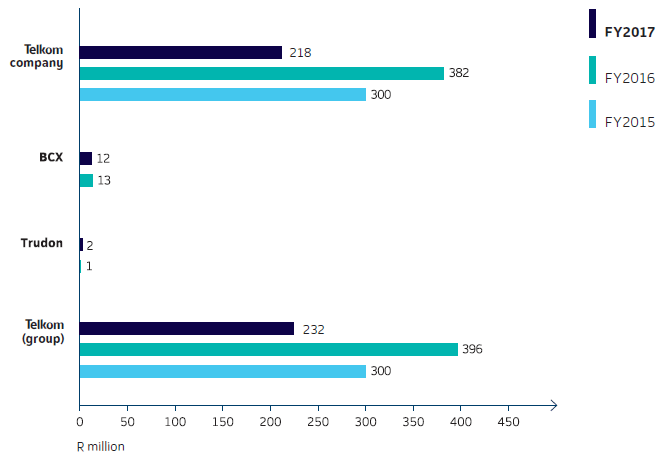
Telkom spent a total of R218 million on employee training and development, with each employee receiving an average of 38.45 hours of training. The decrease in training and development spend was largely a function of headcount reduction and the restructuring of our training programme.
Training and development spend
Deep succession plans
Succession maps were developed for 69 leadership roles. These include identification of emergency, short-term and long-term successors.
Focused and fast-track development plans for the identified successors will be implemented to ensure future readiness and manage future risk.
Impactful performance management
Telkom company has a new variable-based incentive scheme for bargaining unit employees, known as Performance Pays. Performance Pays focuses on customer satisfaction and productivity metrics, and replaces the current STI scheme, which is primarily driven by group financial performance.
This empowers and enables bargaining unit employees to be more in control of their own destiny and rewards, and gives more direct and clear linkage between individuals’ efforts and their monthly pay.
Relevant remuneration
Remuneration is discussed on page 108. This provides details of STI and LTI programmes for employees in addition to the Performance Pays initiative.
Workforce
In order to effectively and sustainably position our business for future growth, permanent employee headcount was reduced by 1 494 in FY2017. This year brought stability, at an employee complement of 18 847 (FY2016: 20 341).
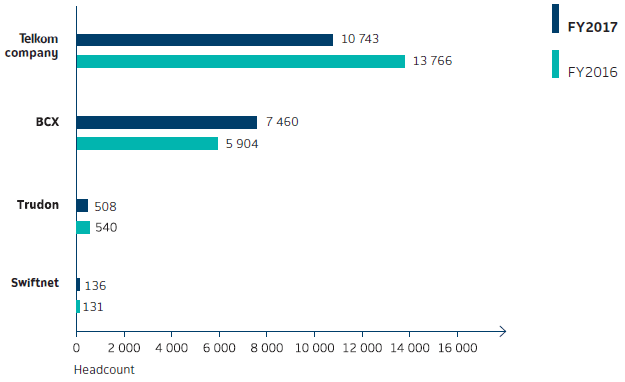
The 22 percent decrease in permanent workforce in Telkom company was primarily due to the transfer of 1 180 employees to BCX as well as the effect of the VERPs and VSPs offered.
Transformation
Transformation speaks to culture empowerment, diversity and respect.
Diversity and inclusion
Telkom believes that blending different cultures, experiences and perspectives in the work environment promotes innovation, improves our ability to tackle challenges, and creates a forward looking and engaged environment. Gender, age, race, culture, and disability are all elements that contribute to this. Our EE plan and disability policy, approved in July 2016, guides us as an equal opportunity employer.
Our female representation as a group reduced to 32 percent (FY2016: 42 percent) mainly due to VSPs and outsourcing. Even though at a group level the female representation reduced, BCX and Trudon increased female representation by 3 percent and 2 percent respectively.
Telkom group: Gender breakdown of permanent employees
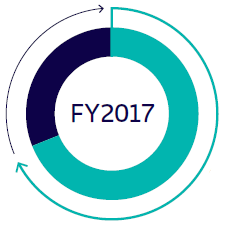
- 68%Men
- 32%Women
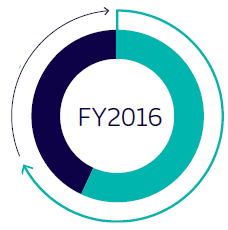
- 58%Men
- 42%Women
Our 2017 figures included BCX, which has operations outside of South Africa.
Telkom group: Racial breakdown of permanent employees
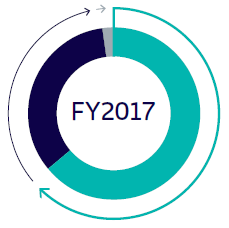
- 68%Black South Africans
- 34%White South Africans
- 2%Non-South Africans
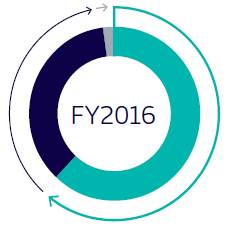
- 62%Black South Africans
- 36%White South Africans
- 2%Non-South Africans
The group employs 158 disabled people (2016: 209).
Occupation level breakdown of disabled employees
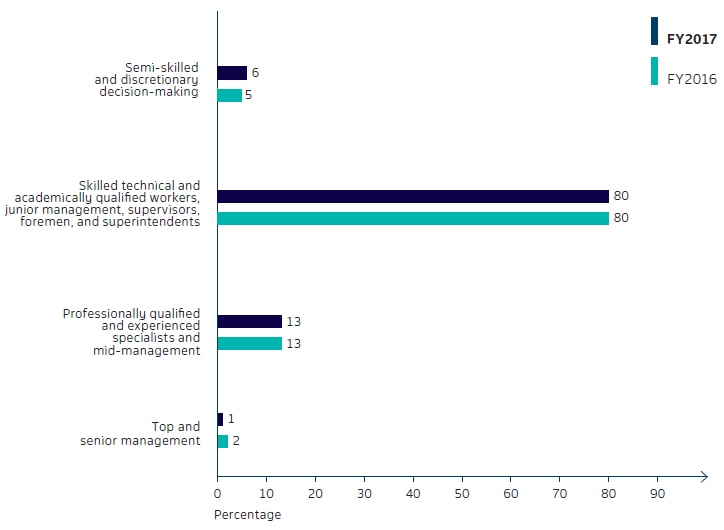
Total number of permanent BCX employees belonging to a recognised union for FY2017 was
15 percent (FY2016: 10 percent).
The rights to freedom of association and collective bargaining were upheld across the group.
Organised labour
Over the past few years, the group has experienced significant structural optimisation and transformation.
We continue to maintain positive relationships with organised labour. While we have processes in place to ensure open and effective communications with unions, we recognise that building and maintaining trust requires constant attention. The group lost 34 days to industrial action during the year (2016: 15 days). This was primarily due to salary negotiations that were ultimately resolved.
The rights to freedom of association and collective bargaining were upheld across the group. The following significant labour-related agreements were concluded:
- collaborative partnership agreements with two recognised unions addressing principles around performance pay, retrenchments and outsourcing
- engagement framework agreement with two recognised unions that outlines the strategic engagement platform at which Telkom will brief, interact and update the recognised union leadership on all group and business unit progress, initiatives, changes and strategic direction
- the full-time shop steward agreement was replaced
Occupational health and safety (OHS)
Safety, health and well-being
It is critical that we manage our employees’ safety, health and well-being to maintain our human capital, and ensure we create and maintain a resilient, productive and agile workforce, thus enabling our employees to create value within our business.
Safety, health and well-being form part of our employee value proposition, contributing to us being identified as an employer of choice.
In addition to our employees, we have a responsibility to ensure the health and safety of our contractors and customers.
How we manage OHS
Safety, health and wellness are strategically managed by the group’s OHS division. The strategy is implemented at business unit level with support from the regional OHS consultants and the group.
OHS management is guided by the OHS strategy, policies and a health and safety system, all of which ensure compliance with the OHS Act, 85 of 1993, and other applicable legal requirements. The health and safety system managed by the OHS division is OHSAS 18001:2007 accredited.
As per the requirements of the OHS Act, health and safety management is supported by health and safety committees and representatives. The social and ethics committee oversees safety, health and wellness. Ultimate accountability rests with the board.
To ensure we comply with health and safety standards and that we provide a safe working environment, we implemented a OHS audit programme for our operations. To date, we conducted 257 OHS audits nationally.
The year in review
Occupational safety
We refined our health and safety management approach, aligned incident
classification and methodologies to global best practice. Historically,
Telkom’s focus regarding health and safety was compliance, audits and
medical surveillance. While we have achieved success in those areas,
we began a drive to move beyond compliance and embed health and safety
within our culture.;
Telkom’s performance improved from the prior year.
“Safety starts with me” campaign was run at the end of 2016 to educate employees on the risks and promoting safe behaviour.
| KPI | FY2017 | FY2016 | ||||||
| Fatalities | 0 | 3 | ||||||
|---|---|---|---|---|---|---|---|---|
| Lost time injuries | 182 | 239 | ||||||
| Total recordable injury frequency rate | 1.68 | 2.02 | ||||||
| Lost time injury frequency rate | 1.37 | 1.39 |

The safety data excludes Trudon and BCX. Trudon and BCX are in a process of aligning definitions and methodology with Telkom. Their data will be included in FY2018.
Occupational health
Occupational health is managed through the industrial hygiene monitoring programme and a risk-based medical surveillance programme. As part of these programmes, indoor air quality, illumination and noise levels are monitored, and entry, periodical and exit medicals are required based on the specific risk profile of the position. No occupational illness risks were identified during the year.Trudon and BCX are in the process of aligning definitions and methodologies with Telkom, and their data will be included in the FY2018 integrated report.
Due to the nature of BCX and Trudon operations, no significant health and safety risks were identified. Limited and no injuries respectively were recorded. The injuries at BCX were as a result of lifting, carrying, and falling on stairs. Training was undertaken to address these risks.
Telkom, through our annual risk assessment, identified the high-risk areas as:
- Gravity – slips, trips and falls
- Motion – lifting and pushing
- Robberies and assault
- Biological – bites, stings etc
- Motor vehicle accidents
Injury on duty causes
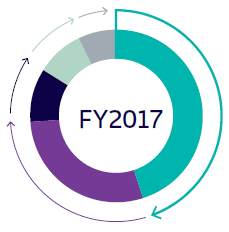
- 14%Gravity
- 29%Motion
- 10%Robberies and assault
- 9%Biological
- 7%Motor vehicle accidents
Of the 223 recordable injuries (medical treatment cases, lost-time injuries and fatalities) for Telkom, 46 percent is due to gravity, and 30 percent due to motion, in the technical field work areas 93 percent of injuries occurred.
In response to the injuries, Telkom company developed an Openserve SHE strategy which focuses on implementing a systematic management approach to OHS, and improving leadership accountability to create an incident and injury-free workplace. A risk assessment was conducted to identify safety gaps and high-risk areas. Action plans were developed to mitigate the risks, and resources were allocated through the Openserve OHS strategy, which was approved by the Openserve exco.
Telkom company experienced challenges regarding the quality and diligence of OHS management by our contractors. In response to this, we introduced OHS KPIs for new and existing service providers. These KPIs will be used to monitor contractor compliance with OHS requirements. Contractor OHS audits will be conducted to verify and validate contractor performance. A consequence management model will be instituted for non-compliant contractors.
Telkom company employee wellness
The following programmes comprised the focus of the year’s investment in wellness:
- Employee assistance programme: This voluntary programme offers sponsored counselling and psychology sessions specifically aligned to the individual’s needs
- Thuso wellness programme: For over a decade this programme continues to offer employees and their families the opportunity to undergo health screening, which includes human immunodeficiency virus (HIV) and tuberculosis screening, and receive subsequent counselling, support and treatment
| FY2017 | FY2016 | FY2015 | ||||||||
| Employees | Employees | Employees | ||||||||
| Number of people who agreed to HIV counselling | 377 | |||||||||
|---|---|---|---|---|---|---|---|---|---|---|
| Number of people who agreed to be tested for HIV | 365 | 4 831 | 3 484 | |||||||
| Number of people who tested positive for HIV | 10 | |||||||||
| Number of people who started antiretroviral treatment (ART) during the year | 28 | 553 | 487 | |||||||
| Number of people who stayed on ART | 257 | 256 | 223 | |||||||
| HIV prevalence rate | 2.73% | 124 | 76 |
The above demonstrates the HIV statistics for Telkom, excluding BCX and Trudon. There has been a large decrease in voluntary HIV testing and counselling for FY2017. This is mainly as a result of testing that took place at the Telkom head office campus only and was not, as previously, a country-wide initiative.
Although Trudon and BCX outsourced their employee wellness to their medical aid providers, their employees have access to the Telkom programmes.

Looking forward
Going forward, in the effort to achieve more efficient and effective outputs from our human capital, safety, health and wellbeing will be considered holistically. Our business units will conduct 360-degree risk assessments to profile and categorise safety, health and wellness risks. The intention is to proactively manage occupational injuries and reduce lost time early injury management. For example, Openserve’s operations require a significant number of technicians to drive. Through managing driver behaviour and fatigue, potential injuries will be reduced.
OHS incident classification, investigation and reporting methodologies and management will be integrated and aligned across the group. As part of continual improvement and fostering the safety culture within the organisation, the following key initiatives will be implemented:
- keeping abreast of the OHS legal requirements - in January 2017, the Department of Labour published the Draft Ergonomics Regulations for comments. The requirements will be analysed and appropriate actions and controls will be developed to ensure compliance once promulgated
- the Openserve OHS strategy - to reduce workplace injuries at Openserve, and build and foster the safety culture and behaviour
- strengthen our relationships with our contractors - Telkom will hold “Contractor Safety Stand-downs” in all regions to facilitate and improve contractor OHS awareness and compliance, and improve the measurement, monitoring and reporting of contractor safety performance
- the integrated occupational health and wellness programme – the programme will offer end-to-end occupational health, safety, and well-being (organisational and individual) solutions. The intention is to maximise the effectiveness of safety interventions and initiatives across the organisation to ensure a healthy and resilient workforce