
Telkom SA SOC Limited
Integrated Report 2017
For the year ended 31 March 2017
Performance

Natural capital
Natural capital is integral to a functioning and sustainable society and economy, and so supports Telkom’s other capitals.
3MW grid-tied solar photo-voltaic (PV) plant at Telkom campus, a R88 million investment, became fully operational in July 2016. Since then it has generated 3 708 MWh. This is 90% of our Telkom campus daytime energy demand, excluding the data centre.
In order for Telkom to generate revenue, it requires multiple inputs
including products, services, labour and market demand.
Sustaining these inputs are the assets and services provided by the
natural environment, such as fossil fuels for electricity and transport,
land for the food we eat, mineral resources for product manufacture,
potable water, a regulated climate, and clean air. During our business
activities, natural capital is either enhanced or destroyed by
operational trade-offs made over the short, medium, and long term.
The majority of environmental data collection, collation, and
management is outsourced to a facilities management service
provider.
Our natural capital management is guided by our sustainability
strategy, environmental policy statement and climate change policy
statement. Due to Telkom’s restructuring, the dissemination and
implementation of the strategy across the group was delayed. As
a result, the management of our natural capital across the group
remained fragmented and compliance driven.
The Telkom OHS division retained its ISO 14001:2004 environmental
management system certification.

Telkom’s natural capital management is guided by our sustainability strategy, environmental policy statement and climate change policy statement.
Climate change
The UN Climate Change Conference (COP22) saw increased global
commitment to implementation and action on climate change. South Africa
is one of 111 countries that share in this commitment through ratification of
the Paris agreement (UN Framework Convention on Climate Change). This
deals with greenhouse gases emissions mitigation, adaptation and finance,
starting in the year 2020, as well as submission of its national emissions
reduction targets (nationally determined contributions).
Telkom realises the vital role business has to play in supporting South Africa
to reach its goals. The impending carbon tax forms part of this international
commitment. While our operations are not significant emitters, there
are complexities to the tax that have the potential to impact us directly
or through our value chain. Emissions mitigation efforts take time to be
implemented and, therefore, we need to be proactive in implementing
without undue delay.
Telkom expanded its reporting scope to include BCX and Trudon, and
refined its calculation methodology to include more actual data, for
example, invoice-based, and assumptions based on actual data.
The total carbon footprint of the group is depicted below. Prior year data
is only available for Telkom and BCX. It is therefore necessary to prioritise
meaningful measurement, monitoring and reporting. Scope 3 data is not
included in this year’s report, however, a value chain assessment will be
undertaken in the next year to determine material indicators.
Contribution to total
carbon footprint per scope
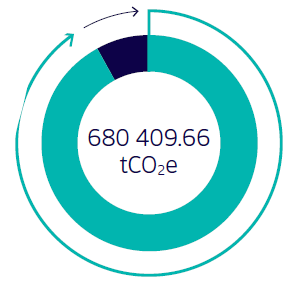
- 92%Scope 2
- 8%Scope 1
Contribution to group
carbon footprint
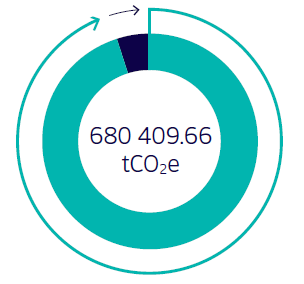
- 96%Telkom company
- 4%BCX
As part of our commitment to managing our carbon emissions and contributing to the global knowledge base, Telkom continues to participate in the Carbon Disclosure Project (CDP).
| KPI | Telkom | BCX | Trudon* | Telkom group | |||||||||
| Scope 1 (tCO2e) | |||||||||||||
| Refrigerants | 23 715.69 | 338.25 | * | 24 053.94 | |||||||||
| Fleet | 22 900.83 | 168.27 | 7.61 | 23 076.71 | |||||||||
| Diesel | 7 750.02 | 81.33 | * | 7 831.34 | |||||||||
| Total scope 1 | 54 366.54 | 587.85 | 7.61 | 54 961.99 | |||||||||
| Scope 2 (MW) | |||||||||||||
| Electricity | 596 677.82 | 28 482.52 | 287.34 | 625 447.67 | |||||||||
| Total scope 2 | 596 677.82 | 28 482.52 | 287.34 | 625 447.67 | |||||||||
| FY2017 total carbon footprint (tCO2e) | 651 044.36 | 29 070.36 | 294.94 | 680 409.66 | |||||||||
| FY2016 total carbon footprint (tCO2e) | 714 204.59 | 30 643.54 | * | 744 848.12 | |||||||||
| % change year-on-year | (9) | (5) | * | (9) |
| * | Limited data available for Trudon. |
Due to the size and nature of its operations, Telkom is the primary
contributor to carbon emissions, of which the most significant source
is electricity consumption. Telkom company’s total carbon footprint for
owned buildings (651 044.36 tCO2e) was externally assured. We use the
carbon footprint analysis to inform the direction and scale of our initiatives
to reduce our emissions.

Telkom carbon
footprint only
includes our owned
buildings and
excludes leased
buildings.
BCX data excludes
all BCX International
operations as well
as other small
South African
operations such
as Integr8, Accsys
and Smart Office
Premises.
The 9 percent decrease in carbon emissions from the prior year is primarily attributed to:
- the implementation of 50 smart meters to measure electricity consumption in key buildings, which resulted in more accurate and reliable data, and improved calculation methodologies
- the rollout of the energy-efficient light-emitting diode (LED) lighting initiative which replaced conventional lighting systems in 900 buildings nationally, with sustainable lighting based on LED technology
- the implementation of a building management system at the Telkom campus. This automation system monitors and controls multiple facilities elements, including air conditioning, power distribution, lighting, and water usage. This results in more efficient operation of our buildings, and reduced energy and water consumption
As part of our commitment to managing our carbon emissions and contributing to the global knowledge base, Telkom continues to participate in the CDP.
This year we refined our calculation methodology to include assumptions based on actual data, and we included BCX and Trudon in the scope of reporting. Telkom’s water consumption data covers owned buildings and leased buildings where utilities are excluded from the lease agreement.
Water
The ongoing drought and water restrictions have demonstrated the impact water scarcity can have on South Africa. If prolonged, this had the potential to impact our business operations. While the group is not a water-intensive business – using water primarily for cooling, drinking, catering, hygiene and landscaping – it is a responsible citizen. Occupying in excess of 7 000 premises, our footprint is large and we need to manage our consumption. Water data is collected using municipal invoices, and is based on what is billed. This is a challenge, as municipal billing is often based on estimates and, in some cases, only a rand value is provided. However, this year we refined our calculation methodology to include assumptions based on actual data, and we included BCX and Trudon in the scope of reporting. Telkom’s water consumption data covers owned buildings and leased buildings where utilities are excluded from the lease agreement. The total water consumption for Telkom company Tof 443 743 kℓ was externally assured. The flow restrictors resulted in an approximate 40 percent savings from a normal flow rate. In addition, implementation of air-cooled heating, ventilation and air conditioning (HVAC) systems in our campus data centres is underway. As the data centres require 24 hours a day, 365 days a year of cooling, converting to air-cooled HVAC technology will significantly reduce the amount of water used. The building management system improved the efficient use of water on campus.
Total water consumption for Telkom group is 1 496 905.91 kℓ.
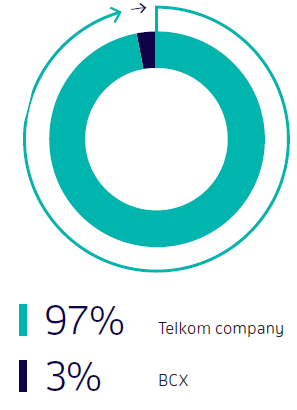
Telkom water consumption only includes our owned buildings and excludes
leased buildings.
BCX data excludes all BCX International operations as well as other small South
African operations such as Integr8, Accsys and Smart Office Premises.
Waste
Based on our operations, it is presumed that our most significant and environmentally impactful waste streams, both internally and within the value chain, are cabling (copper and fibre-optic) and e-waste (batteries and electronic equipment). It is our responsibility to mitigate the environmental impact of these waste streams through responsible management, re-use, recycling and disposal.
Telkom company’s cabling and e-waste is managed by Openserve supply chain management through a service provider responsible for reverse logistics. In this process, products no longer of use to Telkom company (such as out-of-service copper cabling, damaged fibre-optic cabling, ineffective payphones, and defective computers) are collected by distribution centres across the country and sent to a central hub.
Telkom’s cabling and e-waste (tonnes)
| Waste stream | FY2017 | FY2016 | |||||
| Copper | 2 035 | 1 582 | |||||
|---|---|---|---|---|---|---|---|
| Optic fibre | 398 | 228 | |||||
| Batteries | 502 | 324 | |||||
| e-waste | 202 | 471 | |||||
| Total (tonnes) | 3 137 | 2 605 |
All e-waste is auctioned to various approved e-waste recycling companies
based on their ability and expertise to responsibly dispose of these
materials in line with legislation and best practice.
Cabling is sold to Sindawonye, a recycling company, where the cabling is
processed using environmentally and socially responsible techniques (no
chemicals or burning). Copper recovered from the recycling process is sold
to local and international markets. Fibre-optic cables are recycled
through the Thembani Eagle Hout Integrated Project. This sensitive,
labour-intensive process provides employment and empowerment for
an Eastern Cape rural community, with 22 families relying solely on this
project as a source of income.
The higher demand for fibre in
the last year increased the fibre-optic
waste due to unusable scrap
offcuts and damaged pieces.
FY2016 saw large quantities of
computer equipment recycled due
to the consolidation of facilities and
employees to Telkom Centurion
campus. This stabilised during
FY2017 and, as a result, computer
equipment e-waste decreased
by 103 tonnes. In addition to this,
there was a decrease of 83 tonnes
in payphone e-waste from the
prior year. As payphones have
become obsolete and not replaced
when scrapped, it is expected that
payphone e-waste will reduce over
time.
This year BCX began to quantify
the number of units of e-waste
disposed. This included PCs,
laptops, screens, printers and
general e-waste; printers making
up the majority of the total 5 878
units disposed.
Telkom group’s additional solid
waste streams include municipal
waste, garden refuse, and paper.
Telkom, through its facilities service
provider, measured a limited
portion of these additional solid
waste streams. However, Telkom
has a “no bin at desk” policy, which
encourages the use of the recycling
areas provided.
Paper-saving copiers with a printing
time limit were installed to reduce
excessive printing, and thereby
paper wastage. BCX’s total landfill
waste decreased by 19 percent,
and total recycled waste increased
by 68 percent. A significant portion
of the recycled waste was paper
due to the move of office premises.
Outlook
Our primary focus for FY2018 is to refine our sustainability strategy to be inclusive of our subsidiaries and aligned to our future outlook. An integrated management approach will be developed to move the group beyond compliance, to embedding sustainability to maximise value.
Telkom will undertake a value chain assessment to understand our
material impacts on natural capital upstream and downstream of our
activities. The initial focus will be on solid waste streams and carbon
emissions (Scope 3).
BCX is moving to more environmentally responsible offices in 2018.
The building design has been rated four stars by the Green Building
Council of South Africa.
Climate change
PV project is complete and adds value to our business, and we are
investigating the following initiatives to further reduce our energy
consumption and, therefore, our emissions and costs:
- The implementation of an EMS based on ISO 50001
- An energy audit at Telkom campus to determine an energy baseline, and identify high-energy-consuming equipment and wasteful use
- The development of a 3MW trigeneration (gas) plant at our campus to supplement the required base load and reduce our dependence on the national power grid
- Based on the performance of the current electricity meters, we will look to increase the number of metered sites, improving accuracy and reliability of data
- We will continue to roll-out energy-efficient LED lighting, smart lighting and climate control initiatives to more sites
- The sustainable power to strategic sites initiative will install solar/PV systems at other Telkom strategic sites
- At the Telkom head office campus we will offer employees and visitors the use of six electric vehicle charging points, connected to the solar/PV plant, at no cost
Water
Proof of concept was completed at 15 of our sites to install smart
water meters. As a result, we will be able to verify municipal bills,
benchmark facilities’ water usage, and more effectively manage our
water. Other sustainable water management initiatives that will be
investigated during the next year include rain water harvesting and
water recycling (use of grey water).
Waste
During FY2018, integration and standardisation of waste management
will be considered.