Telkom SA SOC Limited
Integrated Report 2017
For the year ended 31 March 2017
Value creation

What is material in our value-creation process? |
Stakeholder engagement
Our stakeholder management programme is achieved by identifying stakeholders, engaging with them, understanding their various challenges and expectations, and aligning these to Telkom’s strategic and operational objectives and targets.
Stakeholder engagement is a critical step in the realisation of business strategies because it helps to identify existing and potential stakeholder capacity (interest, influence, support and resources). We recognise the importance of strong and constructive relationships with our stakeholders, built on the principles of trust, respect, transparency and constructive engagement. We aim to balance the needs of stakeholders with our responsibility to provide reliable ICT networks, products and services.
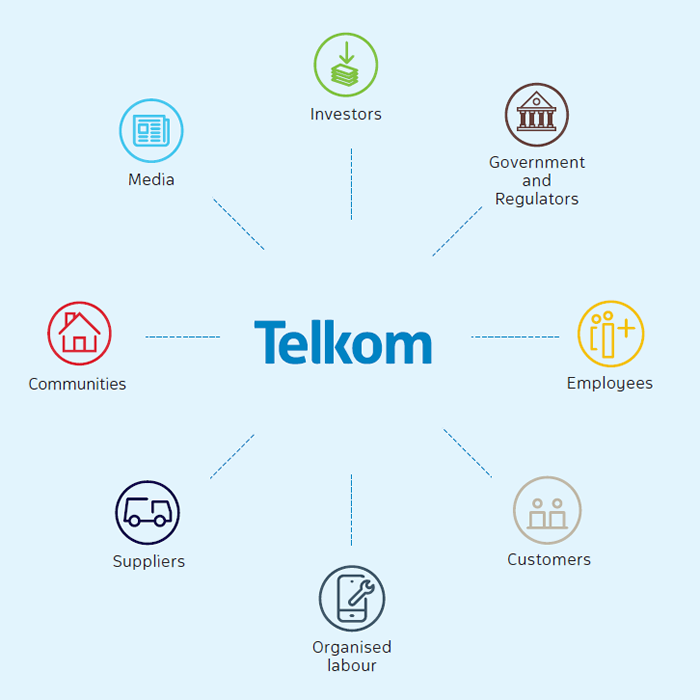
We regularly engage with the following stakeholders
Methods of engagement
|
|
Our stakeholder concerns and our responses
| Stakeholder group and why they are important to us | Their interest in Telkom | Our response | ||||||||||
|
|
Investor community Investors, including equity and debt investors, strategic shareholders, and sell-side analysts The investment community creates access to equity and debt markets, and ultimately drives demand for the shares, increasing our market capitalisation |
Telkom’s ability to meet its guidance to the market and sustain positive momentum | Financial guidance is regularly reviewed by the company and is discussed with the audit committee to ensure it is a fair representation of the company’s internal expectations. We inform the market timeously of any expected changes regarding the company's performance in line with the JSE Listings Requirements. For our revised guidance refer to page 70 | |||||||||
| Whether the integration of BCX is realising synergies as planned and what the outlook is for BCX (post-integration with Telkom Enterprise) | The integration is complete and synergies were realised in line with expectations. There is one go-to-market strategy. BCX continues to gain market share as it leverages its competitive advantage of being the only truly converged platform in the enterprise market. The outlook for BCX is discussed under the strategic focus areas on page 62 | |||||||||||
| Telkom's ability to grow the business and the drivers of growth | The group strategy is geared for growth. All our business units are expected to grow and win against their peers – refer to page 62 for their strategic focus areas. Underpinning the growth strategy is the investment in capital expenditure in our growth areas such as fibre and mobile | |||||||||||
| The outlook for the core fixed-line business given the decline in the business | The decrease in fixed-voice is expected to continue in line with our expectations. Our focus is to grow data connectivity of high-speed broadband across fixed and mobile, as well as IT to offset the ongoing decline in fixed-voice. We continue to modernise our network through deploying fibre deep into our network to grow data revenue. We have accelerated our capex to grow the Mobile business. We are also focusing on growing our IT revenue streams, and leverage on BCX’s ability to offer end-to-end solutions | |||||||||||
| A clear and a sustainable dividend policy | During the year, the board amended our dividend policy to an annual dividend of 60 percent of headline earnings with an interim dividend of 40 percent of interim headline earnings | |||||||||||
Government and regulators including Parliament, the Department of Telecommunications and Postal Services, the Department of Communications and the ICASA They set policies, legislation and regulation that impact on the cost of doing business and the ability to derive a reasonable return on investment. They have the authority to penalise the group through fines for non-compliance |
Ensure efficient use and management of scarce resources such as spectrum and fixed-infrastructure | We established Openserve, a functionally separated wholesale division | ||||||||||
| Promote competition in the mobile industry | We introduced innovative Mobile business products such as FreeMe | |||||||||||
| Promote investment in fixed-broadband infrastructure | We embarking on customer-first initiative to ensure improved customer service | |||||||||||
| Promote compliance with regulations such as customer-focused end-user subscriber charter regulations | We continuously engaged Parliament and the executive arm of government on changes in policy, legislation and regulation | |||||||||||
| Contribution towards socio-economic development | We promoted enterprise development of SMEs through FutureMakers programme | |||||||||||
| B-BBEE compliance | Telkom has adopted an integrated approach to B-BBEE. A plan with focused programmes guides the company’s journey in compliance with the Amended ICT Sector Codes | |||||||||||
Employees Employees present the intellectual capital required for all core and supporting business processes. They are our strategic partner in ensuring that the group is sustainable through performance, culture and |
Lack of job security following several phases of retrenchments and outsourcing in 2016 | The Collaborative Partnership Agreement, which expires on 31 March 2018, has two important provisions that make a serious attempt at assessing the issue of job security within Telkom. In this collective agreement, Telkom and organised labour have agreed a moratorium on section 189 - forced retrenchment processes for the duration of the current substantive collective agreement. Telkom and organised labour have also agreed to limit outsourcing transactions to impact only a maximum of 1 000 Telkom employees for the duration of the current substantive collective agreement. The outsource limitation does not apply where outsourcing is within the Telkom group, but applies to external third parties. This is a ground breaking agreement in the country and received recognition from government and major media houses. With the signing of certain revised collective agreements such as organised labour engagement framework agreement and the full-time shop steward collective agreement, these revised collective agreements support and inculcate the new Telkom operating model and clearly set out engagement structures between the company and organised labour | ||||||||||
| Fair remuneration and rewards system | Telkom’s remuneration structure is designed to ensure that individual contribution is aligned to both short-term business plans deliverables and long-term strategic, operating and financial performance sustainability. The company aspires to reward total remuneration (guaranteed package, STI and LTI) on market median. The fundamental principle of the remuneration model is to ensure that the company moves towards paying equitable remuneration in relation to external market trends based on a job-specific approach for management employees. Telkom has introduced a new variable-based incentive scheme for bargaining unit employees, known as Performance Pays. Performance Pays focuses on customer satisfaction and productivity metrics, and replaces the STI scheme, which is primarily driven by group financial performance. This empowers and enables bargaining unit employees to be more in control of their own destiny and rewards, and gives more direct and clear linkage between individuals’ efforts and their rewards | |||||||||||
| Career progression, including skills development opportunities | Targeted investments across the business aim to identify, develop and retain the right talent for the organisation. The implementation of the talent management framework commenced during the second half of FY2017. This has resulted in gaining clear sight of the talent across the organisation at executive levels, while also safeguarding leadership and key roles by having succession plans in place for executive roles. The talent information is a key input to talent mobility decisions across the business. Specific high-potential development programmes have been established to target key talent. The Step Up programme, which focuses on the development of the identified key talent (as identified through the talent mapping process) aims to enhance the capability, knowledge and skills of Telkom’s future leaders. The FLDP is a two-year blended learning programme aimed at middle and junior management levels, and focuses on identifying women from across the organisation who display leadership potential. A total of 50 women formed part of the first FLDP group, which has recently concluded with 42 percent of the group being promoted during this period. The second intake commenced in May 2017 with 37 women from across the organisation | |||||||||||
| Telkom’s commitment to employment equity (EE) transformation | Telkom recognises the moral, social and economic imperative to embrace and support transformation including EE in South Africa. An EE policy is in place and a strategy to support workforce transformation across all occupational levels, is being implemented. Focused recruitment, especially at senior levels with a specific preference to the most under-represented groups (including black women and people with disabilities) will assist in maintaining and improving Telkom’s workforce profile. Succession management and other talent development strategies are being aligned to EE plans and, in particular, the FLDP, whose main objective is to address the under-representation of women at senior management levels. There is continued focus and investment in young talent development through the implementation of learnerships and internships for both employed and unemployed black people. The creation of a future talent pipeline to address the IT/digital skills gap includes a significant investment that Telkom is making to support coding/programming skills development by partnering with institutions such as “WeThinkCode” that provide skills for the youth in this field. Programmes such as the BYM and now the Future Minds are young talent pipelines whereby a group of millennials is offered a one-year internship programme in Telkom. These graduates, with their unique backgrounds, offer the business a fresh approach to problem solving, strategic projects and new business development prospects. In turn, they have the opportunity to grow their careers as they work on a variety of strategic projects across the business and are mentored by top leadership | |||||||||||
Customers Customers underpin our existence and drive our reputation and brand. They provide the market for our products and services from which we generate revenue. Customers guide our product or service development in terms of new trends |
Poor customer experience | A Workplace Excellence Programme has been introduced to optimise this end-to-end core business process and flow to ensure focus and delivery. This is supported by investment in staff (training/recognition via Performance Pays) to equip them better as well as associated technology enhancements to facilitate better control and visibility. A few examples are knowledge management system, speech analytics application to identify problem and performance issues, Click to Call, and Q-Buster for customers visiting stores to speak to experienced call centre agents | ||||||||||
| Order installation and fault resolution times | Telkom is in the process of migrating to a different, more advanced system which will enhance order processing capabilities to improve customer experience through better order orchestration and visibility in the end-to-end order flow. In parallel we started with an IT transformation project to drive the simplification and automation of core operations | |||||||||||
| Pricing | Product costing and pricing methodologies are reviewed in line with technological changes | |||||||||||
| B-BBEE level and transformation | The implementation plan for programmes is developed to ensure compliance with the amended ICT Sector Codes and to ensure meaningful transformation | |||||||||||
Organised labour Organised labour supports sound labour practices and assists in communication of labour-related matters. They are a strategic partner in creating shared value between the group and our employees. The nature of the relationship can influence the group’s strategic plans through industrial action |
Telkom’s commitment to transformation, diversity, EE and skills development | Telkom revised the EE and disability policies to include organised labour concerns. We also implemented transformation and skills development programmes which include learnerships and preferential recruitment | ||||||||||
| Conflicting relationships | An engagement framework has been developed to improve the relationship between Telkom and organised labour | |||||||||||
| Uncertainty related to restructuring | We held interactive GCEO strategic briefing sessions with union leadership on company performance, initiatives, changes and strategic direction | |||||||||||
| Collaborative partnership agreement – wage gap | Industry and market-related benchmarks are conducted in determining appropriate market positioning offerings which are higher than the minimum prescribed wages. In addition, Telkom recognises “equal pay for work of equal economic value”, and strives to remunerate employees doing the same work or substantially the same work, within the same range in accordance with the Labour Relations Act. However, Telkom recognises that there could be differences which are attributed to the following:
To this end, all bargaining unit employees were placed on the market 50th percentile of their respective functional areas |
|||||||||||
| Reduction of full time shop stewards | The spirit of the new full-time shop stewards’ collective agreement aligns to the new Telkom’s new operating model and embeds the operation of the newly established Strategic Business Unit Forum structures. These forums are aimed at driving business unit-specific discussions | |||||||||||
| Performance and development management (PDM) policy | Performance management focuses on defining key performance indicators (KPIs) for all employees to implement a high-performance management culture that is outcome-oriented, consistent, simple and practical. More rigorous consequence management is a desired outcome of the KPI and target-setting process with specific focus on
|
|||||||||||
Suppliers Suppliers underpin our value chain and have a direct influence on our raw materials and other input costs. Delivery by suppliers impacts our ability to deliver on the customer expectations |
Feedback on tender or application process | The supplier relations framework is being finalised | ||||||||||
| Procurement pay process | Procurement to pay process is finalised and linked to contract terms | |||||||||||
Communities Communities are a source of our future employees, and are our customers that contribute to our revenue. They can be impacted by our operations |
Corporate social investment funding and assistance for educational and social development programmes | The Telkom Foundation works closely with communities to address the socio-economic challenges through a number of programmes which are aimed at educational and social development. The Telkom Foundation invested R32 million in education initiatives providing supplementary teaching to over 3 900 learners in five provinces and resulted in an average of 3 to 5 percent improvement in maths and science. BCX implemented an IT laboratory in partnership with the League of Friends of the Blind in the Western Cape to allow blind grade 12 learners to write their matric exams with the aid of technology | ||||||||||
| Creation of employment and business opportunities in communities | Telkom has established Telkom FutureMakers Programme which is an Enterprise and Supplier Development programme, aimed at supporting black-owned ICT businesses with financial and non-financial support. R234 million has been invested in the FutureMakers programme since inception in May 2015, supporting more than 1 000 ICT small businesses, R63 million was disbursed in business loans and more than R130 million procurement opportunities was accessed by black-owned small businesses. Collectively all our black-owned small business beneficiaries have created 1 102 jobs | |||||||||||
| Network infrastructure connectivity in communities | Telkom has established the FutureMakers programme with significant budget allocation for enterprise and supplier development. The programme provides support and contributes to the development of black-owned companies in the ICT sector, and ultimately contributes to job creation. The FutureMakers programme has provided fully subsidised high-speed connectivity for 27 internet cafés and hubs (Bandwidth Barn in Cape Town, Propella in Port Elizabeth, and Tshimologong in Johannesburg) | |||||||||||
Media The media has an influence on public perception and brand reputation |
Access to significant information | Media releases and product-related publicity | ||||||||||
| Transparent engagement | Ongoing interviews with GCEO and key executives | |||||||||||
| Telkom’s performance and direction | Communicate the new growth strategy, which includes Journey of Independence, and company results, among others, to inform key stakeholders, including shareholders |