

- Page tools


Board diversity and tenure
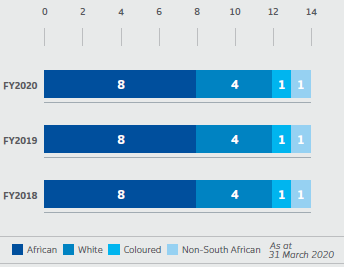
The majority of the board members are independent non-executive directors, with two executives and 12 independent non-executive directors as at 31 March 2020. The roles of Chairperson and GCEO are separated. The board, through its nominations committee, considered the appointment of a lead independent director (LID) and is satisfied that there is no need to appoint a LID at this stage. The matter will be reconsidered should circumstances change.
| Race | Gender | |||
 |
 |
The board-approved diversity policy echoes ’s appreciation for the value that diversity presents. It considers all forms of diversity including, amongst others, gender and race. The nominations committee reviews board diversity as part of its annual board and committee composition activities. It identifies and highlights future needs for skills, expertise, qualifications, gender, race and experience to continually achieve this element.
The diversity policy does not specify targets for diversity. However, the board is committed to improving gender representation. This will be addressed through future appointments with the assistance of the nominations committee. The board is satisfied that its current composition reflects the appropriate mix of knowledge, skills, qualifications, experience and diversity.
Skills and experience
The board and committee compositions are reviewed annually to ensure that the skills representation supports the group’s strategy, suitable for the current business and responds to the external environment.
The nominations committee, with support from the group company secretariat, assists with:
- Continuously training the board and its committees to keep abreast of developments in Telkom’s operating environment
- Board succession planning to ensure appropriate diversity and mix of skills for the group and its continuity
- The board evaluation process for the board and its committees’ performance to ascertain development areas to enhance board effectiveness
The board and its committees were assessed for the skills required in supporting and delivering the group’s strategy towards value creation. The board-approved training plans for FY2020 and FY2021 are aimed at embedding governance outcomes as part of Telkom’s ways of working.
The diagram below highlights relevant training topics that were delivered during the year under review.
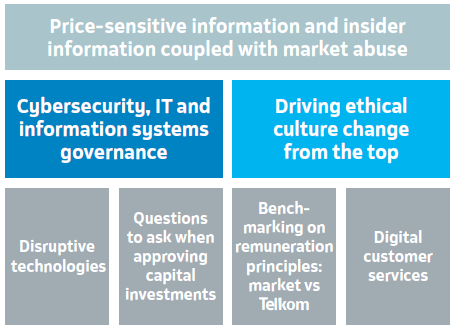
The implementation of the FY2020 training plan is behind schedule due to competing interests and operational requirements. However, the board is committed to ensuring continuous training activities.
The board engaged an executive search service provider to assist it in refreshing its skills and close the identified skills development gaps through the recruitment of additional independent non-executive directors.
Board selection process
Telkom adheres to a well-defined nomination process for appointing directors. This is included in the nominations committee’s terms of reference. The process entails, among others, determining the skills required, requesting referrals from existing board members and suitable candidates from the executive search service provider, vetting and making recommendations to the board. New director appointments are presented at the first annual general meeting (AGM) following the appointment for election by the shareholders.
A formal induction process was conducted for incoming members of the audit, risk and social and ethics committees respectively. This will be supported by a directors’ toolkit, which includes all pertinent governance instruments and Telkom strategic documents that directors need to consider when joining the board.

Independence and tenure
All non-executive directors are independent. Independence in appearance is an essential element of the categorisation of the board. However, the duty to act with independence of mind and in the best interest of the group is an overriding concern when considering independence testing and retirements.
In terms of the company’s MOI, any non-executive director holding office for an aggregate period in excess of nine years since his/her first election or appointment, shall retire from office and be subject to an independence assessment. Further, such a director will be required to retire at every AGM.
The board conducted an independence assessment of Navin Kapila, as his tenure exceeds nine years. This evaluation confirmed that he is still able to exercise objective, unfettered judgement and is not likely to influence unduly or cause bias in decision-making. Based on the outcome, Navin Kapila is recommended for re-election at the AGM and his contribution is invaluable.
The nominations committee, in consultation with the remuneration committee, manages succession planning to ensure the balance of independence is maintained and that successors are appointed to the board in a manner that promotes knowledge transfer to ensure continuity.
Specific governance processes
In terms of the company’s MOI, one third of directors must retire by rotation annually. After due consideration of the performance and contribution of the board, the nominations committee recommended to the board that Sibusiso Luthuli, Dolly Mokgatle, Sello Moloko, and Louis Von Zeuner who are retiring by rotation, be re-elected by the shareholders as indicated in the notice of the AGM.

Conflict of interest management

The group company secretariat manages the conflict of interest process. All directors are expected to disclose any conflict of interest to the governance structures in accordance with the Companies Act. Telkom has additional processes to manage potential, perceived and actual conflicts of interest.
At the start of each financial year, executive and nonexecutive directors, prescribed officers, committee members and meeting invitees complete and sign annual declarations of interest forms. These are submitted to the group company secretariat for filing post tabling through the governance structures. These are updated as and when necessary during the year.
The group company secretariat monitors declarations to ensure that there are no conflicts present when matters are tabled for deliberation or when executing business activities. Where conflicts exist, affected directors or persons do not receive papers for the related matter, and are recused from such deliberations. Telkom’s conflict of interest policy forms part of the group ethics handbook. The board and exco’s commitment to comply with the group ethics handbook forms part of the annual ethics leadership pledge.
The declaration of interest form was enhanced in FY2020 to detail ownership of Telkom securities and disclosure requirements in directors and prescribed officers dealing in Telkom securities as security, guarantee, collateral or otherwise pursuant to the new JSE Listings Requirements.