

- Page tools



Key strategic focus areas
- Building a sustainability mindset
- Transforming our culture
- Enabling diverse, adaptive teams
- Developing next-generation future leaders
Key themes that informed intellectual capital’s performance in FY2020
- Section 189
- Managing the evolving skill set required by Telkom for the future
KPIs and key measurements
Development and refinement of the following:
- Employee turnover
- Training and development spend
- % key employees on succession plans
- Total recordable injury frequency rate (TRIFR)
- Lost-time injury frequency rate (LTIFR)
| 1 | Refer to the remuneration report. |
| Human capital |
 |
We believe the greatest competitive advantage of the future is people.
How we manage our human capital
Our world of work is changing faster than ever before. Human capital is becoming a complex landscape with rising demands. There is an increasing need to unlock the value of people who will, in turn, unlock business value for organisations.
External future drivers of change in the economy – globalisation, technological advancements and the rise of the knowledge economy – are creating shifts within the telecommunications sector. The human capital strategy represents our vision and identity as a business and is designed and informed by a futureled and enduring approach. It is informed by our strategic direction, people and workforce data, as well as the evolving world of work.
We enable an engaged and relevant future workforce through value creation across the employee life cycle. This seamless, meaningful process drives and accelerates employee discretionary effort, ultimately resulting in significant customer value.
The human capital strategy is rooted in delivering on Telkom’s strategy, and ensuring the most optimal people decisions that enable and support the group’s success. The talent management and human capital governance frameworks are aligned to and support the human capital strategy.
Telkom’s human resource policies adhere to global best practice. They uphold critical principals such as those described in the United Nations (UN) Declaration of Human Rights and the International Labour Organization’s Declaration on Fundamental Principals and Rights at Work.
Our approach is fundamentally human and designed around the customer of human resources (HR) services, i.e. the employee. Employee experience across the value chain drives human capital priorities:
- Building a sustainability mindset
- Transforming our culture
- Enabling diverse, adaptive teams
- Developing next-generation future leaders
| Major trends affecting human capital | ||
| – | Automation and “thinking machines” will replace human tasks and jobs. This, in turn, will change the skills that business units are looking for in employees | |
| – | Careers are being built from individual blocks of skills, experience and networks rather than being defined by an employer | |
| – | The commercial value of learning takes precedence; specific and relevant skills or experience are an essential commodity to creating a competitive advantage | |
| – | Projects quickly evolve and resolve, and specialists move rapidly from one project to the next | |
| – | HR and data scientists will use analytics and big data to adapt individual employee value proposition (EVP) and quantify their added value | |
| – | The COVID-19 pandemic is causing a huge impact on people’s lives, families and communities. Within this uncertainty, Telkom needs to build resilient teams to create a people advantage post COVID-19 | |
Telkom’s workforce
Telkom’s headcount decreased by
536 employees.
| Number of permanent employees | 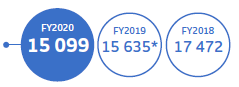 |
Gender
diversity of
permanent
employees
(%) |
 |
Race diversity
of permanent
employees (%)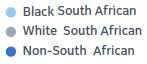 |
 |
| Employee voluntary turnover (%) | 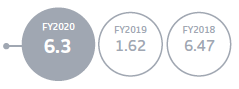 |
| Number of differently-abled employees | 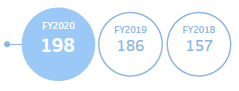 |
As a result of the general South African labour market demands, we have had resignations in areas like SAP K5, SAP Hana and SAP ERP consultants, Cisco certified network engineers, solutions architects, pre-sales specialist and account executives. These critical roles have had to be backfilled to ensure business continuity.
We also repurposed roles to align with the skills that Telkom will require going forward including robotic process automation developers, python software developers, enterprise architects, system engineers: storage, specialists sales segment marketing, digital marketing, e-commerce skills, cybersecurity specialists, and customer and data analytics. Our recruitment efforts have mainly centred around these skills in order to future-proof Telkom.
Building a sustainability mindset
Telkom embraces the philosophy of enabling a sustainability mindset, which encourages employees to analyse complex management challenges and drive innovation. It incorporates a systemic approach, which transcends technical knowledge in enhancing Telkom’s social, human and natural capitals.
As employees navigate the new world of work, Telkom will continue to deepen knowledge around technology and relevant human skills for the future of work which include, emotional intelligence, a growth mindset, an ability to solve complex problems and communicating effectively.
Transforming our culture
It is essential that we create and sustain a culture that aligns, engages and motivates Telkom to collectively achieve our vision. We started to redefine a behavioural blueprint for the business units using a group culture framework.
We also measure the organisational culture through an annual survey. The survey provides insights into the organisational cultural profile in the context of implemented interventions, while informing a meaningful way forward for the organisational culture journey.
The survey’s response rate was 46.97% in FY2020 (7 092 employees). The survey highlighted commitment to organisational performance, customer service consciousness, diversity and inclusion as some of the highest scoring behaviours. Empowerment and openness were highlighted as areas of improvement going forward.
The outcomes of this survey will also contribute to shaping the culture transformation deliverables. This journey will ensure that our leaders champion the values through leadership engagements with employees in all aspects of our business. They will be embedded in day-to-day operations through strategic and operational frameworks that guide, support and govern the group.
Innovation and change management that are effectively implemented will facilitate business sustainability during and post the COVID-19 crisis. To this end, we also started to embed an agile change capability and framework across the group.
* Note: The number of permanent employees reported in FY2019 was inadvertently indicated as 15 296 instead of 15 635.
Enabling diverse, adaptive teams
Transformation
Telkom promotes diversity and inclusion. We believe that blending different cultures, experiences and perspectives in the work environment promotes innovation, improves our ability to tackle challenges, and creates a future-looking and engaged environment. Gender, age, race, culture and differently-abled contribute to this. Our differently-abled policy and three-yearly revised employment equity plan guide us as an equal opportunity employer. The new three-year plan will come into effect on 1 April 2020. Refer to the social and relationship capital section on page 80, for more insight.
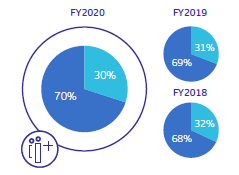
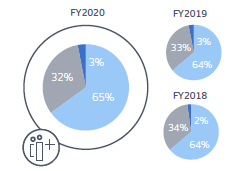
Our black employee representation increased by 1% to 65%. Even though Telkom remains resolute in its endeavour to hire according to our transformation objectives, female representation has remained a challenge – decreasing by 1%. This is mainly due to Telkom competing for future required skills like cloud, data science, engineering, Internet of Things, security and e-commerce where there is a shortage of female candidates. Telkom requires these skills going forward to be a truly converged ICT player, a digital lifestyle provider and to transform the business from manual to digital and online processes and that can offer truly differentiated customer experiences.
Talent management
Heightened levels of competition in the knowledge economy, coupled with the evolving world of work, demand models to gain insights into talent mobility and development. Telkom uses advanced analytics to predict future talent demands and to measure and anticipate performance and retention issues. Telkom implemented an integrated framework that ensures that performance is monitored and measured.
Talent acquisition and employment branding
Talent acquisition is driven by a combination of financial reward and the opportunity to be involved in winning projects. Utilising an appropriate assessment framework in our talent management initiatives continued to be a key focus during FY2020.
Assessments
Assessments are one of the key pillars of the acquisition and development of talent in Telkom. Objective assessment tools assist Telkom to gain insights into normally difficult-to-assess attributes, ensure an optimal fit between a person and a position, and aid in identifying high-potential talent. Multiple online assessment technologies are used to identify key skills and behaviours that leaders, in particular, need to possess to deliver on Telkom’s strategy.
The critical leadership competencies include strategic capability, leadership risk, people and personal leadership, cognitive ability and business acumen. The objective measurement of potential incumbents against these key requirements allows the required rigour while managing costs as the service is run inhouse. Individual feedback sessions further promote input into the development of key competencies for future business requirements and increased self-insight. All assessment practices comply with legislative and ethical requirements.
Career mobility
Career mobility is a key component of our talent
management framework. Our proactive recruitment
framework enables internal employee mobility,
which resulted in 53% of available roles being
filled internally. This is 6% below the mobility rate
of FY2019, which was primarily due to externally
recruiting the future required skills into Telkom (for
example, cloud, data science and
e-commerce) and
appointing external talent pipeline candidates from
our intern and learnership development programmes.
Internal mobility resulted in saving approximately
R66 million in recruitment costs.
Development
Telkom operates in a rapidly changing environment. We are committed to continually develop employees, technically and personally, to remain relevant, build their skills and competencies and to unlock their potential.
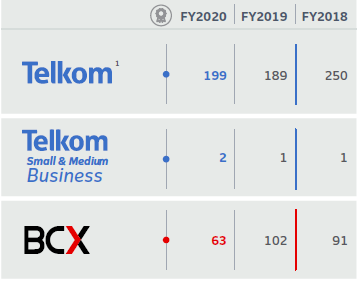
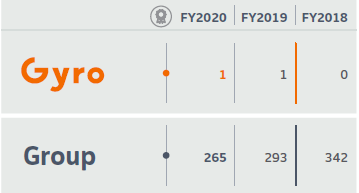
In addition to granting bursaries to those employees who wish to pursue academic studies, we provide classroom and on-the-job training through reputable service providers and through the Telkom Centre For Learning. Telkom spent R265 million on employee training and development.
Training and development spend (R’million)
 |
 |
1 Telkom includes Openserve, Telkom Consumer and Corporate Centre
We targeted high-potential talent development programmes
at various levels to focus on building operational, tactical
and strategic leadership capabilities. The Female Leadership
Development programme, now in its third generation,
started in 2015 and has had
123 delegates to date; 69%
of the participants in this programme are still with Telkom
and 24% were promoted over the past four years.
Other talent development programmes that focused on identifying and investing in high-potential leaders include Top Flight, Step Up and Traction. We focused on relevant exposure, networking opportunities, business projects, stretch assignments, mentoring and coaching, and provided the necessary support to maximise success in higher/ broader roles. Future talent development aims to focus more on digital leadership, aligning closely with the broader leadership development strategy.
Entry-level training programmes
Traction (pilot programme)
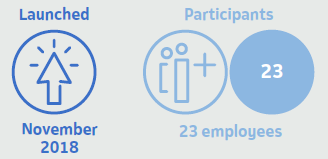
Target audience and objective: This is a one-year blended development opportunity for junior and operational levels across the group. It focuses on building leadership skill sets to equip employees for current and future business demands.
Content: The programme forms part of the Digital Leadership Development programme. The programme was designed to allow for a ladder of learning, such that delegates can progress from one programme to the next higher level.
Outcomes: The pilot group of operational and supervisory level started in November 2018. All 23 delegates successfully graduated from the programme, which included the University of Witwatersrand (Wits) Digital Leadership course in March 2020.
Women in Operations Development programme (WIO-Emerald)
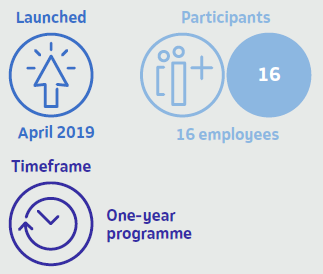
Objective: This programme focuses on accelerating female talent development in Openserve. It focuses on Openserve’s technical environments, i.e. network operations and network technology and systems.
Target audience: Female talent primarily in the technical/operational environment.
Content: The programme combines soft skills and technical development to ensure a rich learning and growth experience. The primary focus is technical development through exposure, experience and application.
Digital skills focus
Digital technologies
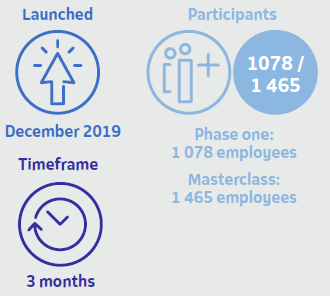
Objective: Creating greater awareness, knowledge and understanding around the digital economy and associated technologies, and the role employees could play in enhancing the solutions and value Telkom offers customers.
Target audience: Junior management (M/S6 down)
Content:
The programme was launched in two phases:
- Phase one: Introduction to digital technology and a digital technology expo where employees had the opportunity to experience some digital technologies
- Masterclass: Further exposure and a deeper understanding of digital technologies, including artificial intelligence, robotic process automation, virtual and augmented reality, Internet of Things and cloud computing
FTTH technology upskilling
There was dedicated focus on increasing FTTH
capability within Openserve, and 537 technicians
were trained in fibre technology. In addition,
434 employees in the network operating centres
attended a fibre overview course to strengthen
their understanding and ability to support the
technology.
Digital Leadership Development programme
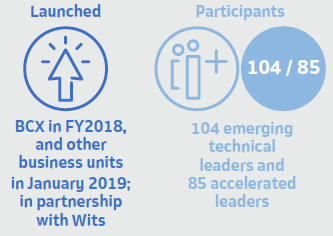
Objective: The one-year programme aims to build a digital leadership mindset and associated capability that will enable the group to leverage digital transformation to drive future growth, performance and success.
Target audience:
- Middle manager programme: emerging technical leaders
- Senior manager programme: accelerated leaders
Content: A range of learning programmes including real-world lessons through hands-on workshops, coaching sessions, case studies, syndicate and individual projects.
Outcomes: Accelerated leaders: 58 of 60 delegates in the Telkom programme graduated. The new cohort of the BCX programme started in September 2019 with 24 delegates.
Emerging leaders: In total, 63 of 64 delegates in the Telkom programme graduated. The BCX programme started in September 2019 with 44 delegates.
Leadership and succession management
Succession planning is another key component of talent management, and maps ways to mitigate vacancy risk. The aim is achieved by ensuring Telkom employs the right people with the right skills, capabilities and experiences, in the right place at the right time.
All management level roles (M/S6 and above) across the group were reviewed for successors, utilising an online talent and succession planning system. This input creates talent pools and talent actions for the future and proactive resource and development planning.
We identified a lack of immediate successors for some key roles. Telkom’s priority is to fast-track targeted development in these areas to ensure these successors’ readiness.
Our aspiration is to ensure at least 50% of all successors are identified as “ready now” to provide stable cover for the group. During the FY2020 talent review cycle, 28% “ready now” successors were identified. Strong focus is placed on investing and developing medium to longer-term successors to improve the readiness levels of successors.
Developing next-generation future leaders
New generation skills
As part of our focus on empowering South African youth, we support learnerships and internships for employed and unemployed black youth. Telkom invests significantly in coding and programming skills development to create a future talent pipeline to address the IT and digital skills gaps.
Explore Data Science Academy
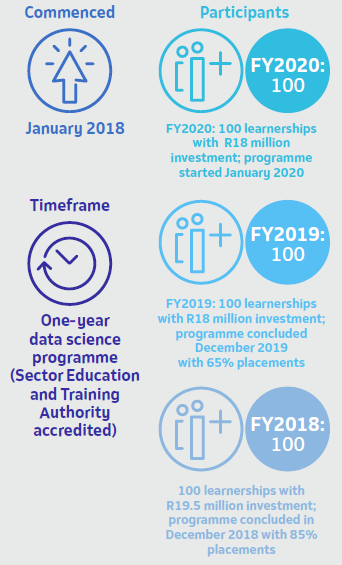
Objective: This programme aims to alleviate South Africa’s shortage of data scientists.
BCX was the founding sponsor of this Cape Town-based academy. The curriculum is an intense accredited skills programme that teaches the foundations of data science. It equips students with practical, on-the-job training to solve practical challenges and teaches business skills. The academy teaches real-world problem-solving skills that are highly valued in corporate South Africa.
Outcomes: Work placements for FY2019 cohort started in December 2019.
Data science is a high-demand scarce skill. The FY2019 cohort completed 20 projects with positive response from the teams. Graduates achieved a 79% average final mark, higher than FY2018. The average market salary of the academy students is around R445 000 per annum.
WeThinkCode (WTC)
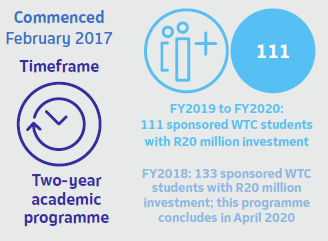
Objective: The programme sources and develops the next-generation coders, aimed at youth aged between 17 and 35 years.
WTC is a technology non-profit organisation dedicated to addressing the IT skills gap. It provides tuitionfree peer-to-peer learning. BCX sponsors qualifying WTC students and provides them with a two-year internship. This provides Telkom access to IT talent.
Outcomes: The partnership empowered WTC to expand from Johannesburg to Cape Town in its second cohort (April 2018 to April 2019). The partnership directly contributed to training 300 students, and indirectly supported 190 Cape Town students on their WTC journey.
The partnership also enabled WTC to support the talent needs for a growing list of South Africa's leading start-ups, including Yoco, Sureswipe, Triggerfish and Hyraxbio. Unlocking this pool of talent empowered some start-ups to significantly grow their development capabilities, beyond what they would achieve alone.
Telkom Centre of Excellence (CoE)
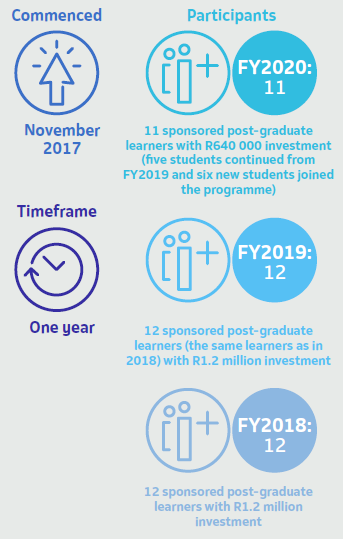
Objective: The one-year Telkom CoE programme
was launched in February 1997. It has proven to be
a sustainable technology research and development
initiative. There are 15 CoEs across South Africa,
making it the largest
co-ordinated research effort
in ICT in South Africa. Approximately 180 fulltime
postgraduate students benefit from the CoE
programme yearly.
Outcomes: WResearch funding provided to the
15 CoEs was R10 million. Telkom had 11 active CoE
students, all engaging in Masters studies in the
electrical engineering (light current) and computer
science study fields.
Ten students are black and five
are female.
Learnerships and internships
Unemployed people in learnerships1 and internships2 serve as a talent pipeline for the group, and learners are able to gain valuable work-related experience and development.
Netcampus
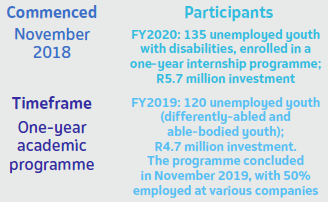
Objective: This is a partnership with Netcampus to develop ICT (primarily Microsoft) skills in BCX. Netcampus is an accredited IT training provider. It offers blended learning through multiple training methods including classroom, e-learning and cloudbased training. Learners are trained in either software programming or infrastructure technical disciplines.
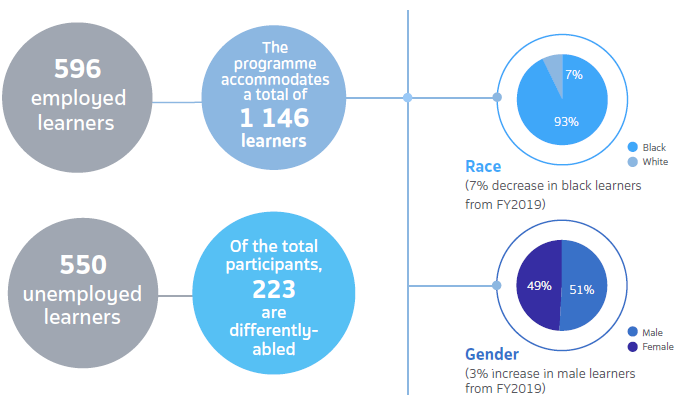
Telkom has also continued its focus on widening opportunities where possible for both unemployed and employed learners, in line with business requirements. Telkom had 1 146 learnerships and internships in progress in FY2020 (482 continued from FY2019 and 664 are new), compared to 848 in FY2019. It comprises various areas, including business administration, management, project management, ICT network maintenance, and IT system support.
Organised labour
Telkom’s labour relations system appreciates trade unions’ involvement as material stakeholders. Telkom has a recognition agreement with the Communication Workers Union (CWU) and South African Customs Union (SACU) (the alliance) as a business strategic partner. The alliance has organisational and collective bargaining rights which enable the union to sit at both business unit and company forums, including the GCEO strategic briefing sessions.
Freedom of association
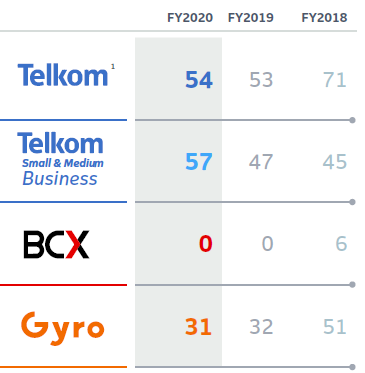
Telkom embraces the right to freedom of association and there are three unrecognised unions (Information Communication Technology Union (ICTU), National Union of Metal Workers of South Africa (Numsa) and Solidarity) with members at Telkom. These three unions have low membership percentages compared to Telkom’s 30% union membership representativity threshold. The recognised alliance requested Telkom to consider entering into an agency shop agreement. As this may be misconstrued as a violation of freedom of association, Telkom did not agree to this request.
BCX does not have a recognition agreement or stop order facilities with any union.
| 1 | A learnership is a work-based learning programme that leads to a National Qualifications Framework (NQF) registered qualification. These programmes directly relate to an occupation or field of work and comprise a theoretical course and practical on-the-job training, under the guidance of a mentor, creating an integrated and impactful learning programme. |
| 2 | An internship is a programme designed to either provide university and further education or training college graduates with an opportunity to gain workplace experience related to their qualification or to provide the workplace experience required to achieve a qualification. |
Permanent employees belonging to a union (%)
1 Telkom includes Openserve, Telkom Consumer and Corporate Centre.
Section 189
Driven by operational requirements, including the evolving needs of customers, technological advancements and the evolving technologies, Openserve, Telkom Consumer and Yellow Pages embarked on a judicious process to redefine their operating and service delivery models. As an alternative to retrenchments, VSP/VERP were offered to affected employees.
The company issued a notice in terms of section 189 of the Labour Relations Act on 15 January 2020, informing its unions and employees of possible retrenchments of an estimated 3 000 employees. The alliance remains the recognised unions for the company. As Solidarity, ICTU and Numsa have no recognition status, they are not eligible to participate in any union/management interaction structures.
However, as part of ensuring an open and fair consultation process, all unions with existing members at the company, regardless of their percentage representation, were informed of the potential retrenchments. The company invited Solidarity, ICTU and Numsa to participate in the company’s section 189 consultation process. Their participation was limited to this process and does not extend to collective bargaining rights.
Yellow Pages also issued a notice in terms of section 189 of the Labour Relations Act on 15 January 2020, informing its union (CWU) and employees of possible retrenchments of an estimated 80 employees.
Employee engagement
The HR function led the employee engagement process, including establishing an employee transition process and engagement portals. The portal ensured a central repository of all information for ease of access for employees and to reduce overall anxiety. The portal included an interactive functionality that allowed employees to pose questions, which were individually answered and consolidated into a “frequently asked questions” document. This document was regularly revised to ensure employees had up-to-date and relevant information.
We also established walk-in support centres in key regional hubs and HR practitioners were deployed to outlying rural areas on a rotational basis. This allowed employees to interact with representatives from HR, the Telkom Retirement Fund and Infund to get immediate face-to-face guidance on various HR, career, pension and personal finance matters. Face-to-face and telephonic counselling services were provided to employees and their direct dependants through ICAS. In addition, psychological debriefing sessions were made available to teams experiencing high levels of anxiety during this period.
The consultation process
Both entities (the company and Yellow Pages) approached the Commission for Conciliation, Mediation and Arbitration (CCMA) to facilitate the consultation process. The respective consultation processes commenced in January.
The CCMA initially objected to being consulted jointly with the three unrecognised unions, leading to two parallel consultation sessions. During February, the alliance declared a dispute. It alleged that Telkom was not consulting in good faith by offering VSP/VERP opportunities to employees affected by section 189 before consultation was concluded. The alliance approached the Labour Court with an urgent application for Telkom to be ordered to withdraw the VSP/VERP opportunities. At Yellow Pages, CWU also approached the Labour Court seeking similar relief.
The Labour Court dismissed the alliance’s application during March. CWU subsequently withdrew its matter for Yellow Pages.
Telkom temporarily suspended the section 189 consultation process after the announcement of the initial COVID-19 lockdown in March 2020. The suspension was lifted when South Africa moved to a level 3 lockdown, which enabled the parties to resume consultation.
| Outcome | |
| 2 271 applications at the company were approved, with employees leaving during FY2021. Yellow Pages approved 62 applications and these employees’ last day was 31 March 2020. |
BCX section 189 update
BCX embarked on a section 189 process during FY2019 and as an alternative to retrenchments, VSP/VERP were offered to employees; 773 employees left BCX during FY2019; and FY2020 respectively. 695 employees left BCX due to their approved applications for voluntary severance/retirement packages; and 78 employees were retrenched.
Company forums
Telkom has adopted health and safety as a standing agenda item at the company forum, a structure where Telkom and recognised trade unions interact on national matters. This ensured that parties engage on all health and safety matters, particularly measures being taken in response to COVID-19.
Occupational health and safety
Telkom’s occupational health and safety (OHS) vision is to provide a safe working environment and create a culture where every employee, service provider, contractor, supplier and visitor believe that zero safety incidents is achievable. Health and safety is an integral part of our operations, and we are committed to ensuring sustainable occupational health, safety and environment (HSE) considerations throughout all our operations.
OHS management is guided by an HSE strategy, policies and a health and safety system. It ensures compliance with the Occupational Health and Safety Act, 85 of 1993 (OHS Act) and other applicable legal requirements. HSE is strategically managed by the Telkom group safety, health and environment (SHE) department. The strategy is implemented by operational level SHE teams, supported by the group. As per the requirements of the OHS Act, health and safety management is supported by health and safety committees and representatives. The social and ethics committee has oversight over safety, health and wellness, and ultimate accountability rests with the board.
Employee wellness
The need to balance our wellness priorities and plans with the group’s reorganisation and current financial focus meant that certain initiatives, including the executive wellness programme, had to be deferred indefinitely. Despite that, we have implemented a few changes aimed at improving our employee value proposition (EVP) and overall wellness profile.
We appointed a single, independent medical aid intermediary to assist with ensuring that employees receive the best possible medical aid guidance, and that the group is positioned to negotiate scheme concessions on behalf of employees.
We moved from hosting an annual wellness day to a national, group-wide wellness week. This showcased various wellness initiatives and service providers and included wellness checks and tests. We hosted events at various sites in August 2019. The test results showed an overall reduction in intermediate lifestyle risk factors.
The wellness response to the COVID-19 pandemic and the section 189 process was timely, extensive and caring. Various initiatives aimed at ensuring that employees are supported, kept informed and best equipped to navigate the impact that both circumstances have had on their physical, psychological and emotional wellbeing were, and still are, being deployed.
Performance
Telkom continuously improves its safety performance. In FY2020 the group had zero fatalities and decreased the total recordable injury rate by 25%, and the lost-time injury rate by 30%. These improvements can be attributed to the following interventions:
- Enforcing consequence management for driver compliance to motor vehicle safety processes, and using statistical data from the vehicle tracking monitoring system to identify non-compliant drivers
- Leadership visibility and accountability at all levels and holding managers accountable for safety performance
- Employee safety awareness through “Safety starts with me” campaigns
| FY2020 target | FY2020 | FY2019 | |||
| Telkom1,2 | |||||
| Total recordable injury frequency rate (TRIFR) | 1.06 | 0.93 | |||
|---|---|---|---|---|---|
| Lost-time injury frequency rate (LTIFR) | 0.83 | 0.68 | |||
| Fatal injury frequency rate (FIFR) | – | – | |||
| Fatalities | – | – | |||
| BCX1 | |||||
| Total recordable injury frequency rate (TRIFR) | 0.55 | 0.41 | |||
| Lost-time injury frequency rate (LTIFR) | 0.45 | 0.29 | |||
| Fatal injury frequency rate (FIFR) | – | – | |||
| Fatalities | – | – | – |
| 1 | Permanent employees only. |
| 2 | Telkom includes Openserve, Consumer and Corporate. |
COVID-19
The COVID-19 outbreak and implementation of a national lockdown presented an unprecedented challenge to the wellness programme. In our efforts to respond quickly and appropriately to the impact of COVID-19, we implemented the following initiatives:
- An online COVID-19 portal was shared with employees. It is a central repository of information pertaining to the virus including Telkom-specific information, awareness material, videos on key aspects of keeping safe, and information on the ICAS-administered counselling and testing services
- A question and answer functionality and frequently asked questions was activated so employees can stay in touch and receive relevant, up-to-date information
- Issued guides to practically assist employees and line managers to navigate working from home under lockdown conditions
- Weekly communication to all employees on wellness topics, including how to manage working from home with children, who to call when they have a crisis or feel overwhelmed, tips for staying healthy
- Deployed a daily log-in app to enable the group to keep track of where employees are working in the event of emergencies, and to monitor potential exposure to the virus
- Deployed other wellbeing initiatives aimed at ensuring that employees are kept informed and to identify and flag, with ICAS, those who may not be coping and who may need additional intervention
These tools also provide Telkom with an indication of employee morale during this time.
FY2021 human capital focus areas
As most other companies, Telkom is assessing the multi-faceted long-term effects of the COVID-19 pandemic. There are real challenges, but also opportunities to strengthen our focus on creating a people advantage in the future.
It remains important that Telkom invests in employee engagement to ensure we build the right levels of support and resilience. The insights gathered from the employee survey, among other diagnostics, shaped our human capital focus areas for FY2021. This includes defining an employee value proposition (EVP), embedding a “new-way-of-working” culture, and broadening development opportunities including digital capabilities. The new EVP will delineate our culture and talent mobility and development framework.
We will implement a pulse survey strategy to capture realtime insights so we can be responsive and provide better clarity to employees.
We will continue our focus on building a sustainability mindset, including embedding the integrated performance management framework. We will strengthen our focus on building a continuous learning environment, with specific focus on next-generation capabilities programmes to enhance our competitive advantage. A digital learning management solution will enable employees to learn anywhere and at their pace to support career management initiatives.
We will complete the section 189 process and continue to assist employees in this regard.
The impact of COVID-19 on the workplace worldwide, highlighted the need for a holistic focus on employee wellbeing, one that includes physical, psychological, social, emotional and financial wellbeing.
Distance working is going to become the new normal and employee engagement, motivation and support are going to become increasingly important. Our future wellness strategy includes expanding responsibility for employee wellness to line management. This will include training line managers on proactively looking for signs of physical, psychological, social, emotional and financial vulnerability and on ways to manage these to ensure a healthy and resilient workforce.
In line with the OHS strategy, FY2021 focus areas will be to continue working towards achieving a zero-harm environment. We will continue the drive to influence the organisational safety culture through implementing the following initiatives.
- Continuous employee and management engagements through visible felt leadership
- Continual improvement of OHS regulatory compliance
- Contractor HSE management
- Implementing International Standards for Occupational Health and Safety – ISO 45001
