
- Page tools


Understanding our operating environment
We monitor local and global trends to assess the potential impact on our markets and customers. As the external market and environment change, we review our strategy to capture new opportunities and to mitigate emerging risks.
For each key external factor, we indicate the timeframe in which we estimate it will significantly impact Telkom. For this integrated report, short term is the next financial year (ending 31 March 2021), medium term is the period to 31 March 2023, and long term is beyond April 2023.

COVID-19 pandemic
South Africa and the rest of the world were
severely impacted
by the COVID-19 pandemic
and ensuing social and economic disruptions.
While these are mentioned in this overview of
Telkom’s operating environment, the full impact
will only be experienced in FY2021 and beyond.
Key external factors
|
Even before the negative impact of COVID-19, South Africa’s economic growth remained constrained. It continued to trend below the population growth rate of 1.6% as shown in the graph below. Moody’s downgraded South Africa to junk status in March 2020, with government debt expected to reach 91% of GDP by 2023, and the government deficit to widen to 8.5% of GDP in 2020*. Economic growth is hampered by electricity cuts and a looming global recession. South Africa’s economic recovery depends on government’s plans to introduce structural reforms to stimulate growth, curb state expenditure and encourage investment. |
Telkom will continue with its sustainable cost management and focused capital investments to mitigate the downside risk of lower economic growth and the limited spending capacity of customers. Initiatives to improve operational efficiency will enable us to offer products, services and solutions that are cost-effective and provide superior value to customers as they navigate economic difficulties. |
|||||
|
Comparison of GDP growth (real) versus population growth 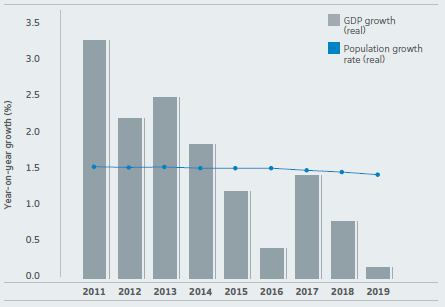
Source: Stats SA website. GDP growth (real) at 2010 prices * "Moody’s downgrades SA to junk", Business Day, |
|

|
Despite the economic downturn, we anticipate that the ICT sector will continue growing in FY2021, fuelled by increased demand for digital and telecommunication services on the back of measures to combat COVID-19 by reducing human contact. We expect digital adoption to grow, driven by the increase in people working from home on fixed broadband, deeper penetration of smart mobile devices and access to cheaper data, with video services driving increasing data traffic. The enterprise segment is experiencing weak demand and a shortage of digital transformation skills to implement cost-cutting technology. The consolidation of ICT companies is expected to continue through FY2021. Projected growth South African fixed data traffic PB (petabytes) 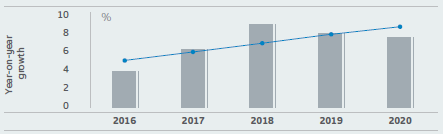
Source: BMI-T 2019 |
Telkom is developing integrated solutions for selected vertical markets, including health and retail. These are combining connectivity with additional ICT services to expand South Africa’s digital footprint. Specifically, in healthcare, we are supporting various government initiatives to use ICT in the management of the spread of COVID-19, such as partnering with the National Institute for Communicable Diseases (NICD) to develop a track and trace tool. We continue to focus on developing digital skills. Telkom will achieve growth organically and through partnerships and acquisitions. Along with digital solutions, cloud and cybersecurity services remain focus areas.
|
|
Digital ecosystems New technology drives the rise of digital ecosystems, comprising diverse companies from the telecom, technology and media industries. They combine their products and services into new business models to disrupt existing value chains, and to create new ones. This is done by creating new revenue sources through digital transformation, lowering costs via the digitalisation of internal business processes, and accelerating the speed of technology adoption by enterprises and their end customers. Locally developed digital platforms are increasingly becoming the primary channel to serve customers in banking, content, travel, health and education. Platform companies dominate the top 10 global companies 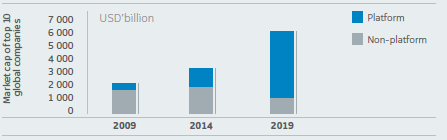
|
As part of the strategy to diversify our portfolio, Telkom will continue investing in the digital We seek to find the optimal balance between crafting meaningful partnerships and developing internal capabilities. |
||
|
Source: Accenture: Platform Business Models (Oct 2019) p28 (Platforms package products and services into a single solution to drive seamless customer experience. The largest examples includes Microsoft, Apple, Amazon, Alphabet and Facebook) |
|
Cybersecurity threats As digital transformation initiatives increase, so does the sophistication of cybersecurity threats. This requires enterprises to develop a layered, holistic and proactive approach to mitigate cybersecurity and digital risks. Furthermore, as infrastructure and services are provided beyond the corporate network parameter (for example, in the cloud), we require new security approaches to ensure effective prevention, detection and response to threats. Growing cost of cybercrime reported to the Internet 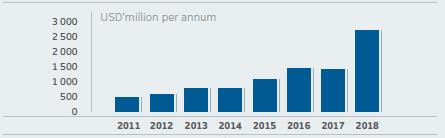
Source: Statista 2019 (From FBI, IC3,US DoJ data) |
Telkom invests in people, processes, technology, partnerships, solutions and intellectual property to remain at the forefront of cybersecurity capabilities. This enables us to effectively safeguard the confidentiality, integrity and availability of our own and customers’ digital workloads and data. We invest in operationalising the security operations centre, powered by in-house intellectual property and vendor technologies. This is a central component of our internal security processes and the managed security services provided by BCX. |
|
Competition is robust in the South African ICT industry. Traditional market players are being challenged by the emergence of new service providers who are rolling out fibre and wireless infrastructure based on start-up operating models, and regional service providers focusing on niche locations. Price remains a key measure of value for customers, driving down traditional voice and connectivity revenues. Fall in fixed broadband average revenue per user (ARPU), despite growth in broadband connections 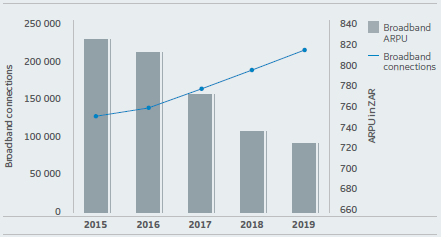
Source: Analysys Mason Datahub (30 March 2020) |
Telkom is committed to product innovation through data-led offerings such as FreeMe, SmartVoice and pre-paid broadband. We continue strategically planning and responding to new regulatory frameworks aimed at driving increased competition through lower effective prices. New innovative platforms, such as Mo ’Nice, utilise advanced analytical modelling to personalise offers to mobile customers, driving increased revenues and retention. |
||||
|
|
The release of high-demand spectrum is imminent and will impact the future mobile market structure. ICASA has issued an information memorandum setting out its proposed framework for licensing. It has undertaken to auction spectrum before the end of 2020, and to license the wireless open-access network (WOAN) in 2021. In April 2020, the mobile service providers (including Telkom) were granted temporary spectrum licences in response to the COVID-19 national disaster regulators. The Competition Commission's Data Services Market Inquiry report led to a decrease in 1 GB data bundle prices and an increase in the provision of zero-rated services in March 2020. Telkom altered the IP connect product offering to provide better value to ISPs. The results of the ICASA Priority Market Inquiry into the efficacy of competition in the mobile broadband market are expected later in 2020. Price of 1 GB data in South Africa compared to median of 36 African countries 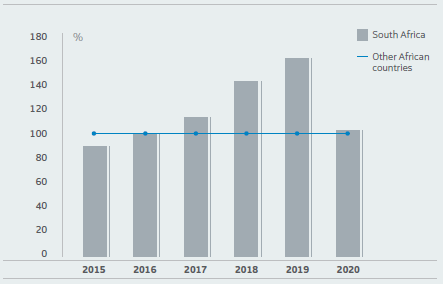
Source: SA Competition Commission – Data Market Services Enquiry December 2019 |
Although Telkom believes that the price remedies imposed by the Competition Commission did not address the competitive failings in the mobile market, overall the regulatory developments in FY2020 were largely consistent with Telkom’s expectations, and are factored into our commercial strategies and plans. Our ambition to win in broadband is affected by access to spectrum, and we continue to participate in the regulatory processes for spectrum auction and establishment of the wholesale open-access network. Lower data prices provide less room for Telkom to differentiate based on price. We extended our network coverage through an enhanced roaming agreement and introduced the YQ self-service capability to improve customer experience. Telkom continuously engages with regulators and policymakers on levelling the playing field in the mobile sector and on measures to improve competition.
|