

- Page tools



Telkom delivered solid performance with the mobile business driving growth, FCF improved three-fold and balance sheet strengthened, notwithstanding the decline in fixed-voice revenue that impacted our EBITDA.
Our
value-creation
strategy:
Group Chief
Executive
Officer’s report
Key strategic themes impacting performance
- Infrastructure investment
- Broadband leadership
- Evolution of fixed business
- Sustainable business
Telkom operates in a constantly evolving telecommunications environment where advances in technology and changing customer needs are impacting traditional revenue streams and requiring the business to transform for long-term growth.
Key highlights
Operating environment
This year was characterised by a tough economic environment where we saw the country slipping into a technical recession in the fourth quarter of the year and Moody’s downgrading South Africa to junk status. The President of South Africa declared a national state of disaster in response to the unprecedented COVID-19 pandemic in the fourth quarter of the year.
This year also concludes a challenging decade of depressed economic growth, currency volatility, technology disruption, increasing competition and regulatory uncertainty – none of which Telkom has been spared from.
Telkom actively engages with telecommunications regulators and policymakers to motivate for a regulatory and policy framework that supports fairness and encourages competition with long-term benefits for consumers and the growth of South Africa.
The Competition Commission’s inquiry into the cost of data affirmed that the South African market has no effective competition, and the recommendations have resulted in a decrease in data pricing to benefit consumers and enable greater access. We welcome this ruling and through our investments into Telkom’s scalable and flexible network, we remain well positioned to offer the best value broadband propositions in the market.
The policy on high-demand spectrum was published in the first half of FY2020, providing much needed clarity for the sector. While we await ICASA to give effect to the policy, the market has proceeded with spectrum sharing agreements that have changed the nature of spectrum access.
In April 2020, as part of the national response to COVID-19. Mobile service providers were granted temporary spectrum licences to ease network concentrations during the lockdown period. Telkom benefited from the emergency spectrum assignment to support increased broadband demand brought about by South Africa’s national lockdown in response to COVID-19. The spectrum is assigned temporarily to be returned no later than three months after the country’s lifting of the national lockdown. We have been very encouraged with the speed and deliberateness of government’s actions and decisions during this time. We are hopeful that a permanent decision on spectrum allocation will be made soon, taking the market structure into account so as to introduce competition – which will result in increased quality and decreased costs for consumers.
Performance overview
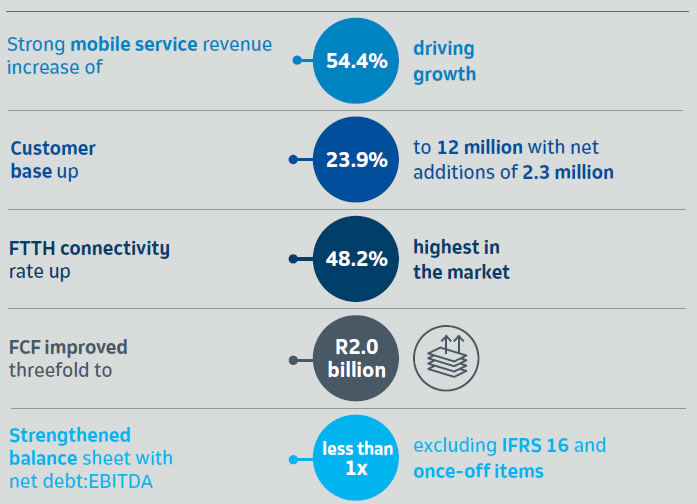
Our group performance depicts the evolution of technologies and revenue mix. Group revenue grew 3.0% to R43.0 billion despite a 22.2% decline in fixed-voice revenue. The ongoing capex investment enabled Telkom to grow new revenue streams and showed growth in evolving technology offsetting the traditional business decline. Mobile, IT and masts and towers contributed positively to group revenue. Capex investment of R7.7 billion, with capex to revenue of 18.0%, underpins revenue growth. We focused our investment programmes on key growth areas, and we are seeing good returns, with mobile service revenue increasing by 54.4% and the connectivity rate for FTTH improving from 38.4% in the prior year to 48.2% the current year – the highest in the market.
The mobile business grew 54.4% in service revenue from a higher base to R12.6 billion to remain the fastest growing mobile business in South Africa with 12 million customers.
This was underpinned by our ongoing network investment and our successful broadband-led proposition, which continue to resonate well with customers. Despite ongoing competitive threats with changes implemented by our competitors in the mobile space, our broadband-led propositions are market leading being best in class for value and effective pricing. The mobile business remains profitable, with its EBITDA margin improving from 1.4% to 14.9.% over the past three years.
BCX IT business contributed positively to group revenue. The performance was supported by the drive to grow the industry-specific owned intellectual proprietary.
The strategy to separate our property and masts and towers portfolio to increase management focus and unlock value for the group continues to be successful. Gyro contributed positively to the group, driven by our masts and towers portfolio, as the demand for external leases increases.
Our challenge for the year was the impact of the fixed-voice revenue on group EBITDA as the decline intensified. The growth in new revenue streams, which have lower margins, was not sufficient to offset the decline caused by high- margin fixed-voice on group EBITDA. Over time, as the revenue mix evolves, we expect the contribution from the fixed-voice revenue to decrease and the contribution from the mobile business, with improved EBITDA, to increase and offset the impact of fixed-voice on group EBITDA. Until this inflection point, management will focus on sustainable cost management, which includes the benefits of the restructuring programme and other levers to ensure that we offset the gap caused by the decline in fixed-voice.
In line with this technology shift, the business requires a new skill set to service these newer technologies and respond to evolving customer needs. Telkom offered voluntary severance and voluntary early retirement packages to 2 271 employees as an alternative to retrenchments at a cost of R1 186 million in the current year. 75% of the employees took early retirement packages. There were no retrenchments in the current year.
To mitigate the pressure on free cash flow (FCF) caused by the fixed-voice decline, Telkom implemented working capital optimisation initiatives. I am pleased that, despite the margin pressure experienced, our FCF improved threefold to R2.0 billion compared to the previous year. We will continue to focus on Telkom’s liquidity during the tough trading environment.
During the year we strengthened our balance sheet, refinancing debt at a cheaper rate and repaying maturing debt totalling R1.2 billion. As a result, our gearing improved in the second half of the year, with net debt to EBITDA reducing to 0.7x (1.3x on a reported basis). The net debt to EBITDA ratio was also positively impacted by the liquidation of the short-term investment of R1.5 billion to fund phase one of the restructuring programme and a significant improvement of approximately R1.4 billion in our FCF compared to the prior year.
COVID-19 response
We adopted the principle of saving lives and livelihoods, and prioritised the health and safety of our employees. The group has taken a dynamic approach to the COVID-19 pandemic, which continues to disrupt every aspect of our daily lives and business operations. We proactively designed and implemented several precautionary measures to mitigate the risk that will lessen the impact of the COVID-19 pandemic, focusing on the wellbeing and safety of employees; continuity of supply and service to customers; supply chain, infrastructure, and network; IT and security; and liquidity.
Key strategic themes underlying performance

1 Refer to Openserve
2 Refer to Consumer
3 Refer to BCX
5 Refer to Gyro
6 Refer to GCFO report
7 Refer to HR report
Safety of our employees
Telkom’s focus is and will always be on the wellbeing of our employees, with approximately 80% being empowered to productively work from home. The global COVID-19 pandemic has forced us to embrace the centrality of technological advancements. The way we connect, communicate, and conduct business has forever been altered. Amid troubled times, we need to ensure full engagement from every team member, whether working from home or on the field, while reducing the stress that tomorrow may bring.
Telkom is not only providing safety gear for essential employees, but also increased education and awareness for those working from home. Telkom has an internal dashboard to track all internal positive cases. Employees have access to a dedicated COVID-19 portal which keeps all employees up to date with COVID-19 developments. Additionally, employees have access to a dedicated COVID-19 helpline to report any possible infection. Employees get free screening and testing. Should they test positive employees also get case management through our partners ICAS to ensure they get the best care possible.
While 80% can work effectively from home, our frontline employees and field service technicians continue to serve customers, and therefore are constantly exposed to the risk of transmission, especially given the rising COVID-19 cases in South Africa. Understanding the seriousness of the disease and risk our essential members are facing, Telkom is supplying all necessary personal protective equipment, such as face masks, face shields, gloves, sanitiser, personal thermometers and Hazmat suits for our field technicians.
The world is living in trepidation, surrounded by uncertainty as COVID-19 continues to loom, with no vaccine yet. At Telkom, concerns over low productivity, high absenteeism, a growing fear to engage with service providers, and the psychological impact the pandemic may have on employees is not a far-off reality.
In memoriam
We extend our heartfelt condolences to the families, colleagues and friends on the passing of our colleagues who lost their lives due to COVID-19. May their souls rest in peace.
Telecommunications is an essential service
It is a time of uncertainty, but it is also a time when the work we are doing is most critical. When President Cyril Ramaphosa first announced the national lockdown in March, telecommunications was declared an essential service in South Africa. As an essential service and as one of the largest telecommunications companies in South Africa, the country has been looking to us to provide support and keep them connected.
Our supply chain remains resilient during the lockdown period. We assessed the adequacy of current inventory levels for shortterm and medium-term consumption. Identifying strategic suppliers ensured higher priority from them and we reviewed suppliers business continuity plans. We identified single-source suppliers and accelerated qualification of new suppliers for alternative sources of supply. Telkom also mapped its high-risk supplier footprint to manage global supply shortages caused by COVID-19.
How Telkom is managing increased demand
The COVID-19 pandemic is fast-tracking digital transformation in companies. Businesses need to quickly adapt or risk redundancy. During the lockdown, Telkom has seen a surge in fixed and mobile network traffic for our telecommunications services, due to more people working from home.
Fortunately, Telkom has a scalable network and enough redundancy to manage the increase in demand. The significant investments we have made in modernising the network, including fibre backhaul, have enabled us to carry more traffic on our network and provided a resilient system to support growing demand. Telkom’s mobile footprint capacity has been improved with new sites and increased radio capacity on existing sites. The assignment of additional spectrum, on a temporary basis, has enabled us to alleviate congestion in certain sites.
In response to COVID-19, we enhanced our broadbandled propositions across our customer segments. We took advantage of our existing copper network, where we launched broadband on copper services and utilised spare capacity ports to cater for individuals working from home and for students engaging in distance online learning with aggressive price points to ensure customers have access to broadband where it is both available and viable.
For the national lockdown, we scaled up our digital platforms as stores were closed. We launched the Telkom business e-commerce platform. This allowed business customers to purchase Telkom connectivity products online 24/7. We managed to successfully launch the platform with the help of various logistics partners and our very own Openserve for fibre-related products.
This goes to show how the role of technology has changed since the start of the outbreak, and as each day passes our dependency on technological innovation grows.
Telkom, supporting a nation through crisis
To assist the government in its objective to contain the virus, Telkom set out on many initiatives to help combat the effects of the virus on the economy and on society. We began developing the novel track-and-trace COVID-19 system after partnering with the NICD, and donated 1 500 devices and data to the Department of Health to assist with track and trace. We zero-rated educational sites of institutions of higher learning and expanded free high school learning content through our BCXLearn platform. Telkom further pledged R15 million and formed a disaster relief fund that supports the Red Cross in support of our unsung heroes – the frontline healthcare workers.
Over and above this, we managed to convey the importance of contributing to the COVID-19 pandemic, relaying the detrimental effect it is having on communities, economies, and health systems. The public took notice and we have seen an increase in contributions as donations are being made via SMSes.
Our “new normal” going forward
As we embrace our “new normal”, we must come to terms with the fact that the pandemic has not only disrupted our lives, but permanently changed the way the world operates. We will continue to do everything in our power to support our people and our country. As global conditions shift, we will swiftly respond to changing market dynamics, minimising impacts to our business and disruptions to our customers who depend on us.
Compliance FY2020
In 2015, the Competition Commission imposed various behavioural conditions on Telkom in approving the merger between Business Connection and Telkom. I can confirm that Telkom has complied with the behavioural conditions that were agreed to as part of the BCX Merger Agreement.
Outlook
Unlock value
We are reviewing our business portfolios and exploring how we can unlock value from these businesses over the next three years. The value unlock programme is underpinned by valuation, strategic imperatives, and capital allocation. This programme seeks to realise value for shareholders. Telkom is not a reflection of its intrinsic value and it is trading at a telco multiple, yet its portfolio of businesses consists of IT, masts and towers and infrastructure businesses which are valued at higher multiples than telcos globally.
Valuation gap – indicative value

Potential multiples
Market cap of R14 billion as at 19 June 2020
Conclusion
Despite the poor economic outlook and the challenges brought about by the measures imposed to combat COVID-19, we anticipate that the ICT sector will continue growing. This demand has been spurred by the increase in people working remotely during the various levels of lockdown and their growing demand and adoption of digital and telecommunication services.
We are focused on addressing and mitigating the impact of COVID-19 on our people and the sustainability of the business. We will remain positively engaged in supporting SA Inc. as the country navigates the unfolding consequences of the pandemic.
Operationally, we will continue to transform the group to make it more resilient and effective. This involves growing the Telkom SMB business, scaling up our mobile business, continuing to transform our network, and reviewing our business portfolios to explore how we can unlock further value over the next three years.
Appreciation
I thank my executive team and employees for their commitment and support during the year. I also thank our customers and service providers for their continued support as we position the group for long-term growth.
My appreciation extends to the board for providing clarity on areas of prioritisation and focus, and for their support.
Sipho Maseko
Group Chief Executive Officer