
- Page tools


Material themes
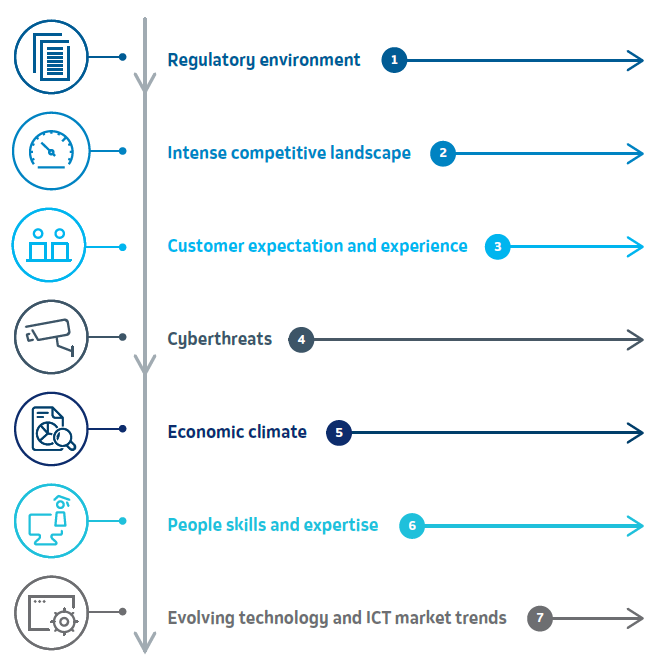
Our material themes represent a prioritised view of our material matters as determined by the materiality determination process.
Telkom disclosed nine materiality themes in FY2019. These were confirmed and updated to reflect their current status. In reviewing the materiality themes, Telkom made the following changes:
- B-BBEE transformation is incorporated under regulatory environment as it is a regulatory agenda
- Utilities supply is included in economic climate. The impact of power supply remains a challenge for the country’s economy. However, the operational impact of load shedding on Telkom is under control as demonstrated in the past two years, and the direct financial impact is immaterial in the context of group revenue
Post our materiality determination process, we considered the impact of COVID-19. We concluded that it is a material matter that significantly impacts most of our material themes.
1 |
2 |
3 |
||
| Regulatory environment |
Intense competitive landscape |
Customer expectation and experience |
||
Telkom operates in a highly regulated environment impacted by policy uncertainty and inconsistency, and continuously evolving regulations and legislation. International regulatory trends further impact Telkom, irrespective of the different operating context; the South African political environment; and the resources required to implement new or changing regulations.
|
The competitive landscape includes OTT players and other nontraditional entrants disrupting the market, and the convergence of telecommunications, technology, media and consumer electronics. This provides us with collaboration opportunities with OTT players, and requires Telkom to sharpen its focus on capital allocation, cost optimisation, business growth, innovative products and services, and customer satisfaction.
|
Our customers expect a differentiated value proposition where they receive value for money. Their experience is impacted by price, available products and services, service speed and reliability, data security, and IT system stability. In the context of Telkom’s competitive landscape, customer experience impacts our reputation and customer attraction and retention. Therefore, Telkom must appropriately invest in products and services, systems and employees to ensure customer expectations are met. |
||
4 |
5 |
6 |
7 |
|||
| Cyberthreats | Economic climate |
People skills and expertise |
Evolving technology and ICT market trends |
|||
Cyberattacks and data breaches can potentially impact Telkom’s service levels, leading to client dissatisfaction, reputational damage, business disruption and loss of revenue. This requires continuous focus on cybersecurity and business continuity plans. Cyberthreats provide the group with opportunities to develop new customer solutions (cybersecurity).
|
Local and international economies impact Telkom’s ability to grow the business, the cost of doing business and customers’ spending power. This is impacted by muted South African economic performance; the South African political environment and geopolitical pressures; investor and business confidence; financial risks related to liquidity and foreign exchange and interest rate exposure; effectiveness of costoptimisation efforts; and socio-economic factors, such as the high youth unemployment rate.
|
Telkom requires skilled
employees in ICT, digital
and other areas to
develop products and
solutions to generate
future revenue and
provide the expected level
of service to customers.
We compete for scarce,
specialised and technical
skills with traditional and
Gender and race diversity, the premium paid for skills and experience, and the anticipated future skills pipeline (fourth industrial revolution) impact our attraction and retention of talent. Telkom’s focus areas are developing and refining the employee value proposition (EVP) and skills development. |
Telkom needs to remain abreast of advances in ICT and disruptive technology. We need to ensure longterm viability by developing innovative products and services and enhancing the group’s networks and infrastructure. This requires appropriate infrastructure, network investment and skilled employees to support product development and delivery. Focus areas include refining Telkom’s capital allocation model, and monitoring the return on invested capital. |
|||