Leadership reflections on FY2026
2
Telkom is on an upward performance trajectory that the Board believes is sustainable. Over the past three years, we have provided direction and oversight that have driven strategic improvements and consistent delivery. We are confident that this trajectory will continue despite the many headwinds evident in Telkom’s external environment.
Q How is the Board navigating a very disruptive time in the world, and what measures are you taking to protect Telkom and its customers from potential negative impacts?
A We are operating in a global environment that continues to be shaped by geopolitical instability, inflationary uncertainty and ongoing energy and supply chain risks. Our responsibility has been to ensure that Telkom remains resilient, well governed and financially strong.
The FY2026 results speak to this resilience, financial strength and high-performance culture. Telkom delivered an improved EBITDA margin of 28.1%, higher free cash flow of R3.1 billion, and robust leverage at 0.5 times net debt to EBITDA, which gives the Group the capacity to absorb shocks while continuing to invest responsibly. Equally important has been protecting customers and network availability. The Board oversaw sustained investment in energy resilience and network optimisation, while encouraging cost discipline.
We have improved our alternative energy options, battery deployment and operational efficiency. This has strengthened network uptime, reduced exposure to electricity supply risk and lowered operating costs, while supporting our environmental commitments.
Rapid growth in AI adoption is a major feature of our disrupted world. Our data-led strategy, fibre expansion and network modernisation are enabling Telkom to capture this shift while delivering margin expansion.
Taken together, these actions position Telkom to navigate ongoing uncertainty while continuing to deliver secure, affordable and reliable connectivity to South Africans.
Q Under these conditions, how does the Board steer the Group to ensure business is conducted in an ethical manner?
A Telkom’s ethics governance systems and processes are mature when you consider the work done by our Group Ethics Office. Comprehensive policies and supporting structures such as the economic crimes forum are also in place.
The Board approved a revised Group Code of Ethics and ethics strategy for FY2027 to FY2030, which provide a practical governance and implementation framework.
However, when you are working with people, including our customers, employees and suppliers, there are always potential risks.
The Board relies on the Social and Ethics Committee to provide detailed oversight of ethics. This includes assessing incident reports and related analyses, which enable us to identify root causes and act to remediate them.
We also rely on management to walk the talk and be role models for the behaviour that we expect. They have to set the tone, and for people to experience this, management has to be visible.
As a Group, we can still do more to engage with suppliers on our ethics and values, which are core to our culture.
Q What emerged in the Board’s strategy review this year, and what stood out in terms of implementation?
A In our annual review, we make sure the PIVOT Strategy remains relevant, deliverable and aligned with the Board’s risk appetite and long-term value creation objectives. There were no fundamental changes to the strategy; rather, the emphasis sharpened around execution discipline, capital efficiency and resilience in a more constrained economic and competitive environment.
In terms of progress, implementation has been mixed. Clear areas of strength are the data-led, core connectivity and infrastructure pillars of the strategy. However, the Board is equally clear on areas of weakness. Top-line growth remains below the Group’s medium-term ambition, and BCX’s performance has yet to stabilise in a subdued enterprise ICT market.
These areas are receiving focused Board attention to ensure that the pace of execution matches the Group's strategic intent.
Overall, the Board believes PIVOT remains the right strategy, and disciplined delivery and sharper prioritisation continue to be essential to realising its full potential.
Q In last year’s report, you anticipated that the Board would pay close attention to FTTH expansion, free cash flow and transformation. What progress was made?
A Openserve delivered its first year of overall revenue growth in nine years. It boosted homes passed to over 1.5 million and increased the connectivity rate to 53.1% while maintaining strong service quality and uptime. The fibre market remains highly competitive, which places pressure on pricing and returns. However, the Board is satisfied that network capability and monetisation are moving in the right direction.
Free cash flow increased by 10.4%, supported by disciplined cash management, structural cost improvements, lower lease liability repayments and reduced financing costs. Cash flow also benefited from improved collections and ongoing cost optimisation. Net debt reduced materially, strengthening the Group’s financial resilience. Sustained cash generation remains essential to fund growth while preserving balance sheet strength.
The Board continues to view transformation as a strategic and governance priority. We saw progress in workforce capability, digital skills development and leadership diversity, as well as measurable advances in sustainability and energy resilience.
However, performance remains uneven across the Group. In particular, the enterprise ICT services business is receiving ongoing Board attention to ensure that execution matches strategic intent.
Q Telkom is committed to smart capex deployment anchored in improving returns. How has this been shaping capital decisions?
A We want to deploy capital in smart, cash-generative opportunities where Telkom has enduring structural advantage – notably, in national fibre, mobile and core network infrastructure. At the same time, we want to reduce complexity, capital intensity and operational drag elsewhere.
Returns on invested capital remained stable in FY2026 at 11.2%, applying the effective tax rate, despite increased capital expenditure. This reflects disciplined deployment of capital into value-accretive opportunities.
While it is important to allocate capital to innovation and research and development (R&D), the Board ensures we take a holistic approach. This is based on a rigorous and strategic capital decision-making process that considers growth, operational efficiency, sustainability and shareholder dividend requirements.
Q Were there any changes to the Board composition and Committees this year?
A Following recommendations raised A during the Board evaluation process, the Board Committees were reconstituted from 1 May 2026 to ensure a better balance of skills, experience, independence, continuity and diversity. We strengthened regulatory expertise on the Social and Ethics Committee and took particular care over the Remuneration Committee, which is always in the shareholder spotlight.
The voting results from our AGM held on 21 August 2025 confirm that shareholders support the appointment of Board and Committee Members. They also voted overwhelmingly in favour of our remuneration policy and implementation report.
Our engagement with shareholders at the Chairperson’s roadshow and the AGM continued to build relationships of trust anchored in transparent communication, delivery on our promises and a positive performance trajectory.
Q A positive performance trajectory means higher dividends for shareholders. How did the Board approach dividends in FY2026?
A The Board approved a revised dividend policy with a higher payout ratio of 40% to 60% of free cash flow, up from last year's 30% to 40%.
The Board declared a 65.7% increase in the final ordinary dividend per share. Both decisions were based on resilient free cash flow and a strong financial position. We continue to balance Telkom’s long-term financial viability and business requirements for additional capital investments to drive future growth.
I am sure our shareholders will appreciate both the short-term reward and a responsible long-term approach. Our commitment is the continued focus on revenue growth, the execution of our strategy, and the delivery of shareholder returns.
Q In providing strategic oversight, what will the Board prioritise in FY2027?
A The Board’s priorities for the coming financial year include:
Q Stakeholders are central to Telkom's value creation. How would you like to thank them?
A We are fortunate to have Board Members who go beyond fulfilling their fiduciary duties and delivering on the Board’s charter. I am grateful for their diligence in providing oversight and ensuring Telkom’s sustainability through our collective and robust deliberations.
I also thank Telkom’s employees for their unwavering commitment and resilience over the years. This does not go unnoticed.
What stood out this year was the openness, continued trust and support of our stakeholders, especially our shareholders. We are privileged to enjoy ever-strengthening engagements and relationships with stakeholders, and we do not take their support for granted.
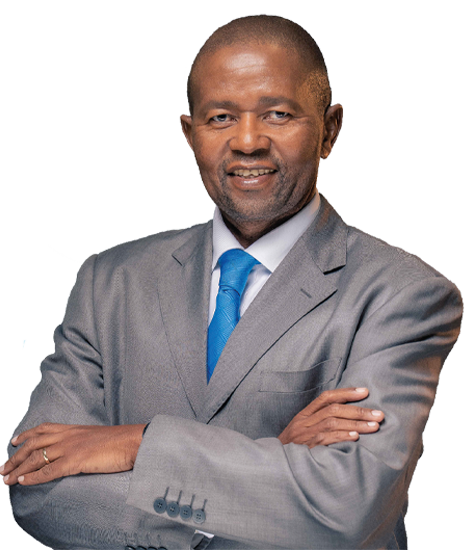
Mvuleni Geoffrey Qhena
Board Chairperson