

In a challenging IT market, BCX maintained a stable margin relative to the third quarter through disciplined cost management. The overall revenue of the IT business was stable in a market characterised by subdued enterprise spend, heightened customer price sensitivity, and delays in project execution that muted growth in the sector. Despite this, cybersecurity services recorded robust growth, while hardware and software revenue also grew for the year.
Enterprise performance remains highly dependent on deal timing, project delivery and customer investment decisions, with clients prioritising cost containment over transformation.
EBITDA margin
Cybersecurity services revenue
IT hardware and software revenue growth
Strategic focus areas
Challenges
We implemented a structured operating cadence, strengthening oversight of performance, pipeline quality and deal execution. This helped us improve deal conversion, which is being driven at appropriate margins. The focused execution across key operational levers was reflected in an improved net working capital position and higher quality of earnings in hardware and software, driven by credit management and strong cash conversion.
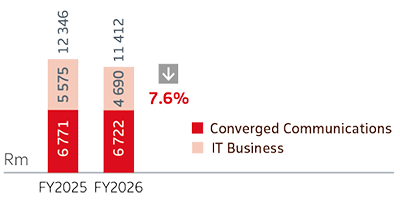
Total revenue declined by 7.6% to R11 412 million. Annuity-based revenue remained stable, with the decline being due to the Converged Communications business. The deliberate migration to fibre services resulted in voice and traditional data revenue declining by a combined R458 million, while fibre-related data revenue declined by R140 million.
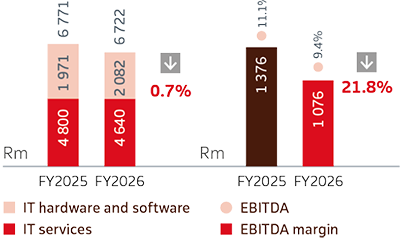
EBITDA decreased by 21.8%1 to R1 076 million, resulting in an EBITDA margin of 9.4%. The decrease was largely due to the decline in Converged Communications revenue, partly offset by cost efficiencies realised from the cost transformation programme completed in FY2025.
Disciplined cost management led to operational expenditure declining by 5.2%1. This was mainly due to lower employee costs and maintenance, and a significant reduction in impairment of receivables as we continued to proactively manage receivables.
Revenue
The IT business showed resilience. Overall revenue was stable, with a robust 21.1% growth in cybersecurity services reflecting sustained client demand for advanced threat management, advisory and network protection services. Municipal services grew by 7.5% as we continued to partner with municipalities, providing backbone IT services to enable them to service their communities. Field services grew by 12.1% on the back of supporting project spend in the retail IT industry, and IoT showed commendable growth as we offered greater customer value to offset softness in traditional project-based work.
Cloud revenue growth was hindered by customers' cost containment to fund their public cloud journeys, intensified competition from hyperscalers, and lower-than-expected enterprise migration. However, this remains a growth focus area for the business.
IT hardware and software revenue grew by 5.6%, driven by a larger proportion of revenue realised as hardware. Profitability improved marginally as we continued to attach services that support annuity-based revenue.
IT services profitability grew year on year, reflecting disciplined execution of strategy and a focus on high-quality revenue and cost efficiency. This stands in contrast to market trends, where margin pressure is a key theme. Our results demonstrate the resilience of our operating model and the progress we are making in repositioning our business.
1 Excludes R157 million restructuring cost provided for in the prior year.
IT business revenue
EBITDA/EBITDA margin
The deliberate migration to fibre-based platforms, together with client migration due to pricing dynamics, resulted in revenue declining by 15.9%. Fibre-related data revenue contributed 82.4% to total data revenue. Overall demand pressure and muted growth led to a 6.6% decline in fibre-related data revenue, a deceleration from 19.0% in the third quarter.
We will continue to focus on retaining existing customers and protecting volume revenue through targeted service improvement. Operational integration within the OneTelkom framework improved our implementation timelines and incident resolution. Optimisation of the Converged Communications business model strengthened service delivery, lowered cost to serve, and improved customer experience, particularly for high-value enterprise clients.
These efforts were reinforced by next‑generation network monitoring capabilities, positioning the business for AI‑driven network operations.