
Telkom has a well-defined risk and compliance approach that supports the PIVOT strategic pillars and is well integrated into operational processes. Our operating environment is characterised by ever-changing threats and unprecedented opportunities. This requires us to balance potential challenges and rewards by consistently monitoring our risks and opportunities.
Telkom is committed to complying with all applicable laws and regulations. We actively support key non-binding codes and standards, such as King IV and a range of International Organization for Standardization (ISO) standards. The ISO standards guide our policies, risk management and information security processes.
Telkom reports annually on performance against the risk and compliance plan. Where required, improvement areas are identified and used as input in the review of the following financial year plan. In reviewing our Group risks and opportunities, we consider both internal and external contexts.
To determine the effectiveness of our risk and compliance management, Telkom performs control self-assessments and compliance control validation reviews. The annual reviews ensure we meet the King IV requirements. Any undue or unexpected risks, and those risks outside appetite, are reported with the necessary mitigating actions, responsibilities and timeframes.
In a dynamic and competitive industry, it is imperative to have an effective enterprise risk management (ERM) strategy. The enterprise risk management framework (ERMF) has been designed to navigate the risk inherent to our business. All business units, support functions, processes, projects and other controlled entities are subject to the ERMF.
In FY2026, we undertook an ERM transformation project to ensure the ERMF remains robust, forward-looking and responsive to an increasingly complex and dynamic risk environment.
A core focus of the project was the redesign of Telkom’s risk universe and taxonomy to improve clarity, consistency and comparability of risks across the Group and its subsidiaries.
The transformation project strengthened:
The transformation enabled more integrated insights at Group level, supporting timely decision-making and proactive management responses.
The ERM transformation project reinforced Telkom’s commitment to embedding risk and opportunity considerations into strategic planning, capital allocation and operational decision-making. The Group is enhancing its capacity to anticipate disruption, respond with agility and protect long-term stakeholder value.
The project will continue to mature in FY2027 and beyond, further embedding leading practices and fostering a strong risk-aware culture across the Group.
Telkom operates in a highly regulated environment, and regulatory risk is one of the Group's principal risks and material themes. To ensure compliance, we focus on:
Licence to operate – Spectrum allocation and licence conditions remain a priority amid evolving regulatory frameworks. These require proactive compliance monitoring and stakeholder engagement.
Data privacy and digital regulation
– Large-scale data processing, digital service coverage, and complex cyberthreats require that we enhance our cybersecurity capabilities and third-party oversight, and embed robust data governance frameworks to safeguard information and maintain stakeholder trust.
Regulatory compliance – We maintain a comprehensive regulatory universe and continuously monitor digital, interception, and cybercrime legislation. This enables a proactive approach to mitigate compliance gaps and improve our processes.
Market conduct and consumer relations
– Our shared value of customer centricity places customers at the core of our purpose and value creation. Compliance with the Consumer Protection Act is a cornerstone of our approach, supported by enhanced controls to safeguard customer interests. This year, we launched consumer-focused training to ensure improved consumer experiences.
Environmental, health and public safety
– We remain committed to environmental, health and public safety by ensuring compliance with the National Environmental Management Act (NEMA). We have also assessed the impact of Administrative Adjudication of Road Traffic Offences (AARTO) amendments on our operations and are implementing appropriate controls to strengthen compliance and mitigate associated regulatory risks.
We confirm that no material or repeated regulatory penalties, sanctions or fines for contravention of statutory obligations were reported in FY2026.
| End‑to‑end assurance |  |
Oversees risk and compliance across the Group. Provides an integrated approach to the governance and management of risk and compliance, supported by a risk and compliance operating model aligned with Telkom’s business model. | Oversight |
| Board | |||
|
Monitor and advise the Board on risk and compliance, laws and regulations. | ||
| Audit, Risk, and Social and Ethics Committees | |||
|
Integrates risk and compliance management, systems and people across the Group. | ||
| Group Exco | |||
|
Assess risks and resulting
opportunities within the agreed risk framework. Reduce the impact of regulatory risk by driving compliance awareness for all applicable laws, regulations and supervisory requirements. |
Enablement | |
| Integrated Governance and Risk Committees | |||
|
Shares best practices and knowledge and monitors key risks and mitigation plans. | ||
| Enterprise risk management forum | |||
|
Applies effective risk and compliance management and combined assurance, aligned with the ERMF, to optimise risk-taking. | ||
| Business unit assurance forum | |||
Business unit risk and compliance management Business unit management |
Implement the risk, compliance and business
continuity management policies, standards and frameworks. Apply and maintain the compliance risk registers, identify mitigating controls, implement action plans, and operationalise the business unit assurance forum. All business unit Excos are accountable for managing risk and compliance within the approved delegation of authority (DoA). |

| Emerging risks and/or opportunities and topical events | Mitigation and/or response |
|
Disruption from OTT, fintech, and broader competition Disruption from OTT players, fintech companies, and retail banks with strong digital platforms is eroding Telkom’s traditional market position. Beyond the typical OTTs like WhatsApp and Netflix, competitors from adjacent industries (e.g. banking) are aggressively entering the digital and telecommunications space, blurring the sector boundaries. |
|
|
Workforce and skills Telecoms operations are undergoing rapid digital transformation, driven by 5G, AI, cloud and automation. However, workforce capabilities have not kept pace. There is a growing gap between current skill sets and those required for next-generation networks and digital services. |
|
|
AI data centres as an opportunity Competitors and hyperscalers are expanding data centre AI infrastructure and localising AI services, while making advanced tools more accessible to reduce costs and latency. This is expected to accelerate digital transformation across sectors such as finance, healthcare, logistics and manufacturing, and enhance the quality of their digital products and user experiences.BCX can position itself as an implementation partner by rolling out AI infrastructure services once these are market-ready. Due to the high investment required to deploy AI infrastructure, BCX remains cautious while preparing to be an executing partner through key skills development. |
|
|
Gambling and possible network abuse There is growing use of mobile and digital platforms to access online gambling services provided by illegal or grey market operators. This poses risks to platform owners. The telecoms industry, and Telkom specifically, might be accused of being an enabler of the gambling problem facing society. |
|

As part of the ERM transformation journey undertaken in FY2026, Telkom identified 12 top strategic risks related to strategy implementation. This is a transition from the six risks identified and tracked in FY2025.
The two heatmaps below reflect the shift in Telkom's risk profile between FY2025 and FY2026.
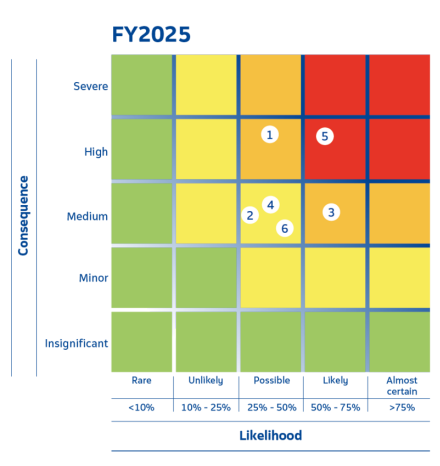
| 1. | Market forces and disruption exacerbating competition pressures |
| 2. | Inability to attract and retain a suitable and resilient workforce |
| 3. | Increased focus and scrutiny on ESG matters |
| 4. | Financial sustainability |
| 5. | Macro-environmental instability |
| 6. | Inability to manage and meet material stakeholder expectations |
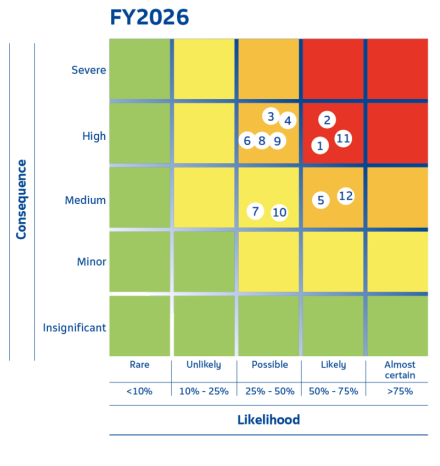
| 1. | Market forces and competition risk |
| 2. | Cybersecurity and data protection risk |
| 3. | Regulatory compliance risk |
| 4. | Customer experience risk |
| 5. | Attraction and retention risk |
| 6. | Sustainability risk |
| 7. | Profitability and cash flow risk |
| 8. | Network performance risk |
| 9. | Third-party risk |
| 10. | Stakeholder management risk |
| 11. | Macro-economic conditions risk |
| 12. | Geopolitical risk |
| 1. Market forces and competition risk | |
| The telecommunications industry continues to undergo structural disruption driven by OTT players, fintechs, hyperscalers and MVNOs entering the digital ecosystem. These players are eroding traditional voice and data revenue streams, intensifying price competition and reshaping customer expectations. Telkom’s long-term competitiveness depends on its ability to scale digital services, innovate rapidly and remain relevant in a highly dynamic and commoditising market. | Impact on value creation
|
|
Strategic pillars
P
V
O
T
Trend
Material themes Residual rating
|
Our mitigating strategies
|
| 2. Cybersecurity and data protection risk | |
| As Telkom expands its digital footprint and operates critical national infrastructure, it presents a high-value target for increasingly sophisticated cyberthreats. These include ransomware, AI-enabled attacks and supply chain vulnerabilities. Maintaining resilience, protecting customer data and ensuring uninterrupted service delivery are critical to sustaining trust and regulatory compliance. | Impact on value creation
|
|
Strategic pillars
I
O
T
Trend
Material themes Residual rating
|
Our mitigating strategies
|
| 3. Regulatory compliance risk | |
| Telkom operates in a complex and evolving regulatory environment covering telecommunications, data privacy and digital services. Regulatory uncertainty and increasing compliance obligations elevate risk exposure. Failure to anticipate regulatory changes can constrain operations, increase costs and impact strategic execution. | Impact on value creation
|
|
Strategic pillars
0
Trend
Material themes Residual rating
|
Our mitigating strategies
|
| 4. Customer experience risk | |
| Customer expectations are increasingly shaped by digital-first experiences, reliability and responsiveness. Service failures, network issues and gaps in digital capability directly impact customer satisfaction, retention and brand perception. In a competitive market, customer experience is a key differentiator. | Impact on value creation
|
|
Strategic pillars
P
I
V
O
T
Trend
Material themes Residual rating
|
Our mitigating strategies
|
| 5. Attraction and retention risk | |
| The pace of digital transformation is reshaping workforce requirements, with growing demand for skills in AI, cloud and advanced technologies. Telkom faces a structural gap between existing capabilities and future needs, increasing execution risk. | Impact on value creation
|
|
Strategic pillars
P
I
V
O
T
Trend
Material themes Residual rating
|
Our mitigating strategies
|
| 6. Sustainability risk | |
| ESG expectations continue to rise, with increasing focus on climate transition, governance and responsible business practices. ESG performance is directly linked to reputation, regulatory compliance and access to capital. | Impact on value creation
|
|
Strategic pillars
0
Trend
Material themes Residual rating
|
Our mitigating strategies
|

| 7. Profitability and cash flow risk | |
| Economic pressure, rising costs and pricing constraints impact profitability and cash generation. Maintaining financial resilience is critical for sustaining operations and funding growth. | Impact on value creation
|
|
Strategic pillars
P
V
0
Trend
Material themes Residual rating
|
Our mitigating strategies
|
| 8. Network performance risk | |
| Network reliability is central to Telkom’s service delivery. Infrastructure challenges, outages and legacy systems create operational risks and impact customer experiences. | Impact on value creation
|
|
Strategic pillars
V
O
T
Trend
Material themes Residual rating
|
Our mitigating strategies
|
| 9.Third-party risk | |
| Increasing reliance on suppliers and partners introduces operational and security risks. Limited visibility into supplier ecosystems amplifies our risk exposure. | Impact on value creation
|
|
Strategic pillars
P
I
V
O
T
Trend
Material themes Residual rating
|
Our mitigating strategies
|
| 10. Stakeholder management risk | |
| Strong stakeholder relationships are important for regulatory alignment, investor confidence and strategic execution. Poor engagement can impact trust and reduce our influence. | Impact on value creation
|
|
Strategic pillars
P
Trend
Material themes Residual rating
|
Our mitigating strategies
|
| 11. Macro-economic conditions risk | |
| Economic volatility affects customer demand, affordability and overall performance. Structural economic challenges continue to influence Telkom's growth prospects. | Impact on value creation
|
|
Strategic pillars
P
V
O
Trend
Material themes Residual rating
|
Our mitigating strategies
|
| 12. Geopolitical risk | |
| Global geopolitical instability impacts supply chains, costs and operational continuity. External shocks can have cascading business impacts. | Impact on value creation
|
|
Strategic pillars
O
Trend
Material themes Residual rating
|
Our mitigating strategies
|
| Residual rating Description | Description | |
 |
Very high |
|

|
High |
|

|
Medium |
|
 |
Low |
|
 Risk exposure remained constant Risk exposure remained constant |
 Risk exposure decreased Risk exposure decreased |
 Risk exposure increased Risk exposure increased |