
In our opinion, the consolidated and separate financial statements present fairly, in all material respects, the consolidated and separate financial position of Telkom SA SOC Limited (the Company) and its subsidiaries (together the Group) as at 31 March 2026, and its consolidated and separate financial performance and consolidated and separate cash flows for the year then ended in accordance with IFRS Accounting Standards and the requirements of the Companies Act of South Africa.
What we have audited
Telkom SA SOC Limited's consolidated and separate financial statements set out on pages 17 to 130 comprise:
We conducted our audit in accordance with International Standards on Auditing (ISAs). Our responsibilities under those standards are further described in the Auditor's responsibilities for the audit of the consolidated and separate financial statements section of our report.
We believe that the audit evidence we have obtained is sufficient and appropriate to provide a basis for our opinion.
Independence
We are independent of the Group in accordance with the Independent Regulatory Board for Auditors' Code of Professional Conduct for Registered Auditors (IRBA Code), as applicable to audits of financial statements of public interest entities, and other independence requirements applicable to performing audits of financial statements in South Africa. We have fulfilled our other ethical responsibilities in accordance with the IRBA Code and in accordance with other ethical requirements applicable to performing audits in South Africa. The IRBA Code is consistent with the corresponding sections of the International Ethics Standards Board for Accountants' International Code of Ethics for Professional Accountants (including International Independence Standards).
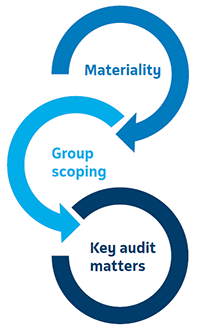
Final materiality
Group audit scope
Key audit matter
As part of designing our audit, we determined materiality and assessed the risks of material misstatement in the consolidated and separate financial statements. In particular, we considered where the Directors made subjective judgements; for example, in respect of significant accounting estimates that involved making assumptions and considering future events that are inherently uncertain. As in all of our audits, we also addressed the risk of management override of internal controls, including among other matters, consideration of whether there was evidence of bias that represented a risk of material misstatement due to fraud.
In terms of the IRBA Rule on Enhanced Auditor Reporting for the Audit of Financial Statements of Public Interest Entities, published in Government Gazette Number 49309 dated 15 September 2023 (EAR Rule), we report final materiality and group audit scope below.
Final materiality
The scope of our audit was influenced by our application of materiality. An audit is designed to obtain reasonable assurance whether the consolidated and separate financial statements are free from material misstatement. Misstatements may arise due to fraud or error. They are considered material if individually or in aggregate, they could reasonably be expected to influence the economic decisions of users taken on the basis of the consolidated and separate financial statements.
Based on our professional judgement, we determined certain quantitative thresholds for materiality, including the final materiality for the consolidated and separate financial statements as a whole as set out in the table below. These, together with qualitative considerations, helped us to determine the scope of our audit and the nature, timing and extent of our audit procedures and to evaluate the effect of misstatements, both individually and in aggregate on the consolidated and separate financial statements as a whole.
| Consolidated financial statements | Separate financial statements | |
|---|---|---|
| Final materiality | R444.77 million | R326.62 million |
| How we determined it | 1% of consolidated revenue. | 1% of revenue. |
| Rationale for the materiality benchmark applied |
We chose consolidated revenue, because in our view, it is the benchmark against which the performance of the Group is most commonly measured by users when profitability fluctuates year on year. Consolidated revenue is considered to be a key objective and focus of the Group's businesses and a key performance indicator for management and investors. We chose 1% as the benchmark threshold, based on our professional judgement, which is the quantitative materiality threshold that we would typically apply when using consolidated revenue to compute materiality. In making this determination, we took into account various factors, including the intended users and distribution of the financial statements, and the financial covenants over the Group's debt. |
We chose revenue, because in our view, it is the benchmark against which the performance of the Company is most commonly measured by users when profitability fluctuates year on year. Revenue is considered to be a key objective and focus of the Company's business and a key performance indicator for management and investors. We chose 1% as the benchmark threshold, based on our professional judgement, which is the quantitative materiality threshold that we would typically apply when using revenue to compute materiality. In making this determination, we took into account various factors, including the intended users and distribution of the financial statements, and the financial covenants over the Company's debt. |
Group audit scope
We tailored the scope of our audit in order to perform sufficient work to enable us to provide an opinion on the consolidated financial statements as a whole, taking into account the structure of the Group, the accounting processes and controls, and the industry in which the Group operates.
We considered the Group's organization or legal structure and its financial reporting processes when identifying components for purposes of planning and performing audit procedures. The Group comprises of the Company and its controlled entities (each considered to be a "component" for purposes of our group audit scope).
Our scoping assessment included consideration of the Group's significant components, due to risk and/or size, and the sufficiency of work performed over the material financial statement line items within the consolidated financial statements. We have determined three components to be significant, one component to be non-significant and seven components to be inconsequential to the Group.
We performed full-scope audits on three components that were considered significant due to risk and/or size. We also performed specified procedures on one non-significant component.
In establishing the overall approach to the group audit, we determined the type of work that was needed to be performed by us, as the group engagement team, and by component auditors, in order to issue our audit opinion on the consolidated financial statements of the Group. Where the work was performed by component auditors, we determined the level of involvement we needed to have in the audit work at those components to be able to conclude whether sufficient appropriate audit evidence had been obtained as a basis for our opinion on the consolidated financial statements as a whole.
We issued group audit instructions to the component auditors, outlining key aspects such as risk assessment, materiality, and scope. We held meetings with the auditors from the significant components. During these meetings we discussed our group instructions, developments relevant to the component, audit execution, significant risks, findings of their procedures and other matters that could be of relevance to the consolidated financial statements.
We assessed the competence, knowledge and experience of the component auditors and evaluated the procedures performed on the significant audit areas to assess the adequacy thereof in pursuit of our audit opinion on the consolidated financial statements.
Further audit procedures were also performed by the group audit engagement team, including substantive procedures over the consolidation process. The work performed at a component level, and the procedures performed at the group level, provided us with sufficient evidence to express an opinion on the consolidated financial statements as a whole.
Key audit matters
Key audit matters are those matters that, in our professional judgement, were of most significance in our audit of the consolidated and separate financial statements of the current period. These matters were addressed in the context of our audit of the consolidated and separate financial statements as a whole, and in forming our opinion thereon, and we do not provide a separate opinion on these matters.
In terms of ISA 701 Communicating key audit matters in the independent auditor's report / the EAR Rule (as applicable), we are required to report key audit matters and the outcome of audit procedures or key observations with respect to the key audit matters, and these are included below.
| Key audit matter | How our audit addressed the key audit matter |
|---|---|
|
Recognition and measurement of revenue in terms of IFRS 15: Revenue from Contracts with Customers This key audit matter relates to both the consolidated and separate financial statements. The Group's revenue is derived from three segments. This key audit matter specifically addresses the following revenue streams within these segments:
In respect of the Company, this key audit matter addresses the revenue streams that are aligned with the Telkom Consumer segment above, as Telkom Consumer is a division of the Company. We considered the recognition and measurement of the above revenue streams for the Group and Company to be a matter of most significance to our audit because of the following factors:
Refer to the following notes to the financial statements for the disclosures as it relates to this key audit matter: |
Our audit addressed this key audit matter as follows:
Telkom Consumer and BCX With respect to mobile and fixed-line telecommunication services, and with the involvement of our IT specialists where relevant, we performed sample testing over:
We did not identify any material exceptions when performing these procedures. Telkom Consumer
We did not identify any material exceptions when performing these procedures. BCX
We did not identify any material exceptions when performing these procedures. Openserve With respect to fixed-line telecommunication services and with the involvement of our IT specialists, where relevant, we performed sample testing over:
In addition, we:
We did not identify any material exceptions when performing these procedures. |
The Directors are responsible for the other information. The other information comprises the information included in the document(s) titled "Telkom SA SOC Ltd Annual Financial Statements For the year ended 31 March 2026", which include(s) the Directors' report, the Audit Committee report and the Certificate from the Group Company Secretary as required by the Companies Act of South Africa, which we obtained prior to the date of this auditor's report, and the document(s) titled "Telkom SA SOC Ltd Integrated Report For the year ended 31 March 2026", which is expected to be made available to us after that date. The other information does not include the consolidated or the separate financial statements and our auditor's report thereon.
Our opinion on the consolidated and separate financial statements does not cover the other information and we do not and will not express an audit opinion or any form of assurance conclusion thereon.
In connection with our audit of the consolidated and separate financial statements, our responsibility is to read the other information identified above and, in doing so, consider whether the other information is materially inconsistent with the consolidated and separate financial statements or our knowledge obtained in the audit, or otherwise appears to be materially misstated.
If, based on the work we have performed on the other information that we obtained prior to the date of this auditor's report, we conclude that there is a material misstatement of this other information, we are required to report that fact. We have nothing to report in this regard.
The Directors are responsible for the preparation and fair presentation of the consolidated and separate financial statements in accordance with IFRS Accounting Standards and the requirements of the Companies Act of South Africa, and for such internal control as the Directors determine is necessary to enable the preparation of consolidated and separate financial statements that are free from material misstatement, whether due to fraud or error.
In preparing the consolidated and separate financial statements, the Directors are responsible for assessing the Group's and the Company's ability to continue as a going concern, disclosing, as applicable, matters related to going concern and using the going concern basis of accounting unless the Directors either intend to liquidate the Group and/or the Company or to cease operations, or have no realistic alternative but to do so.
Our objectives are to obtain reasonable assurance about whether the consolidated and separate financial statements as a whole are free from material misstatement, whether due to fraud or error, and to issue an auditor's report that includes our opinion. Reasonable assurance is a high level of assurance, but is not a guarantee that an audit conducted in accordance with ISAs will always detect a material misstatement when it exists. Misstatements can arise from fraud or error and are considered material if, individually or in the aggregate, they could reasonably be expected to influence the economic decisions of users taken on the basis of these consolidated and separate financial statements.
As part of an audit in accordance with ISAs, we exercise professional judgement and maintain professional scepticism throughout the audit. We also:
We communicate with the Directors regarding, among other matters, the planned scope and timing of the audit and significant audit findings, including any significant deficiencies in internal control that we identify during our audit.
We also provide the Directors with a statement that we have complied with relevant ethical requirements regarding independence, and to communicate with them all relationships and other matters that may reasonably be thought to bear on our independence, and where applicable, actions taken to eliminate threats or safeguards applied.
From the matters communicated with the Directors, we determine those matters that were of most significance in the audit of the consolidated and separate financial statements of the current period and are therefore the key audit matters. We describe these matters in our auditor's report unless law or regulation precludes public disclosure about the matter or when, in extremely rare circumstances, we determine that a matter should not be communicated in our report because the adverse consequences of doing so would reasonably be expected to outweigh the public interest benefits of such communication.
Audit tenure
In terms of the IRBA Rule published in Government Gazette Number 39475 dated 4 December 2015, we report that PricewaterhouseCoopers Inc. has been the auditor of Telkom SA SOC Limited for 3 years.
Prior to that, Telkom SA SOC Limited was jointly audited by PricewaterhouseCoopers Inc. and another auditor for 5 years.
PricewaterhouseCoopers Inc.
Director: SN Madikane
Registered Auditor
Johannesburg, South Africa
1 June 2026